

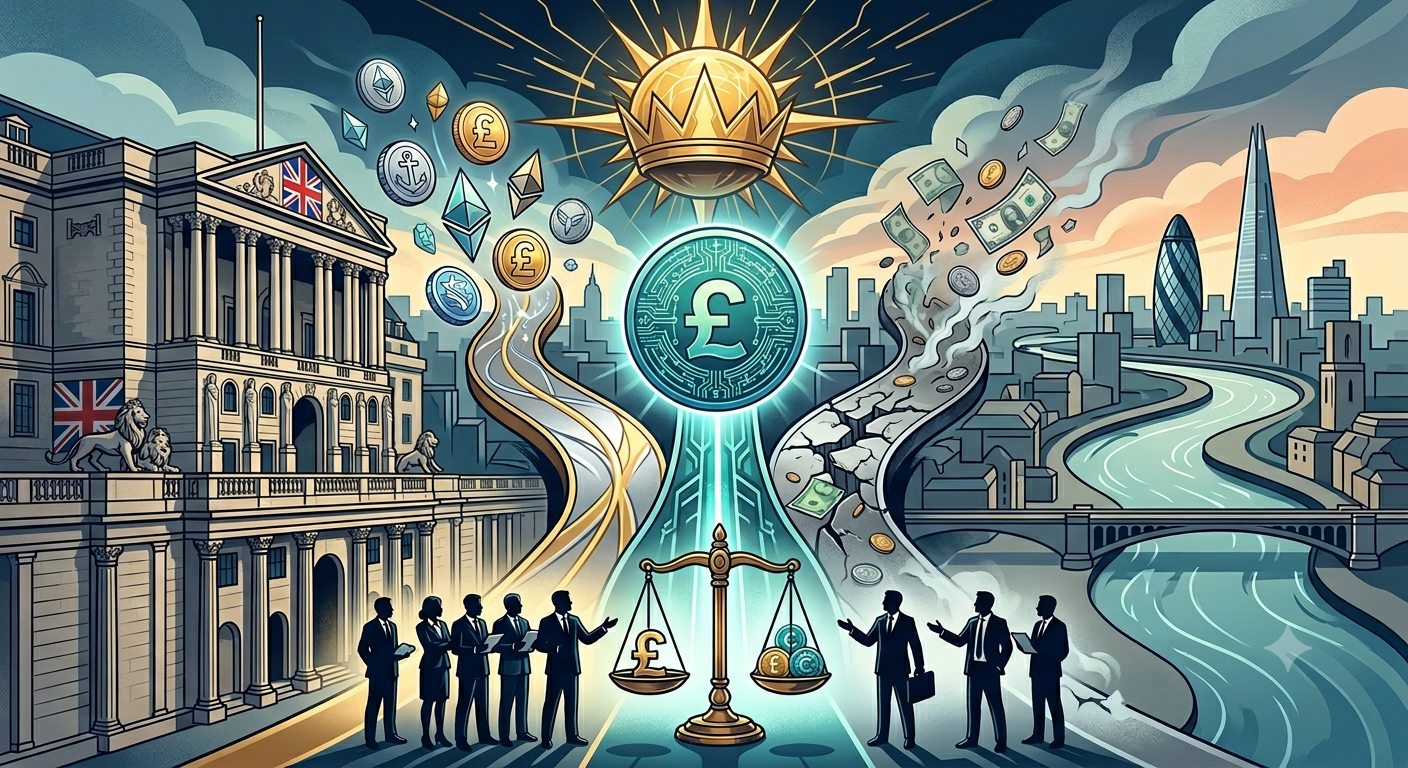
The recent debate in the United Kingdom regarding stablecoin regulation is about far more than cryptocurrency.
At first glance, the discussion appears technical. Policymakers are debating reserve requirements, financial stability, consumer protection, prudential supervision, and the role stablecoins may play within the British financial system.
However, beneath these regulatory questions lies a deeper and more important issue.
Who will control the monetary infrastructure of the digital economy?
The answer is beginning to divide the world into competing models of digital money. The United States, the European Union, and the emerging Internet Jurisdiction are moving in different directions. The United Kingdom now finds itself positioned between these competing visions.
The American Strategy: Exporting the Dollar Through Stablecoins
The United States has increasingly recognized that stablecoins can strengthen rather than weaken the global dominance of the dollar.
For years, critics argued that cryptocurrencies threatened monetary sovereignty. Yet dollar-backed stablecoins such as USDT and USDC have produced the opposite effect. Every new stablecoin issued increases demand for dollar-denominated assets, particularly short-term U.S. Treasury securities.
Stablecoins are becoming an extension of the international dollar system.
This explains why American policymakers have generally pursued integration rather than prohibition. The strategic logic is simple: if businesses, consumers, and increasingly AI agents use dollar-backed stablecoins for payments and settlements, global demand for dollars expands automatically.
Stablecoins therefore function as more than payment instruments. They operate as a mechanism for exporting monetary influence.
This phenomenon is closely connected to the rise of what BACS describes as the Internet Jurisdiction, where digital assets increasingly operate beyond traditional territorial boundaries. As we discussed in Seven Trillion Dollars and the Internet Jurisdiction, blockchain networks are creating entirely new forms of economic activity that cannot be understood solely through the lens of traditional financial regulation.
The European Strategy: Preserving Monetary Control
Europe has approached the issue from a fundamentally different perspective.
Rather than viewing stablecoins as an opportunity to extend monetary influence, European institutions have largely viewed them as a potential threat to monetary sovereignty.
The concern is understandable. If European citizens increasingly adopt dollar-backed stablecoins, the influence of the euro within the digital economy may gradually decline. This concern helps explain both the adoption of the Markets in Crypto-Assets Regulation (MiCA) and the continuing development of the Digital Euro project by the European Central Bank.
The objective is not simply innovation.
The objective is control.
As we argued in Europe Is Making a Strategic Mistake on Stablecoins, excessive restrictions on private stablecoins may ultimately reduce Europe’s competitiveness while accelerating the global dominance of digital dollars.
The debate therefore extends beyond technology.
It is fundamentally a debate about monetary power.
The United Kingdom Between Two Models
The recent UK stablecoin discussions reveal that British policymakers understand the significance of this transformation.
The United Kingdom recognizes that blockchain-based payment systems are developing rapidly and that digital assets are becoming an important component of global financial infrastructure.
Yet Britain has not fully committed to either the American or European approach.
On one hand, it seeks to maintain its position as a global financial center and encourage innovation. On the other, it remains concerned about financial stability and regulatory oversight.
As a result, the UK appears to be searching for a middle path between monetary competitiveness and institutional control.
However, this balancing exercise may overlook the most important issue of all.
The Real Question Is Not Regulation
Most stablecoin debates focus on how digital money should be regulated.
A more fundamental question receives far less attention.
Who will possess the power to execute digital money?
This question is increasingly important because stablecoins are no longer passive financial instruments.
They can be frozen.
Addresses can be blocked.
Transactions can be restricted.
Assets can become subject to sanctions or legal orders.
As demonstrated in The Tether Case: To Freeze Is To Enforce, the ability to freeze digital assets represents a form of legal authority. In practice, stablecoin issuers are already exercising powers traditionally associated with courts, regulators, and governments.
This means that the future debate is not merely about money.
It is about enforcement.
From Money to Digital Governance
The transformation of stablecoins reveals a broader evolution taking place throughout the digital economy.
Early blockchain advocates often argued that code would replace legal institutions. Reality has proven more complex.
Disputes still exist.
Fraud still occurs.
Assets are still stolen.
Users still make mistakes.
One of the most common examples involves transfers sent to incorrect wallets or blockchain networks. As discussed in What Should You Do If You Send Crypto to the Wrong Address?, technological innovation does not eliminate legal problems. It simply transforms them.
This broader transition reflects what we described in From Code Is Law to Law Is Code. Blockchain networks are gradually evolving from purely technical systems into governance systems that increasingly require legal infrastructure.
The Missing Layer: Digital Justice
Whether the future belongs to stablecoins, CBDCs, or a combination of both, every monetary system ultimately requires mechanisms for dispute resolution and enforcement.
The digital economy is no different.
As tokenization expands and financial assets increasingly move on-chain, legal certainty becomes just as important as technological efficiency. This is precisely why The Tokenization of Finance Needs Digital Courts may become one of the defining legal questions of the coming decade.
Similarly, traditional litigation often struggles to address cross-border blockchain disputes effectively. This challenge explains the growing relevance of specialized mechanisms such as those examined in Crypto Arbitration: Why Traditional Courts Don’t Work.
The future digital economy requires more than digital money.
It requires digital justice.
Conclusion
The UK stablecoin debate reveals a much larger global struggle.
The United States sees stablecoins as a mechanism to expand demand for dollars and Treasury debt.
Europe sees digital money as a question of monetary sovereignty and state control.
Blockchain networks are creating an alternative vision based on transnational digital infrastructure.
The future debate will not be about whether digital money exists.
That question has already been answered.
The real question is who will govern it.
And ultimately, who will enforce the rules that govern the digital economy.
Because the future of monetary power will not be determined solely by technology.
It will be determined by the relationship between money, governance, enforcement, and law.