

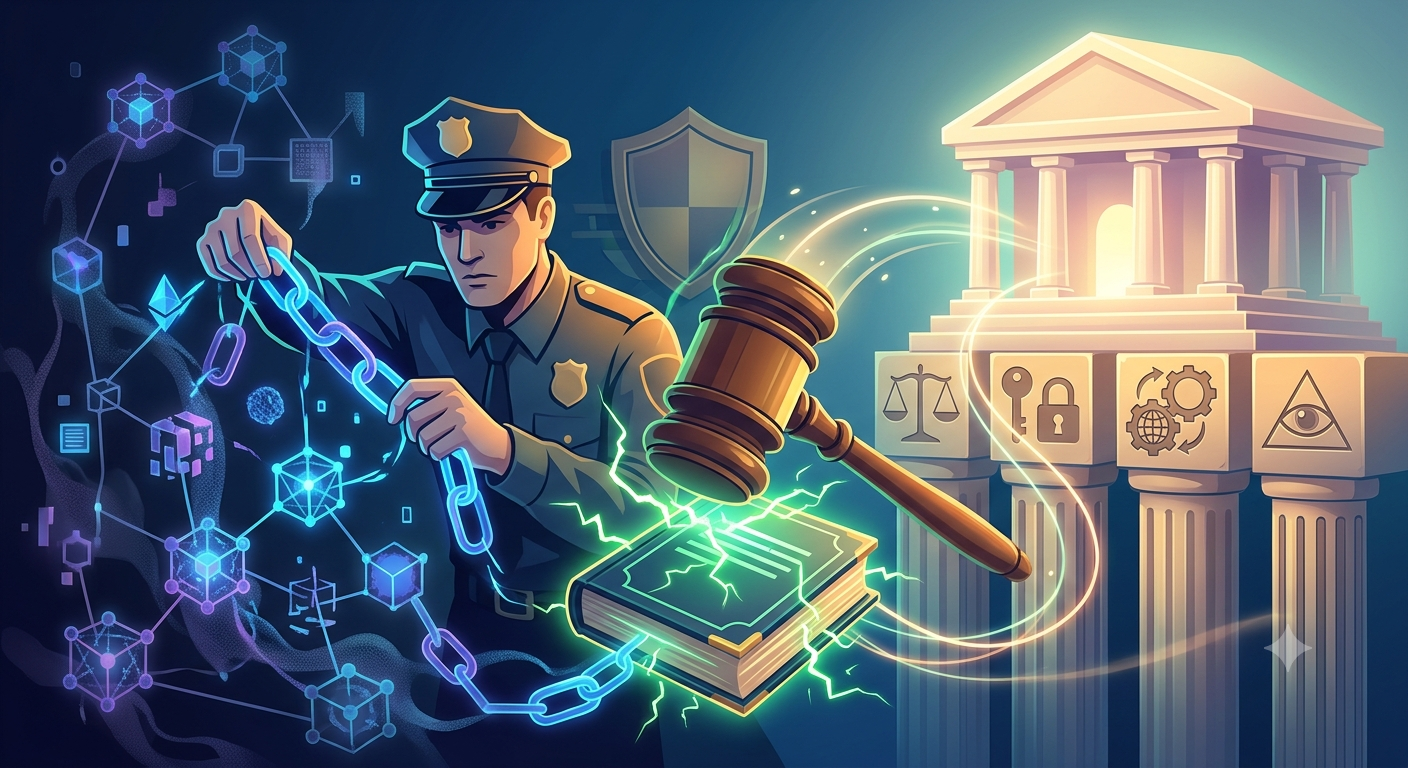
One of the most common arguments in the decentralized finance (DeFi) industry is that DeFi operates in a legal vacuum.
The reasoning is familiar.
Protocols are decentralized.
Participants are pseudonymous.
Transactions occur across borders.
Smart contracts execute automatically.
Therefore, traditional legal systems supposedly have no meaningful role to play.
This narrative has become so widespread that many people now assume DeFi exists outside the reach of law.
The reality is very different.
The problem facing DeFi is not the absence of law.
It is the absence of effective enforcement.
Law Already Exists
Contrary to popular belief, DeFi activities do not occur in a legal vacuum.
Fraud remains fraud.
Theft remains theft.
Breach of contract remains breach of contract.
Misrepresentation, negligence, market manipulation, insider trading, money laundering, and unjust enrichment all continue to exist regardless of whether the transaction occurs through a traditional bank or a decentralized protocol.
The legal principles governing ownership, obligations, liability, and damages have not disappeared simply because financial activity has moved onto blockchain networks.
As we explained in From “Code Is Law” to “Law Is Code”, blockchain is increasingly creating new forms of digital governance, but governance should not be confused with the disappearance of law.
The real question is not whether legal rights exist.
The real question is whether those rights can be effectively enforced.
The Confusion Between Decentralization and Immunity
Many DeFi participants mistakenly assume that decentralization creates legal immunity.
It does not.
A decentralized protocol may eliminate certain intermediaries, but it does not eliminate legal consequences.
History provides numerous examples.
The collapse of Terra-Luna, the governance disputes surrounding MakerDAO, and the sanctions imposed on Tornado Cash demonstrate that regulators, courts, and public authorities continue to intervene when significant legal issues arise.
The legal system has never depended entirely on intermediaries.
It depends on the ability to identify rights, obligations, and remedies.
The challenge is that traditional enforcement mechanisms were designed for a world of banks, corporations, and identifiable counterparties.
DeFi introduces new enforcement difficulties that existing legal frameworks were not designed to address.
The Real Problem Is Enforcement
Suppose a user loses assets through a smart contract exploit.
Suppose a DAO treasury is misappropriated.
Suppose governance tokens are manipulated to approve a harmful proposal.
The legal analysis may be relatively straightforward.
The difficulty arises when attempting to enforce the resulting rights.
Who should be sued?
Where should proceedings be initiated?
Which jurisdiction applies?
How can a judgment be enforced against pseudonymous wallets operating across multiple blockchain networks?
These are not questions about the existence of law.
They are questions about enforcement.
This distinction is fundamental.
As discussed in Crypto Arbitration: Why Traditional Courts Don’t Work, many blockchain disputes do not suffer from a lack of legal principles. They suffer from the inability of traditional legal systems to deliver practical and timely remedies.
Code Executes Transactions, Not Justice
One of the great achievements of blockchain technology is its ability to automate execution.
Smart contracts can transfer assets, distribute rewards, execute loans, and settle transactions without human intervention.
However, execution should not be confused with justice.
A smart contract can execute an unfair transaction perfectly.
It can execute a fraudulent transaction perfectly.
It can execute a mistaken transaction perfectly.
Code determines what happens.
It does not determine what should happen.
As we argued in The Tokenization of Finance Needs Digital Courts, the growth of digital economies requires mechanisms capable of resolving disputes, interpreting facts, and delivering legally enforceable outcomes.
These functions remain fundamentally legal rather than technological.
Stablecoins Reveal the Reality
One of the clearest examples of this enforcement problem can be found in stablecoins.
Many people assume blockchain transactions are irreversible.
Yet issuers such as Tether and Circle regularly freeze and restrict access to digital assets when required by court orders, law enforcement agencies, or compliance obligations.
The existence of these mechanisms demonstrates an important reality.
Digital assets are not beyond enforcement.
The challenge is creating predictable, transparent, and legitimate enforcement mechanisms rather than relying exclusively on centralized intervention.
As discussed in The Tether Case: Freezing Is the Power to Enforce, the ability to freeze assets is ultimately the ability to execute legal decisions.
The debate is no longer whether enforcement exists.
The debate is who should control it and under what legal framework.
DeFi Needs Legal Infrastructure
The future of DeFi will not be determined solely by better protocols.
It will be determined by better legal infrastructure.
Investors, institutions, and businesses require certainty.
They need to know how disputes will be resolved.
They need to know which rules apply.
They need to know that rights can be protected when conflicts arise.
This is why legal infrastructure is becoming one of the most important frontiers in blockchain development.
The rise of decentralized governance, tokenized assets, AI agents, and cross-border digital commerce is creating increasing demand for specialized dispute resolution systems.
According to the World Economic Forum, trust remains one of the most important requirements for the adoption of digital financial systems. Trust does not emerge solely from technology. It emerges from credible institutions and enforceable rules.
From Legal Vacuum to Enforcement Infrastructure
The next stage of DeFi evolution is unlikely to focus exclusively on scalability, interoperability, or transaction speed.
Those challenges are largely technical.
The more difficult challenge is legal.
How can rights be enforced across decentralized systems?
How can disputes be resolved efficiently?
How can governance decisions be challenged when necessary?
How can digital assets be protected without sacrificing the advantages of decentralization?
These questions are increasingly shaping the future of blockchain.
At BACS, we believe the answer lies in combining arbitration, digital enforcement, and blockchain-native governance into a single legal infrastructure layer capable of operating within the Internet Jurisdiction.
The future of DeFi will not be determined by whether law exists.
Law already exists.
The future of DeFi will be determined by whether effective enforcement mechanisms can be built for a decentralized world.
And that is not a legal vacuum.
It is an enforcement challenge.