

The real legal innovation of stablecoins is not the digital dollar
For years, much of the debate surrounding stablecoins has focused on a monetary question.
Are they money?
Do they compete with banks?
Do they threaten sovereign currencies?
Will they replace traditional payment systems?
However, the most revolutionary aspect of stablecoins may not be monetary at all.
It may be legal.
Because the real innovation introduced by issuers such as Tether is not simply the digitization of dollars.
It is the demonstration that legal enforcement can be integrated directly into digital financial infrastructure.
In this context, one reality becomes increasingly clear:
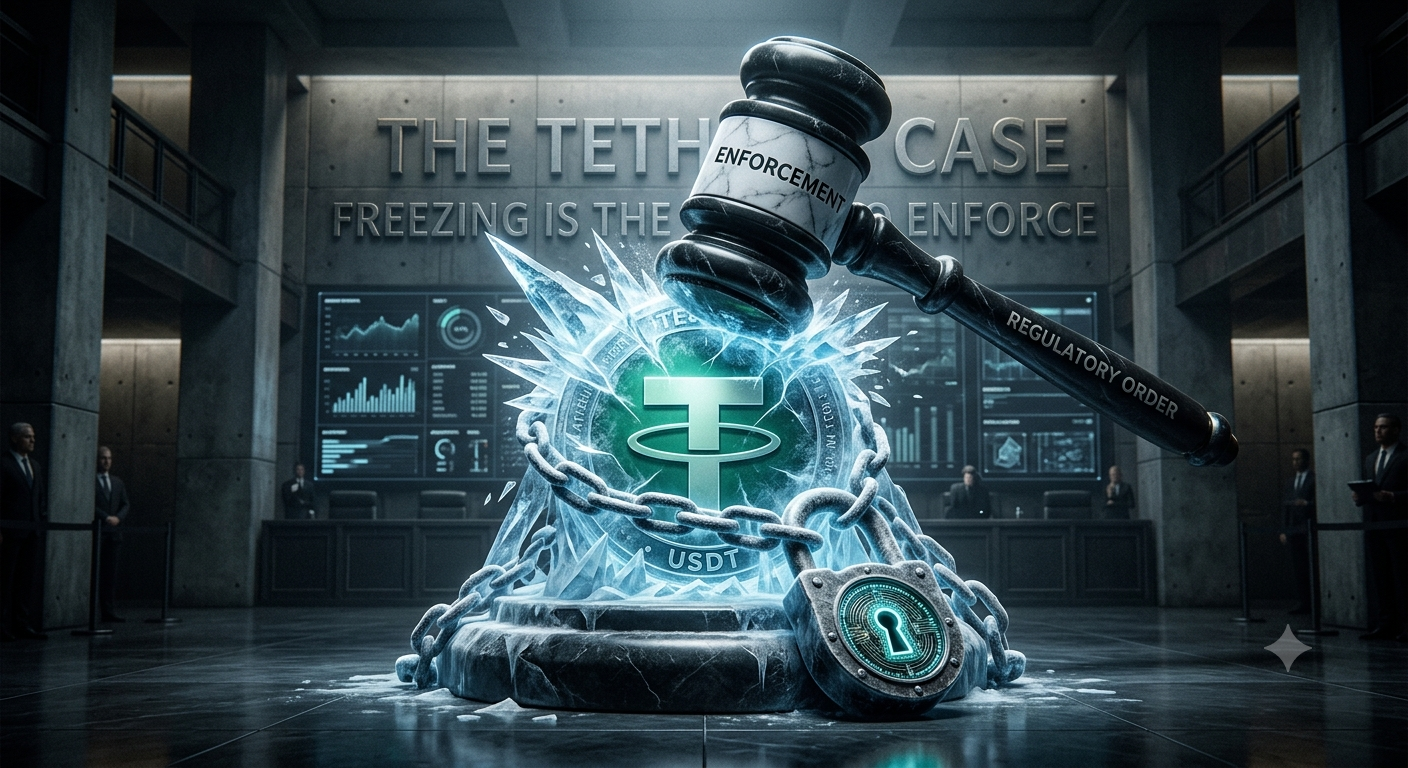
Freezing is the power to enforce.
Tether is not simply a stablecoin issuer
When most people think about USDT, they think about a digital representation of the U.S. dollar.
Yet Tether performs a far more complex function within the digital economy.
With more than one hundred billion dollars in circulation and deployment across virtually every major blockchain network, Tether has become one of the most important financial infrastructures within what BACS describes as the Internet Jurisdiction.
But there is one characteristic that fundamentally differentiates USDT from Bitcoin.
And from much of decentralized finance.
Tether can freeze assets.
Under certain circumstances, it can also reissue or recover them.
As documented in Tether’s own transparency and enforcement reports available through Tether News, these powers have been used repeatedly in cooperation with law enforcement agencies, sanctions compliance efforts, and investigations involving stolen digital assets.
The important question is not whether these actions are right or wrong.
The important question is what they reveal.
They reveal that even within the blockchain economy there is a growing need for enforcement mechanisms.
Blockchain executes transactions, but it does not resolve disputes
One of the foundational promises of blockchain was the elimination of intermediaries.
Bitcoin demonstrated that value could be transferred without banks.
Ethereum demonstrated that agreements could be automated through smart contracts.
Yet as the ecosystem matured, an unavoidable reality emerged.
Disputes continue to exist.
Fraud.
Human error.
Hacks.
Asset theft.
Contractual disagreements.
Governance conflicts.
Defective tokenization structures.
Disputes between participants.
Blockchain can automatically execute a transaction.
But it cannot independently determine who is right when a dispute arises.
Nor can it resolve questions involving fraud, coercion, mistake or breach of obligations.
As discussed in BACS’s analysis, Crypto Arbitration: Why Traditional Courts Do Not Work, the central challenge facing the blockchain economy is increasingly dispute resolution and enforcement rather than technological execution.
The true meaning of freezing power
When Tether freezes an address, it is doing something much more significant than simply blocking an asset.
It is enforcing a decision.
It is altering the legal and economic position of a specific holder.
It is producing real consequences within a digital infrastructure.
From a legal perspective, this is extraordinary.
Because it demonstrates that blockchain’s primary challenge is no longer the ability to execute transactions.
The challenge is determining who has the authority to execute decisions.
For centuries, that function belonged to:
courts,
banks,
public registries,
administrative authorities,
state institutions.
Now new actors are emerging with the ability to exercise similar powers inside digital infrastructures.
Tether is perhaps the most visible example.
The decentralization paradox
Many critics argue that the ability to freeze assets proves that stablecoins are centralized.
And they are correct.
But this criticism also exposes a deeper contradiction within the blockchain ecosystem.
Most users simultaneously demand two things:
absolute immutability,
protection against fraud.
Yet these objectives are difficult to reconcile.
If a system can correct injustices, it requires intervention mechanisms.
If a system is entirely immutable, injustices become immutable as well.
Therefore, the relevant question is not whether enforcement should exist.
The real question is who exercises that enforcement and under what rules.
The next step: from private enforcement to legal enforcement
Today, freezing powers largely depend on decisions made by private issuers.
But as the digital economy matures, an unavoidable question will emerge:
Should private companies decide when assets are frozen?
Or should specialized legal mechanisms exist to authorize and legitimize those decisions?
This is one of the central institutional challenges of the Internet Jurisdiction.
The digital economy requires dispute-resolution systems capable of producing enforceable outcomes inside blockchain infrastructures.
Recognition alone is not enough.
Rights must also be enforceable.
As explained in The Real Problem Is Not Losing Crypto but Being Unable to Recover It, recovery and enforcement increasingly represent the missing legal layer of blockchain.
The BACS vision
At BACS (Blockchain Arbitration & Commerce Society), we defend a fundamental idea:
Blockchain’s greatest weakness was never transaction execution.
Its greatest weakness has always been effective dispute resolution and enforcement.
That is why BACS proposes a legal infrastructure adapted to the Internet Jurisdiction based on:
specialized blockchain arbitration,
smart contract integration,
legal oracles,
hybrid on-chain and off-chain execution,
compatibility with the 1958 New York Convention,
digital enforcement mechanisms.
In this model, the technical powers already available to issuers, custodians, protocols and blockchain infrastructures could become connected to specialized legal decisions.
The objective would not simply be freezing assets.
The objective would be enforcing legitimate decisions within the digital economy.
As argued in We Are Moving from “Code Is Law” to “Law Enforces Code”, blockchain is entering a new phase where legal enforceability becomes as important as technological execution.
From “Code Is Law” to “Law Enforces Code”
The Tether case demonstrates that the natural evolution of blockchain is not leading toward the disappearance of law.
It is moving in exactly the opposite direction.
The digital economy increasingly requires enforcement.
It requires rules.
It requires dispute resolution.
It requires institutional legitimacy.
And it requires effective mechanisms capable of executing decisions.
This is why the famous blockchain slogan is evolving.
The reality is no longer simply:
Code Is Law.
The emerging reality is:
Law Enforces Code.
Conclusion
Tether has demonstrated something that much of the blockchain ecosystem still struggles to acknowledge.
The power to freeze assets is, in reality, the power to enforce decisions.
And whoever controls enforcement controls a fundamental source of authority within any economic system.
For this reason, the debate surrounding stablecoins is no longer merely monetary.
It is legal.
Because the next major battle in the digital economy will not be about who creates digital assets.
It will be about who possesses the legitimate authority to enforce the rules.