

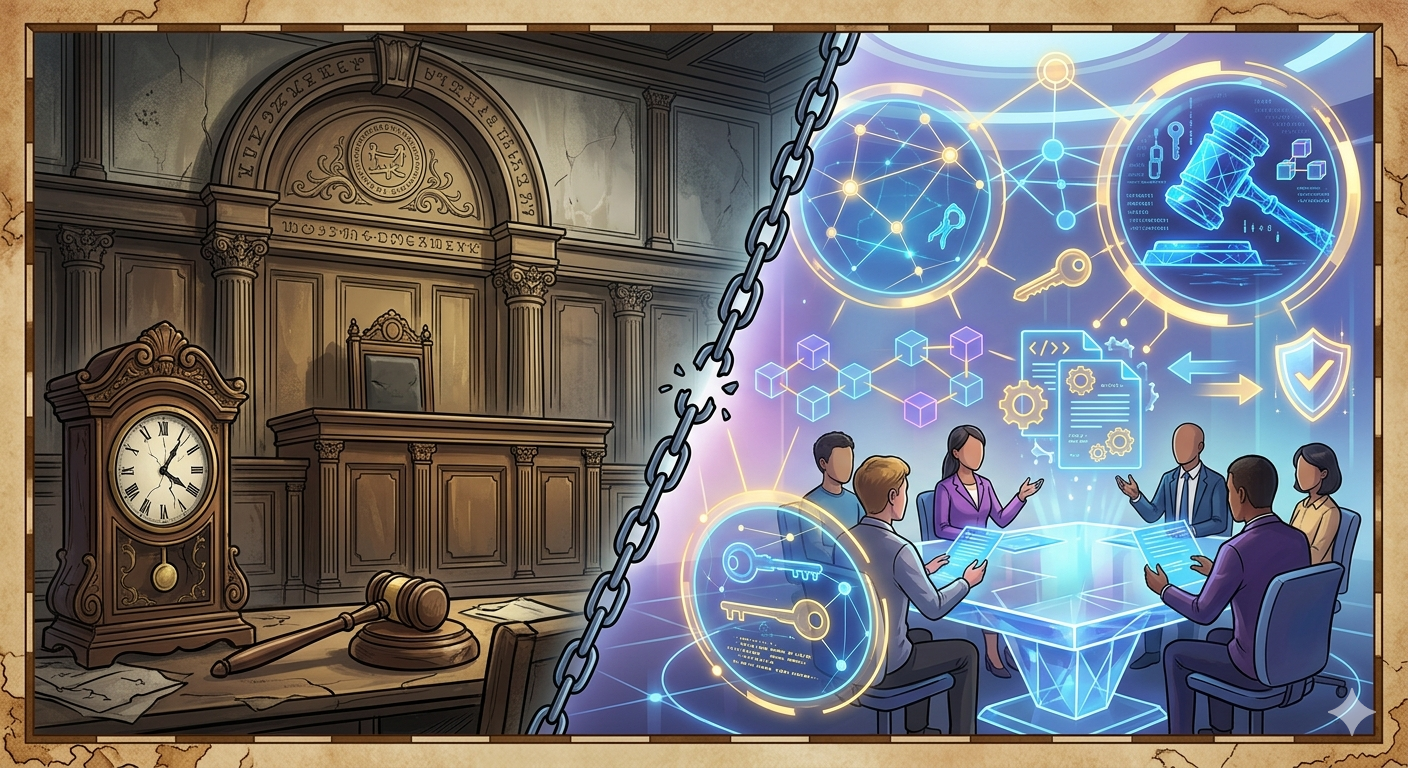
The New Digital Economy Is Also Creating New Disputes
Bitcoin, Ethereum, stablecoins, tokenization, and decentralized finance (DeFi) have created a new global economy that operates continuously, across borders, and through programmable systems.
But together with this expansion, entirely new categories of disputes have emerged:
- crypto sent to the wrong wallet address,
- hacks and digital asset theft,
- smart contract failures,
- tokenization disputes,
- DeFi protocol exploits,
- exchange account freezes,
- DAO governance conflicts,
- cross-chain bridge failures,
- wallet and custody disputes.
These conflicts are no longer marginal. They are becoming an inherent part of the digital economy itself.
As explained previously in The Tokenization of Finance Needs Digital Courts, blockchain infrastructure is evolving faster than traditional legal systems can adapt.
The problem is simple:
These disputes arise inside a global digital infrastructure, while traditional courts continue operating through territorial systems designed for the physical world.
Blockchain is global.
Justice is still fragmented by borders.
Traditional Courts Were Designed for a Different Economic System
National judicial systems were built around three classical principles:
- territorial jurisdiction,
- slow procedural structures,
- state-based enforcement.
Blockchain fundamentally alters all three.
A wallet may not belong clearly to any country.
A smart contract can execute simultaneously across multiple jurisdictions.
A DeFi protocol may operate without a formal company, headquarters, or identifiable administrators.
Traditional courts must first determine essential issues such as:
- which law applies,
- which court has jurisdiction,
- where the damage occurred,
- who the counterparty actually is,
- how the decision can be enforced.
In blockchain disputes, these questions are often extremely difficult to answer.
While courts spend years litigating jurisdictional issues, digital assets can already have been moved through mixers, bridges, offshore exchanges, or decentralized protocols beyond the reach of conventional judicial enforcement.
The result is increasingly obvious:
Traditional justice moves too slowly for an economy that operates in seconds.
The Problem Is Not Only Legal — It Is Also Technical
Most courts are not technically prepared to understand highly complex blockchain disputes.
Concepts such as:
- multisig wallets,
- liquidity pools,
- staking,
- cross-chain bridges,
- smart contracts,
- tokenized assets,
- DAOs,
- stablecoin infrastructure,
- oracles,
- automated execution systems,
remain highly specialized even within the legal sector itself.
This creates substantial legal uncertainty.
Many judicial proceedings depend entirely on external experts to explain how a blockchain transaction works or whether digital assets can realistically be recovered.
But even when courts understand the technical issue, another structural limitation appears:
Obtaining a judgment does not necessarily mean recovering the digital assets.
As discussed in The Real Problem Is Not Losing Crypto, but Being Unable to Recover It, the core issue in blockchain disputes is increasingly enforcement rather than legal recognition.
The Real Problem Is Enforcement
Blockchain does not eliminate the need for law.
What changes is the mechanism of enforcement.
In the traditional system, judicial decisions are enforced through banks, public registries, asset seizures, and state authorities.
But digital assets can be stored in private wallets controlled exclusively through cryptographic keys.
Without technical enforcement capacity, a court judgment may become legally valid but economically useless.
This is one of the great structural weaknesses of traditional litigation in blockchain disputes.
The challenge is no longer simply resolving disputes.
The challenge is enforcing decisions inside digital infrastructures.
That is why the future of blockchain legal infrastructure increasingly requires systems capable of combining legal enforceability with technological execution.
Why Arbitration Fits Blockchain Better
International arbitration possesses several characteristics that make it significantly more adaptable to blockchain disputes.
1. International Flexibility
Arbitration allows parties to determine:
- applicable law,
- procedural rules,
- specialized arbitrators,
- digital evidence systems,
- hybrid enforcement structures,
- blockchain-compatible procedures.
This flexibility is essential in disputes where parties may operate simultaneously across multiple jurisdictions.
2. Technical Specialization
Arbitration enables the incorporation of genuine blockchain and digital asset specialists.
Blockchain disputes are not merely legal disputes.
They are technological disputes with legal consequences.
Traditional courts often struggle to bridge that gap.
3. Speed
Digital economies move in real time.
A judicial procedure lasting several years may destroy the economic value of any eventual decision.
Arbitration provides faster and more adaptable mechanisms for resolving highly technical disputes.
4. International Enforcement
One of arbitration’s greatest strengths is the 1958 New York Convention, which allows arbitral awards to be enforced across more than 170 countries.
This makes arbitration one of the few truly global legal enforcement systems currently available.
Blockchain Needs a Native Justice Layer
For years, part of the crypto industry defended the idea that “Code is Law.”
But the evolution of the digital economy is demonstrating a deeper reality:
Code can execute transactions.
Code cannot judge disputes.
Fraud, coercion, human error, contractual ambiguity, tokenization conflicts, and governance disputes all require legal interpretation and enforceable resolution systems.
As explored in We Are Moving From “Code Is Law” to “Law Enforces Code”, blockchain infrastructure is entering a new phase where legal enforceability becomes as important as technical execution.
At BACS (Blockchain Arbitration & Commerce Society), we believe the Internet jurisdiction requires its own justice infrastructure:
- blockchain arbitration,
- digital enforcement,
- smart contract integration,
- specialized digital asset experts,
- hybrid legal and on-chain execution systems.
Because the true weakness of blockchain has never been transaction execution.
The real weakness has always been dispute resolution and enforcement.
Conclusion
Blockchain is creating a new global economic system based on programmable rules and digital assets.
But no economy can scale sustainably without effective mechanisms for resolving disputes.
Traditional courts remain essential institutions.
However, they were designed for a territorial economy based on intermediaries and slow procedural structures.
Blockchain operates in the opposite way:
global, instantaneous, and decentralized.
That is why crypto arbitration is not simply a modern legal alternative.
It is increasingly becoming the legal infrastructure required for the institutional growth of the digital economy.
For further reading on blockchain legal infrastructure and digital enforcement, see also: