

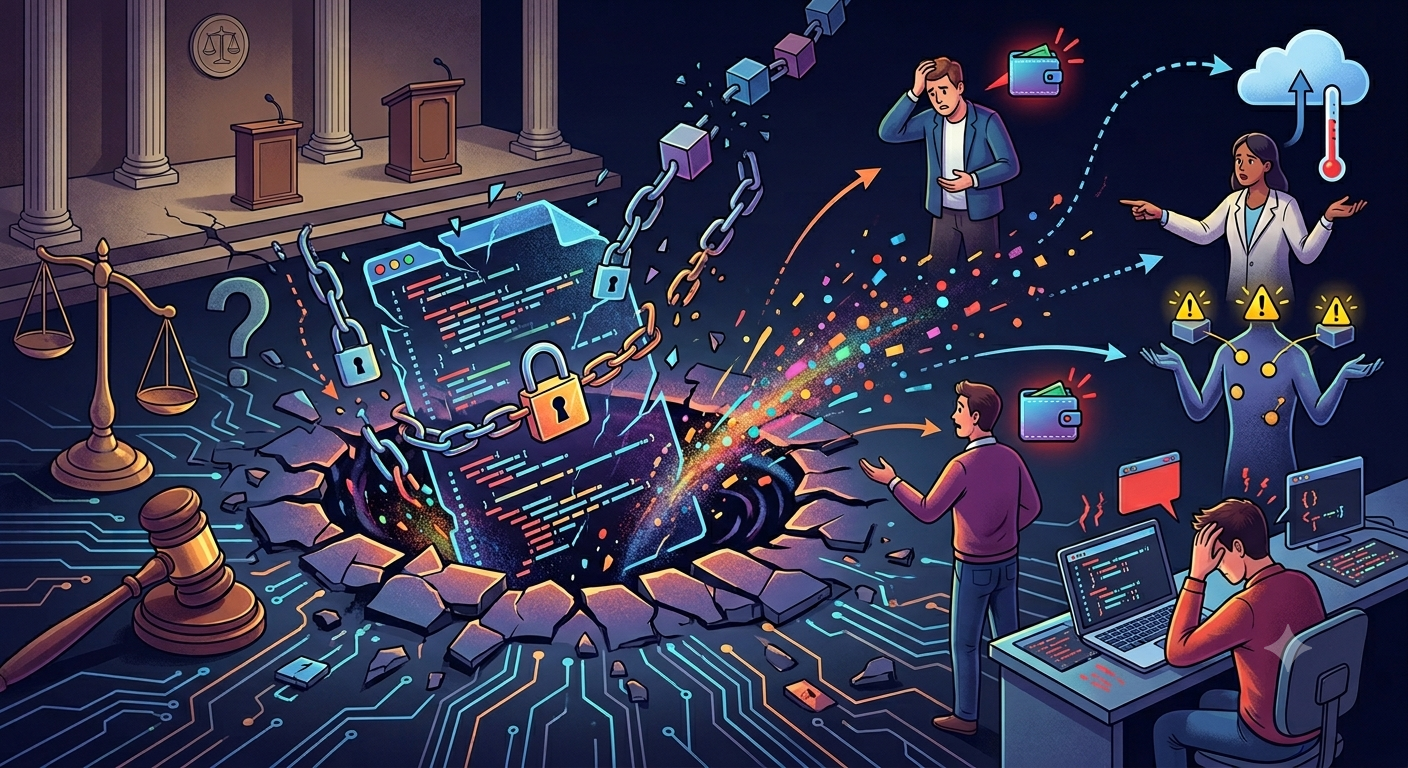
Blockchain technology was built on a powerful promise: eliminate uncertainty through code.
Smart contracts would automatically execute agreements, remove intermediaries, reduce costs, and create trustless systems where outcomes depended on predefined rules rather than human discretion.
For many years, the dominant narrative was simple:
“Code is law.”
If the code executes correctly, the transaction is valid.
If the code allows an action, that action is permitted.
If users interact with the protocol, they accept the outcome.
However, as decentralized finance (DeFi), tokenization, DAOs, and blockchain-based commercial activity have expanded, a difficult question has become increasingly unavoidable:
Who is responsible when a smart contract fails?
The answer is far more complex than many blockchain enthusiasts originally imagined.
And it may become one of the most important legal questions of the digital economy.
Smart Contracts Do Fail
Despite their reputation for precision, smart contracts are not immune to failure.
In fact, blockchain history is full of examples where code performed exactly as written but produced disastrous consequences.
The most famous example remains the 2016 The DAO hack, where vulnerabilities in Ethereum smart contract code allowed an attacker to drain millions of dollars worth of ETH. The incident became so significant that the Ethereum community ultimately approved a hard fork to reverse the effects of the attack.
More recently, the DeFi ecosystem has experienced hundreds of exploits involving:
- Flash loan attacks
- Oracle manipulation
- Governance attacks
- Coding errors
- Access control failures
- Bridge vulnerabilities
According to data published by the blockchain security firm Chainalysis, billions of dollars have been lost through smart contract exploits and protocol failures over the last several years.
The technology may be revolutionary.
It is not infallible.
The Traditional Legal Assumption
In traditional commerce, identifying liability is relatively straightforward.
If a software company releases defective software, it may face contractual or tort liability.
If a financial institution improperly processes a transaction, regulators and courts can determine responsibility.
If a professional advisor provides negligent services, legal remedies are available.
The legal system operates on a simple premise:
Someone is accountable.
Blockchain introduces a significant challenge to this principle.
Smart contracts often operate through decentralized networks involving:
- Developers
- Validators
- Token holders
- DAO governance participants
- Liquidity providers
- Oracles
- Users
When something goes wrong, determining who bears responsibility becomes significantly more difficult.
The Myth of Complete Decentralization
Many blockchain projects present themselves as fully decentralized systems.
In practice, however, most protocols still involve identifiable actors exercising meaningful control.
Developers write and update the code.
Foundations manage treasury assets.
Governance bodies vote on protocol changes.
Core teams coordinate upgrades.
Front-end operators control user interfaces.
Oracles provide external data.
This reality has increasingly attracted the attention of regulators and courts.
In several jurisdictions, authorities have begun examining whether decentralized protocols truly operate without responsible parties or whether identifiable entities continue to exercise sufficient control to incur legal obligations.
The legal analysis is shifting from technological architecture to practical governance.
The question is no longer:
“Is this decentralized?”
The question is:
“Who actually controls the system?”
Code Does Not Resolve Disputes
Even when a smart contract executes exactly as programmed, disputes can still arise.
A transaction may comply with the code while violating the parties’ expectations.
An oracle may provide inaccurate information.
A governance vote may be manipulated.
A protocol upgrade may create unexpected losses.
A tokenized asset may become subject to conflicting legal claims.
The smart contract can execute the transaction.
It cannot determine whether the outcome is legally fair.
This distinction is fundamental.
Technology executes rules.
Law resolves disputes.
These are not the same function.
The Emerging Need for Legal Infrastructure
As blockchain increasingly supports real economic activity, legal infrastructure becomes unavoidable.
This is particularly evident in:
- Tokenized real estate
- Stablecoins
- Institutional custody
- Cross-border payments
- DAO governance
- AI agent transactions
- Decentralized lending
When substantial economic value is involved, participants require mechanisms capable of resolving conflicts that code alone cannot solve.
This is one of the reasons why discussions about blockchain arbitration and digital dispute resolution have become increasingly important.
Projects such as the Blockchain Arbitration and Commerce Society (BACS) argue that blockchain ecosystems require a complementary legal layer capable of addressing disputes while preserving the efficiency of decentralized systems.
The objective is not to replace smart contracts.
It is to provide legal certainty when smart contracts encounter situations they were never designed to resolve.
From Code Is Law to Law Enforces Code
The future of blockchain is unlikely to be a world without law.
Instead, it may become a world where technology and legal systems become increasingly interconnected.
Smart contracts will continue to automate execution.
Blockchain networks will continue to reduce transaction costs.
Decentralized systems will continue to expand.
But whenever significant value exists, disputes will inevitably follow.
And every dispute ultimately raises the same question:
Who decides what happens next?
The protocols that successfully answer this question may become the true infrastructure of the digital economy.
Because the future of blockchain is not simply about writing better code.
It is about building systems where code, governance, enforcement, and law work together.