

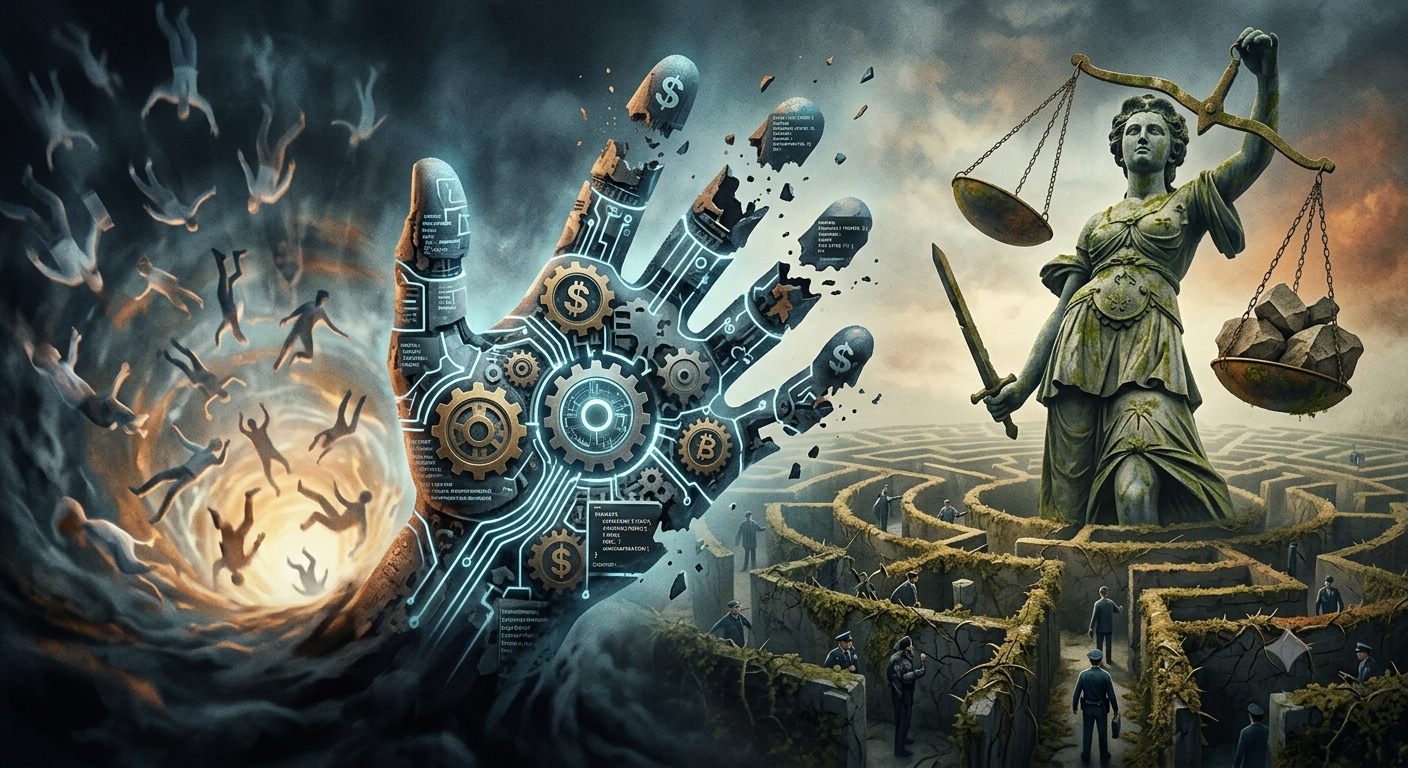
During March and April 2026, a series of attacks against decentralized finance (DeFi) protocols resulted in losses exceeding $600 million. The incidents affected platforms such as KiloEx, Cork Protocol, Loopscale, Cetus, and other projects operating on blockchain infrastructures.
The usual reaction to these events focuses on technology.
More audits.
More code reviews.
More monitoring tools.
More protection of private keys.
All of these measures are necessary.
But they are not sufficient.
The blockchain industry has reached a stage of maturity where its greatest challenges are no longer purely technical. The real problem begins when technology fails and the question every economy must ultimately answer emerges:
Who can enforce rights when harm occurs?
Absolute Security Has Never Existed
The history of finance demonstrates that no system is completely secure.
Banks suffer fraud.
Stock exchanges experience manipulation.
Corporations are victims of cyberattacks.
Even the most sophisticated government infrastructures have been compromised.
The difference is not the absence of incidents.
The difference is the ability to respond when they occur.
When banking fraud takes place, courts, regulators, asset-freezing measures, and recovery procedures exist.
When corporate disputes arise, judges and enforcement mechanisms are available.
When financial transactions cause damages, liability systems determine responsibility.
Trust does not emerge because a system is perfect.
Trust emerges because there is an effective mechanism to correct failures.
The Current Limit of DeFi
Decentralized finance has proven that global markets can operate without traditional intermediaries.
Billions of dollars move daily through smart contracts.
Users can lend, trade, invest, and earn yield without relying on banks.
However, when hacks, exploits, or unauthorized appropriations of funds occur, structural limitations become visible.
Smart contracts execute instructions.
They do not resolve disputes.
Code can determine whether a transaction complies with predefined rules.
But it cannot independently determine whether fraud, market manipulation, misappropriation, or unjust enrichment has occurred.
Technology executes.
Justice interprets.
Every advanced economy requires both functions.
The False Promise of Code Is Law
For years, parts of the blockchain ecosystem argued that code could entirely replace law.
The phrase “Code Is Law” became one of the industry’s most frequently repeated principles.
Yet practical experience has demonstrated that reality is far more complex.
When the DAO hack occurred in 2016, the Ethereum community chose to intervene through a hard fork that reversed the effects of the attack.
This decision revealed a fundamental truth.
Even highly decentralized systems still rely on human decisions, governance mechanisms, and legal interpretation.
Law never disappeared.
It simply changed form.
As we explained in From Code Is Law to Law Is Code: Why Blockchain Is Becoming a New Legal System, blockchain protocols do not eliminate the need for rules. They create new ways of producing and enforcing them.
The DAO crisis itself remains one of the clearest examples that governance and legal judgment continue to play a critical role even within decentralized networks, as documented by the Ethereum Foundation’s analysis of The DAO hack.
The Real Challenge: Enforcement
The central question is not how to prevent every attack.
That is impossible.
The real question is what happens afterward.
Today, many victims of DeFi exploits face several obstacles:
- Difficulty identifying responsible parties.
- Absence of a clear jurisdiction.
- High costs of international litigation.
- Cross-border enforcement challenges.
- Limited mechanisms for rapid asset recovery.
Paradoxically, blockchain technology allows billions of dollars to move globally within seconds, while dispute resolution continues to depend largely on institutional structures designed for twentieth-century international commerce.
There is a growing asymmetry between the speed of technological innovation and the ability of legal institutions to adapt.
The Emergence of Digital Enforcement
Recent developments suggest that the industry is already moving toward new forms of enforcement.
Stablecoin issuers such as Tether and Circle have repeatedly demonstrated their ability to freeze assets associated with illicit activities.
Protocols increasingly incorporate governance mechanisms designed to respond to critical incidents.
Regulators continue to develop supervisory tools specifically tailored to digital assets.
These developments point toward an unavoidable conclusion.
The next phase of blockchain evolution will not be limited to improving technical infrastructure.
It will involve building native legal infrastructure for the Internet economy.
As discussed in The Tether Case: To Freeze Is To Enforce, digital asset ecosystems are already witnessing the emergence of what may be described as digital enforcement.
This trend is also reflected in broader industry research published by Chainalysis, which has documented the growing sophistication of digital asset investigations and recovery efforts.
The Role of BACS
At BACS (Blockchain Arbitration and Commerce Society), we have long defended a simple idea:
The digital economy requires specialized dispute resolution and enforcement mechanisms designed specifically for blockchain environments.
Smart contracts are extraordinarily effective at executing agreements.
But when disputes arise, something more is required.
Facts must be determined.
Conduct must be interpreted.
Responsibility must be assigned.
Decisions must be enforced.
This is why the development of digital arbitration systems, legal oracles, and on-chain enforcement mechanisms represents one of the most important components in the consolidation of the global digital economy.
As explored in Crypto Arbitration: Why Traditional Courts Don’t Work, legal infrastructure must evolve alongside technological infrastructure if digital markets are to achieve long-term legitimacy and trust.
Likewise, The Digital Economy Needs Specialized Legal Capacity explains why blockchain-based markets require institutions capable of operating across borders and digital jurisdictions.
The fundamental question is no longer whether blockchain can move value.
The question is whether it can effectively protect the rights associated with that value.
Conclusion
The $600 million stolen from DeFi protocols in only two months is not merely a story about technical vulnerabilities.
It is evidence that the ecosystem is entering a new stage of maturity.
Blockchain technology has already proven that it can create global markets.
Now it must prove that it can protect them.
Because trust is not created solely by code.
Trust emerges from the certainty that when something goes wrong, there is an effective mechanism to resolve the dispute and enforce the outcome.
That is where the next major challenge of the digital economy lies.
As organizations such as the World Economic Forum increasingly recognize, the future of digital assets will depend not only on technological innovation but also on the development of governance and legal frameworks capable of supporting global digital markets.
In the coming years, legal security will become just as important as cybersecurity.