

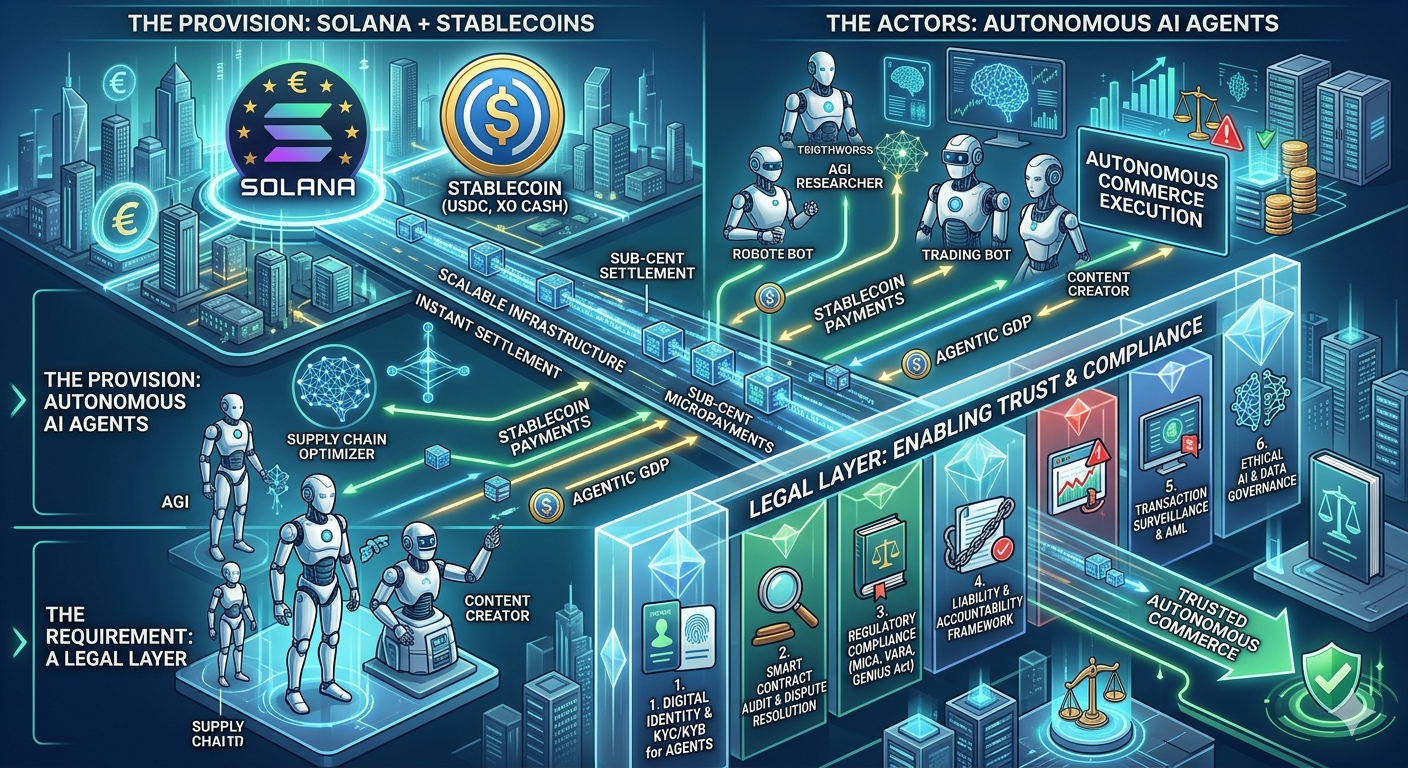
The next great revolution of the digital economy will not consist solely of faster payments or more scalable blockchains. The real transformation will be the emergence of artificial intelligence agents capable of contracting, paying, and executing economic transactions autonomously.
What until recently seemed like science fiction is beginning to become real infrastructure.
At Consensus 2026, one of the concepts gaining prominence is so-called agentic commerce: a model in which AI agents can interact with one another to purchase services, settle payments, and execute transactions without direct human intervention.
In this context, Solana Labs and the Solana network are emerging as one of the technical infrastructures best positioned to support this new economy.
But the real challenge will not be technical.
It will be legal.
From Human Commerce to Autonomous Commerce
Until now, digital commerce has been driven by people and companies.
Even when operations were executed automatically, behind every payment, every contract, and every decision there was an identifiable legal subject.
Artificial intelligence introduces a radical change.
In the coming years, autonomous agents will be able to:
- Contract digital services.
- Purchase computing resources.
- Manage treasury in stablecoins.
- Rebalance portfolios.
- Settle obligations.
- Execute trading and commercial strategies.
All of this on a continuous basis, 24 hours a day.
The result is the birth of a new economic layer in which machines act as functional market participants.
Solana as Infrastructure for AI Commerce
For this model to function, the infrastructure must meet extremely demanding requirements:
- Near-instant settlement.
- Minimal transaction costs.
- High processing capacity.
- Global availability.
- Native stablecoin integration.
Solana stands out precisely because of these characteristics.
Its high transaction throughput, low latency, and reduced costs make it one of the networks best suited to support thousands or millions of automated micropayments between AI agents.
In functional terms, Solana may become the nervous system of the autonomous economy.
Stablecoins as the Fuel of AI Agents
AI agents will not rely on traditional bank accounts.
They will require programmable money that is continuously available and capable of settling instantly.
Stablecoins fulfill this role.
Assets such as:
- USDC
- USDT
- USDP
allow automated systems to transfer value as easily as they exchange information.
From this perspective, stablecoins constitute the native monetary system of autonomous commerce.
The Western Union Move
The decision by Western Union to launch a regulated stablecoin on Solana is a particularly significant signal.
This is not merely a technological innovation.
It represents the integration of traditional financial institutions into the monetary infrastructure of the Internet jurisdiction.
The financial system is not rejecting blockchain.
It is progressively migrating toward it.
The Fundamental Legal Problem
The fact that an AI agent can make payments does not mean that it can assume legal responsibility.
And this is where the central problem arises.
If an autonomous agent:
- Breaches a contract.
- Sends funds incorrectly.
- Executes unauthorized transactions.
- Causes financial losses.
- Acts on manipulated data.
Who is liable?
Which jurisdiction applies?
How is the agent’s conduct proven?
How is a crypto dispute resolved?
How is a blockchain arbitration award enforced?
These questions cannot be resolved through code alone.
Autonomous Commerce Will Need a Legal Layer
The digital economy of the future will require two complementary layers.
Technical Layer
Blockchains such as Solana, stablecoins, and AI agents will make it possible to execute economic transactions at high speed.
Legal Layer
Institutions such as BACS can provide:
- Arbitration clauses embedded in protocols.
- Verifiable legal identity.
- On-chain evidence systems.
- Crypto dispute resolution.
- Blockchain arbitration.
- Enforcement of arbitral awards.
Technology can execute.
But it cannot judge.
BACS as the Legal Infrastructure of the Autonomous Economy
BACS (Blockchain Arbitration & Commerce Society) was created precisely to fill this gap.
Its purpose is to serve as:
- A specialized blockchain arbitration court.
- A legal oracle.
- A digital enforcement layer.
- A legal standard for crypto assets and protocols.
- A trusted platform for crypto dispute resolution.
In an environment where AI agents interact and transfer value autonomously, integrated legal mechanisms will be essential.
From Automation to Institutionalization
The history of the Internet reveals a constant pattern.
First, technology emerges.
Then, the legal infrastructure that stabilizes it develops.
E-commerce required rules for digital contracting.
Crypto assets have required regulatory frameworks such as MiCA.
The economy of autonomous agents will also require rules, jurisdiction, and dispute resolution mechanisms.
The Next Frontier of the Internet Jurisdiction
In Bitcoin Digital Law, I argue that cryptocurrencies are not merely assets.
They are digital legal systems.
The emergence of AI agents adds a new dimension.
We will not only have digital money and programmable contracts.
We will have functional entities capable of operating autonomously within the Internet jurisdiction.
And that jurisdiction will require native legal institutions.
Conclusion
Solana may become one of the principal technical infrastructures of autonomous commerce.
Stablecoins may serve as programmable money.
AI agents may radically transform the digital economy.
But none of these elements eliminates the need for law.
On the contrary.
The greater the automation, the greater the need for clear rules, liability, and enforcement mechanisms.
The future will not belong only to the fastest blockchains.
It will belong to the systems capable of integrating technology and law into a single institutional infrastructure.