

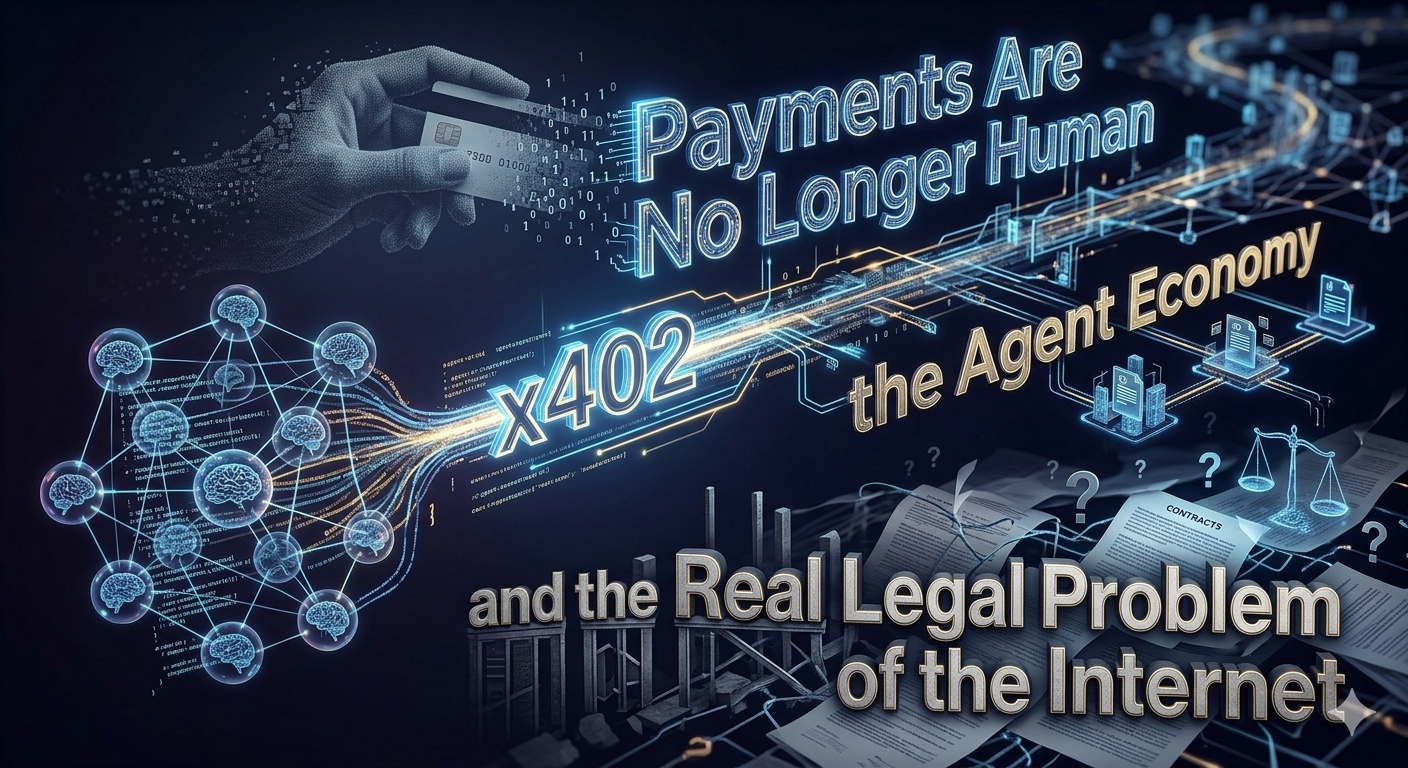
Payments Are No Longer Human
The recent commitment by Coinbase, Stripe and Cloudflare to the development of payment protocols oriented toward artificial intelligence marks a turning point that goes far beyond financial innovation.
We are not simply facing an improvement in payment systems.
We are facing a structural change: payments cease to be a human action and become an automatic function of software.
The development of the x402 protocol, promoted as an open standard under the Linux Foundation, points toward a scenario in which economic exchanges will not be executed by people, but by digital agents operating autonomously on the Internet.
And this completely changes the rules of the game.
From Human Payments to an Agent Economy
For decades, the financial system has been designed around a basic premise: transactions are human decisions.
Even in digital environments, behind every payment there is a person who authorizes, validates and assumes the consequences.
The model that is beginning to emerge breaks with this logic.
With the integration of artificial intelligence and protocols such as x402, payments become machine-to-machine, automated and directly integrated into APIs and digital services.
This allows AI agents to contract services, systems to settle pay-per-use payments in real time, and autonomous devices to manage their own operating costs.
The result is the emergence of a true agent economy, where money circulates without direct human intervention.
The Problem Is Not Technological: It Is Legal
The dominant narrative presents this change as a threat to the traditional banking system. However, this approach is superficial.
Banks do not disappear. They transform.
Intermediaries are not eliminated. They are redefined.
The real problem does not lie in the payment infrastructure, but in the absence of a legal framework capable of operating in this new environment.
When a machine makes a payment, fundamental questions arise: who is legally responsible, how consent is determined, what happens in the event of error or fraud, and which jurisdiction applies.
And, above all, how a dispute between autonomous systems is resolved.
x402 as an Execution Layer Without a Decision Layer
The potential of x402 lies in its capacity to become a kind of HTTP for payments: an open standard that allows value to be integrated directly into the architecture of the Internet.
But, as happens with many technological infrastructures, it solves only part of the problem.
x402 allows payments to be executed, but it does not allow them to be judged.
The digital economy is developing extremely efficient execution layers, but lacks equivalent layers of decision and enforcement.
The result is a system that works until something fails.
The Real Bottleneck: Enforcement
As the agent economy expands, the number of interactions and transactions will grow exponentially.
And with them, conflicts, errors and breaches will also increase.
In the absence of effective resolution mechanisms, the system faces a structural problem: it cannot scale legally at the same pace at which it scales technologically.
This is where the ecosystem’s true need emerges. Not for more code, but for more law.
Toward a Native Legal Layer for the Internet
The logical evolution of this model points toward the integration of legal mechanisms directly into digital infrastructure.
This implies legal identity for wallets and agents, dispute resolution clauses integrated into protocols, arbitration systems adapted to automated environments, and effective execution of decisions over digital assets.
In other words, the creation of a native legal layer for the jurisdiction of the Internet.
If the evolution of protocols such as x402 demonstrates anything, it is that the future does not depend only on who builds the technical infrastructure.
It depends on who is capable of providing it with legal certainty.
The Role of BACS
In this context, Blockchain Arbitration & Commerce Society (BACS) proposes precisely this legal infrastructure for the digital economy.
The mission of BACS is to connect the automatic execution of code with effective dispute resolution and enforcement mechanisms.
Because the true value of the next generation of protocols will not lie solely in moving money, but in providing global legal certainty.
The New Architecture of Money
The idea that these advances eliminate banks or destroy the financial system is incomplete.
What is really happening is a reconfiguration of the architecture of money: execution moves toward open protocols, intermediation concentrates in new infrastructures, and the need for enforcement becomes critical.
In this new environment, control is exercised not only over money, but over the rules that make it possible to resolve the conflicts that money generates.
And that is where it will be decided who leads the next phase of the digital economy.