

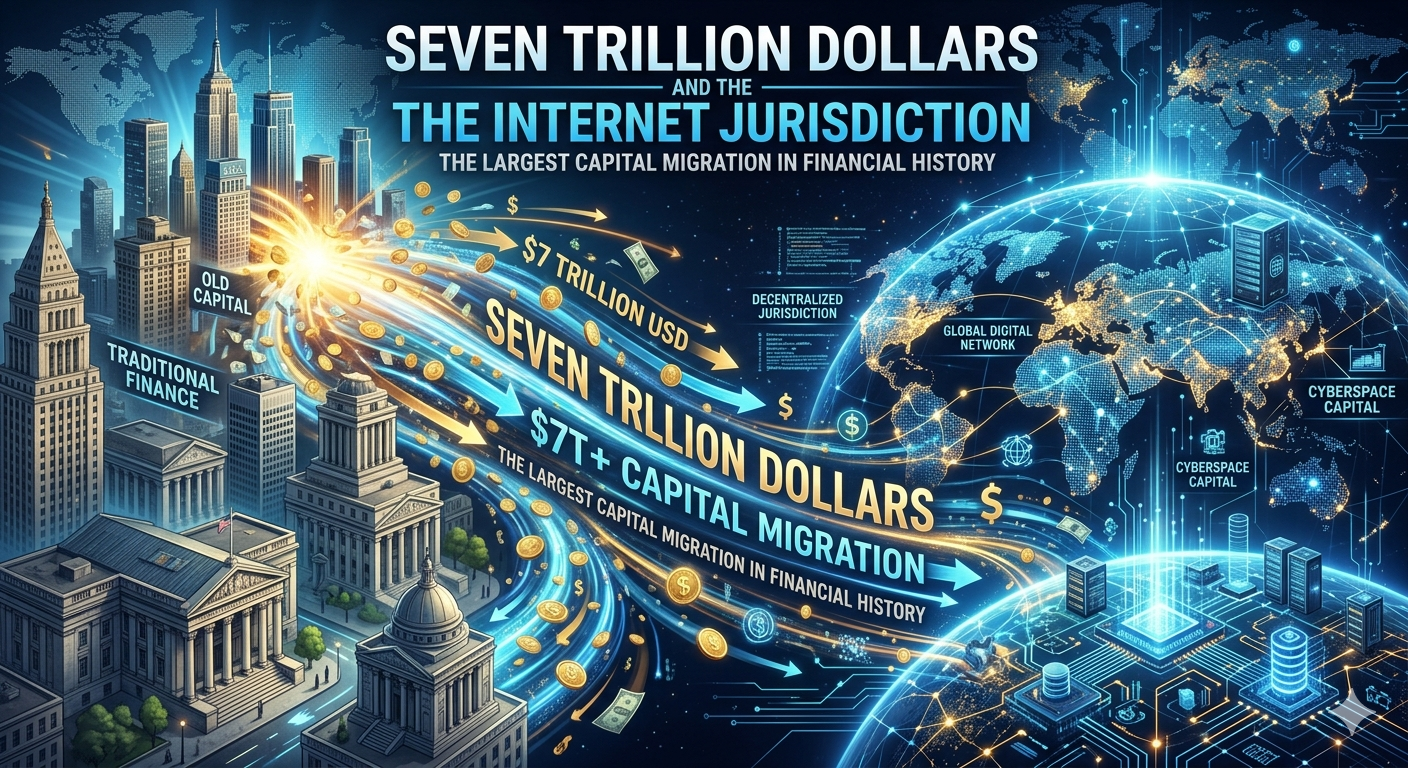
This figure represents one of the largest concentrations of liquid capital in financial history.
For now, much of this money remains on the sidelines because cash has once again become attractive. With interest rates above 4%, investors can generate meaningful returns while taking very limited risk.
But this situation may not last.
If the Federal Reserve System begins a new cycle of rate cuts, the economic logic that has kept trillions in cash could rapidly change.
And when that happens, a fundamental question will arise:
Where will this capital go?
My view is that a meaningful portion of it will not simply return to equities or traditional fixed income.
It will flow into a new economic system: the Internet Jurisdiction.
The Return of Capital to Risk
Capital always seeks the best possible balance between security, liquidity, and return.
When cash yields 4–5%, many investors are comfortable remaining in money market funds.
But when rates decline, the return on idle cash becomes less attractive.
At that point, capital begins to search for new destinations.
Historically, this has meant:
- Equities
- Real estate
- Corporate debt
- Commodities
Today, however, another destination has emerged.
A digital economic system based on blockchain networks, programmable money, and tokenized ownership.
What Is the Internet Jurisdiction?
The Internet Jurisdiction is the emerging legal and economic order in which rules are embedded directly into software.
In this system:
- Bitcoin functions as digital monetary law.
- Ethereum functions as programmable legislation.
- Tether and USD Coin function as Internet-native dollars.
- Smart contracts automate execution.
- Tokenization represents ownership.
- Arbitration and digital enforcement provide legal certainty.
This is not merely a technological ecosystem.
It is a parallel jurisdictional infrastructure for organizing economic relations.
Why Capital Is Already Moving
The migration has already begun.
Capital is entering the Internet Jurisdiction through several channels.
Bitcoin ETFs
Products such as IBIT allow institutional investors to gain exposure to Bitcoin through regulated securities markets.
Stablecoins
Stablecoins are becoming the settlement layer of digital commerce and increasingly serve as the monetary infrastructure of the Internet economy.
Tokenization
Banks and asset managers are converting bonds, funds, and real-world assets into blockchain-based instruments.
Decentralized Finance
On-chain protocols provide lending, trading, and settlement without traditional intermediaries.
Autonomous AI Commerce
AI agents are beginning to transact directly using stablecoins and blockchain infrastructure.
What Happens If Only 5% Moves?
The scale becomes clearer through simple arithmetic.
7.75×1012×0.05=3.875×10117.75\times 10^{12} \times 0.05 = 3.875\times 10^{11}7.75×1012×0.05=3.875×10¹¹
A 5% allocation from $7.75 trillion would represent approximately $387.5 billion entering the digital economy.
If the allocation reached 10%:
7.75×1012×0.10=7.75×10117.75\times 10^{12} \times 0.10 = 7.75\times 10^{11}7.75×1012×0.10=7.75×10¹¹
That would amount to $775 billion.
Such flows would materially transform:
- Bitcoin markets
- Stablecoin adoption
- Tokenized securities
- DeFi protocols
- Digital legal infrastructure
The Legal Infrastructure Requirement
Capital does not move only toward innovation.
It moves toward systems that provide legal certainty.
Institutional investors require:
- Clear ownership rights
- Enforceable contracts
- Predictable dispute resolution
- Cross-border legal certainty
Technology alone is not enough.
Code executes.
But code does not judge.
This is where BACS Society becomes relevant.
BACS is building the legal infrastructure of the Internet economy by providing arbitration, legal standards, and digital enforcement mechanisms for blockchain-based systems.
From Financial Rotation to Jurisdictional Migration
The core issue is not merely a portfolio reallocation.
It is a jurisdictional transition.
For decades, global capital has operated primarily within a system governed by:
- Central banks
- Commercial banks
- Securities regulators
- Traditional courts
Increasingly, economic activity is being organized under a parallel system governed by:
- Open protocols
- Stablecoins
- Smart contracts
- Digital arbitration
This is the Internet Jurisdiction.
Powell, Rate Cuts, and Structural Incentives
Whether Jerome Powell remains influential or future policymakers adopt a more accommodative monetary stance, the structural dynamic remains the same.
When rates decline, the opportunity cost of holding cash increases.
Capital begins to seek new forms of return, efficiency, and legal certainty.
Blockchain-based systems increasingly offer all three.
Conclusion
Will all $7.75 trillion enter the Internet Jurisdiction?
Almost certainly not.
Will a meaningful share migrate into Bitcoin, stablecoins, tokenization, and the legal infrastructure that supports them?
That is highly plausible.
And if only a fraction of this capital moves, the consequences could be transformative.
We may be witnessing not just another market cycle.
We may be witnessing the largest migration of capital in financial history into a new jurisdictional and economic order.
The future of finance may not simply be digital.
It may be governed by digital law.