

Skip to content

What is BACS?

  • Join BACS
  • International regulation
  • International tribunal
  • Contact
  •   Access
  • Español
  • Join BACS
  • International regulation
  • International tribunal
  • Contact
  •   Access
  • Español
Blockchain Arbitration & Commerce Society
  • About BACS
    • Board of directors and tribunal of arbitration
  • Services
    • Quality seal
    • Crypto complaints
    • Networking
    • Training
    • Events
  • News
  • Members
  • Home
  • About BACS
    • Board of directors and tribunal of arbitration
  • Services
    • Quality seal
    • Crypto complaints
    • Networking
    • Training
    • Events
  • News
  • Members
  • Home
Home » Arbitration » Stablecoins Are Not Digital Money: They Are Programmable Monetary Power

Author

Picture of Ignacio Ferrer-Bonsoms

Ignacio Ferrer-Bonsoms

Ignacio Ferrer-Bonsoms is a business lawyer and founder of the Blockchain Arbitration & Commerce Society (BACS), an initiative focused on the development of legal infrastructure for the digital economy.

His work centers on how legal systems interact with emerging technologies such as blockchain, digital assets and artificial intelligence, with a particular focus on cross-border structures, dispute resolution and legal enforceability.

He has been involved in the structuring of digital and blockchain-related projects across multiple jurisdictions, providing him with a practical perspective on how these systems operate and where they face limitations.

Through BACS, he develops frameworks and proposals aimed at bridging the gap between law and technology, contributing to the evolution of legal systems in digital environments.

He is the author of Bitcoin Digital Law, where he explores blockchain as an emerging form of digital legal order and analyzes its implications for traditional legal frameworks.

Home » Arbitration » Stablecoins Are Not Digital Money: They Are Programmable Monetary Power
16 de May de 2026

Stablecoins Are Not Digital Money: They Are Programmable Monetary Power

Agent Economy AI Agents Artificial Intelligence BACS Bitcoin Blockchain Blockchain Arbitration Central Banks Crypto assets Dai digital assets Digital Dollar Digital Euro Digital Law Digital Money Ethereum GENIUS Act Internet Jurisdiction MiCA Monetary Infrastructure Private Digital Dollar Programmable Monetary Power Programmable Money smart contracts Stablecoins Tether Tokenization Treasury Securities USDC USDT

Share

Sign up for this activity

Discounts on events and training are available to all BACS members.

Your level is STANDARD and you have a 10% discount.

Your level is PREMIUM and you have a 20% discount.

Your level is PREMIUM + and you have a 30% discount.

Send request

For a long time, stablecoins have been presented as a simple technological innovation: digital tokens whose value remains stable because they are backed by fiat currencies, mainly the United States dollar.

However, this description is insufficient.

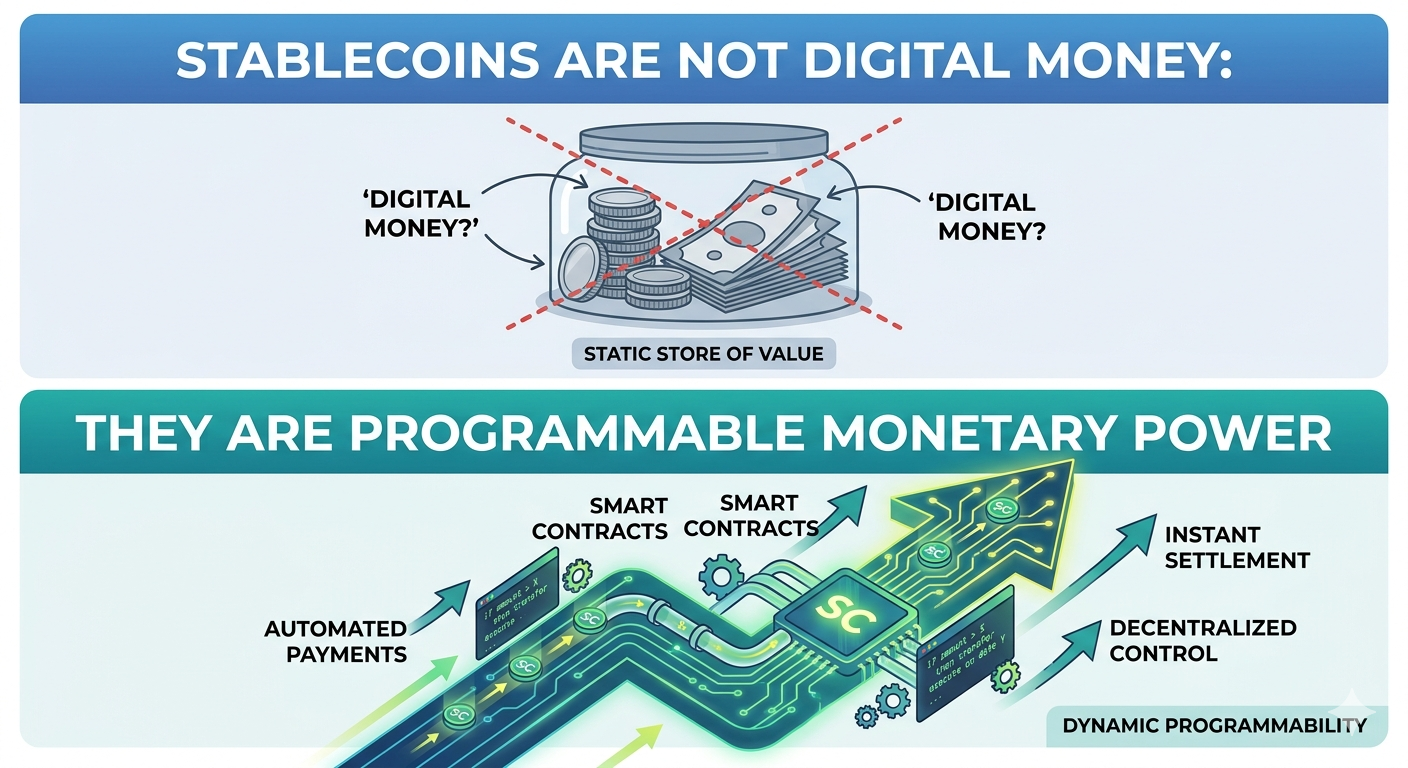
Stablecoins are not merely digital money.

They are a new form of programmable monetary power.

And that difference is fundamental.

From Money to Code

Money has always been a legal and political institution.

A banknote is not valuable because of the paper from which it is made, but because there is a legal and institutional structure that guarantees its acceptance, its convertibility, and its use as a means of payment.

In the traditional system, monetary issuance has historically been reserved to States and central banks.

With the emergence of Bitcoin, a decentralized monetary system capable of functioning without a central authority appeared for the first time.

Later, Ethereum made it possible to create programmable tokens and smart contracts.

On that infrastructure, a new phenomenon was born: stablecoins.

What Is a Stablecoin Really?

A stablecoin is a digital token designed to maintain a stable value, normally equivalent to one United States dollar.

Well-known examples include Tether, USD Coin, and Dai.

At first glance, they appear to be simple digital representations of the dollar.

But their nature is much deeper.

A stablecoin combines three elements:

  1. A monetary unit.
  2. A globally transferable digital asset.
  3. A set of programmable rules executed automatically.

Consequently, we are not dealing with passive digital money, but with money that has behavior built into it.

The Birth of the Private Digital Dollar

For decades, the dollar existed in two main forms:

  • cash issued by the Federal Reserve;
  • bank deposits held within the financial system.

Stablecoins introduce a third form:

the Internet-native digital dollar.

This dollar can circulate 24 hours a day, settle in seconds, and be used in global financial applications without the need for correspondent banks.

For this reason, stablecoins constitute the most advanced version of the international dollar.

They do not depend on borders, banking hours, or traditional intermediaries.

They function as a global monetary infrastructure.

Programmable Monetary Power

The true innovation does not lie only in the digitization of the dollar.

The innovation is that money can incorporate automatic rules.

A stablecoin can:

  • be blocked;
  • be frozen;
  • be transferred automatically;
  • generate yield;
  • serve as collateral;
  • be integrated with lending protocols;
  • distribute payments to artificial intelligence agents;
  • execute according to predefined conditions.

In other words, money ceases to be a static instrument and becomes software.

And whoever controls that software controls a form of monetary power.

Tether and the New Private Central Banks

The case of Tether Holdings Limited is paradigmatic.

Tether issues tens of billions of digital dollars and maintains a substantial part of its reserves in United States Treasury securities.

In practice, Tether performs functions typical of a private monetary authority:

  • it issues monetary units;
  • it manages reserves;
  • it manages liquidity;
  • it facilitates global payments;
  • it can freeze assets.

Without being a formal central bank, it operates as one within the jurisdiction of the Internet.

This demonstrates that monetary power no longer belongs exclusively to States.

The GENIUS Act and the Integration of the Digital Dollar

In United States, the legislative debate on stablecoins has crystallized in proposals such as the GENIUS Act.

The underlying philosophy is clear: to allow private issuers to operate under supervision, provided that they maintain secure reserves, mainly in Treasury securities and cash.

The strategic objective is to consolidate global demand for United States public debt and reinforce the hegemony of the dollar.

In this context, stablecoins become a geopolitical instrument.

Each token backed by dollars increases the monetary influence of the United States over the global digital economy.

Europe and the Risk of Irrelevance

The European Union has responded through Markets in Crypto-Assets Regulation (MiCA), which establishes a legal framework for issuers and crypto-asset service providers.

Although MiCA provides legal certainty, the European approach remains primarily defensive.

While the United States uses stablecoins to expand the digital dollar, Europe focuses on limiting risks and on developing the digital euro.

The result may be a growing dependence on dollar-denominated monetary infrastructures.

Stablecoins and the Agent Economy

The next major transformation will be the integration of stablecoins with artificial intelligence agents.

An autonomous agent will be able to:

  • contract services;
  • pay for computing resources;
  • receive income;
  • invest surplus funds;
  • execute automatic agreements.

All of this using stablecoins as a means of exchange.

In this scenario, programmable money will be the operational foundation of the automated economy.

It will not merely be about faster payments.

It will be about economic systems that function autonomously.

The Legal Dimension

If stablecoins represent programmable monetary power, their regulation cannot be limited to technical or prudential issues.

It must address essential questions:

  • who may issue digital money;
  • what rights users have;
  • in which cases funds may be frozen;
  • which jurisdiction resolves disputes;
  • how decisions are enforced.

This is where institutions such as BACS become relevant, conceived to provide arbitration and legal enforcement within blockchain infrastructure.

Because programmable money also requires programmable justice.

Conclusion

Stablecoins are not simple digital versions of traditional money.

They are a new monetary architecture.

They transform the dollar into software.

They turn currency into a global infrastructure.

And they transfer part of monetary power from central banks to private issuers and technological protocols.

Ultimately, stablecoins are not merely digital money.

They are programmable monetary power.

And whoever controls that infrastructure will control an essential part of the Internet economy.

Share your crypto thoughts

All BACS members have access to this section to share their reports, narratives, and other thoughts related to their professional sector and the blockchain technology environment.

If you wish to submit your publication, please email info@bacsociety.com or use the form.

Submit article

Previous Seven Trillion Dollars and the Internet Jurisdiction: The Largest Capital Migration in Financial History

Newsletter

Crypto industry news, international regulation, training and professional events

Contact

  • SPAIN
  • C/ Antonio Acuña 9, 2º izq. - Madrid (Spain)
  • DUBAI
  • Innovation Hub Gate Avenue- South Zone Unit GA-00-SZ-G0-RT-147 DUBAI
  • info@bacsociety.com
  • +34 91 018 29 46
  • Web form

Communication area

  • Crypto industry news
  • Events and networking
  • Blockchain training
  • International regulation

Social media

Twitter Telegram

© The Blockchain Arbitration. All Rights Reserved 2023

Legal Notice  |  Privacy policy  |  Cookies Policy
Manage cookie consent
Our website uses cookies to improve your user experience by analyzing your browsing habits and in compliance with Law 34/2002, of July 11, 2002, on information society services and electronic commerce (LSSICE). The information about the cookies we use is what will ensure that the user can make their decision consciously and freely when giving their consent or, on the contrary, not to accept the installation of cookies on your device under the terms of Article 22 of Law 34/2002 of July 11, Services of the Information Society and Electronic Commerce (LSSICE).
Functional Always active
The storage or technical access is strictly necessary for the legitimate purpose of enabling the use of a specific service explicitly requested by the subscriber or user, or for the sole purpose of carrying out the transmission of a communication over an electronic communications network.
Preferencias
El almacenamiento o acceso técnico es necesario para la finalidad legítima de almacenar preferencias no solicitadas por el abonado o usuario.
Statistics
Technical storage or access that is used exclusively for statistical purposes. El almacenamiento o acceso técnico que se utiliza exclusivamente con fines estadísticos anónimos. Sin un requerimiento, el cumplimiento voluntario por parte de tu Proveedor de servicios de Internet, o los registros adicionales de un tercero, la información almacenada o recuperada sólo para este propósito no se puede utilizar para identificarte.
Marketing
The storage or technical access is necessary to create user profiles to send advertising, or to track the user on a website or multiple websites for similar marketing purposes.
  • Manage options
  • Manage services
  • Manage {vendor_count} vendors
  • Read more about these purposes
See preferences
  • {title}
  • {title}
  • {title}

Your level is STANDARD and you have a 10% discount.

Your level is PREMIUM and you have a 20% discount.

Use the form below to apply for registration for the activity. We will confirm your registration by email after checking the availability of places.

Basic information about your data protection:

Responsible party: Blockchain Arbitration Society (hereinafter BACS)

Purpose: Manage your request for inscription +info

Rights: You have the right to access, rectify and delete the data, as well as other rights, as explained in the additional information. +info

Additional information: You can here consult additional and detailed information on Data Protection

Idioma ES

.

.