

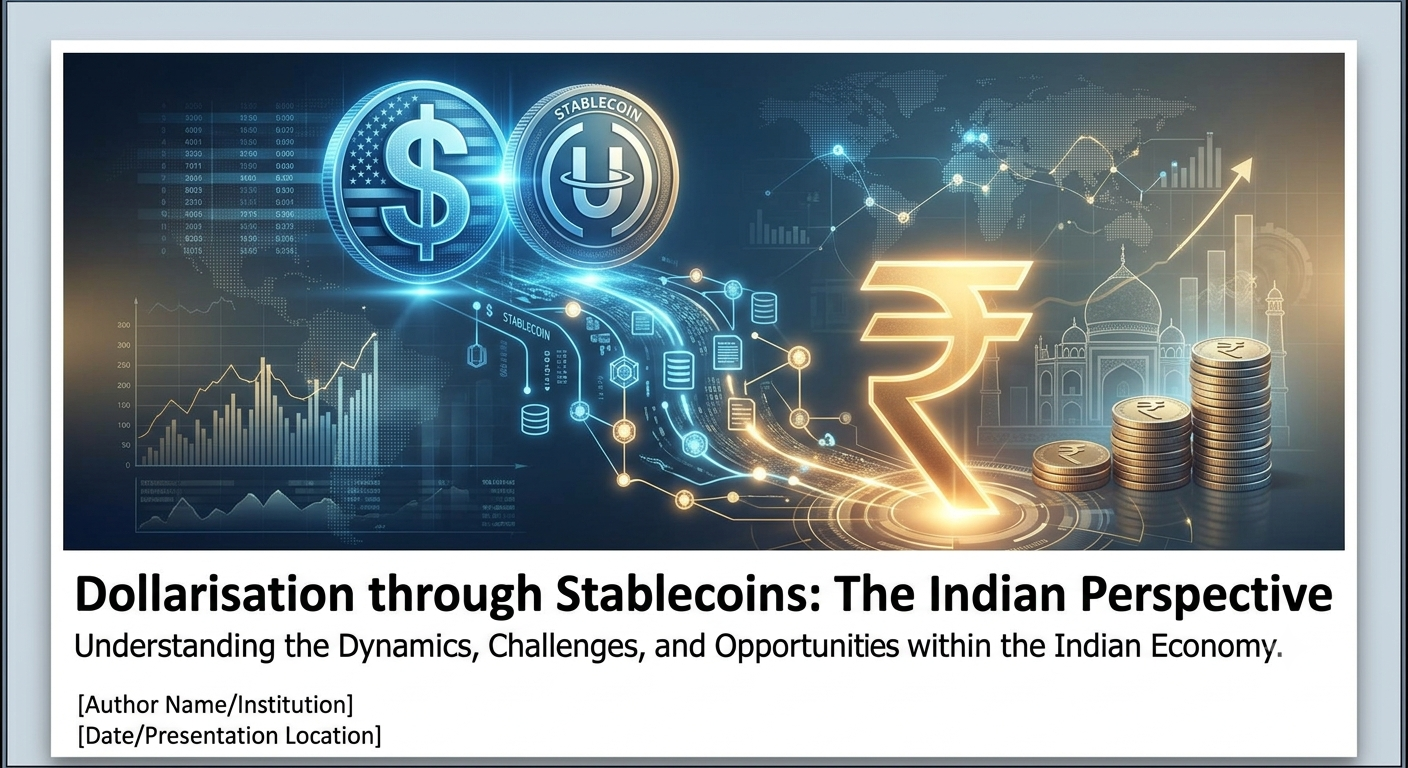
In the Mint Annual BFSI Conclave 2025 on December, 12, 2025, the Deputy Governor of the Reserve Bank of India, Shri T Rabi Sankar, proposed that stablecoins should not be integrated into the Indian financial system as the risks outweigh any proclaimed benefits, and promoted CBDCs as a safer alternative to foster innovation.
One of the risks cited was currency substitution, and more specifically, “dollarization.”
This article is going to critically evaluate this claim by analysing the benefits and detriments of adopting stablecoins in emerging markets and developing economies (EMDEs). Based on these results, and the approach taken by other countries like Japan, it aims to provide a potential regulatory framework for stablecoins in India that balances economic utility and innovation, in line with the RBI’s objectives.
EVIDENCE FROM DEVELOPING COUNTRIES
The most prevalent conditions in an economy that determine the likelihood of adopting stablecoins are as follows:
- High cost and slow digital currency transfer or exchange
BENEFITS
SWIFT-based international wire transfers, used primarily by banks, carry a fee of $20–$50 per transaction at the sending institution. Settlement times range from one to three business days under standard SWIFT processing. The payment corridors to poor countries, by which citizens working abroad send money back to their families, cost 6 per cent to 7 per cent on average, which is more than double the G20 target of 3 per cent.
A Harvard Business School working paper analysing cross-border payment rails found that stablecoin-based transfers are four to thirteen times cheaper than bank wire transfers for equivalent transaction values. Another study found that blockchain-based transfers reduce per-corridor fees from the 6–8% traditional average to 1–3%, with disintermediation of correspondent banks as the primary mechanism.
Furthermore, stablecoins pegged to the dollar are preferred as they are universally accepted and make a compelling use-case for cross-border remittances. Stablecoin remittances are instantaneous and much cheaper compared to the traditional remittance route offered by Indian banks.
As high inflation rates erode savings, a common strategy is to rely on the U.S. dollar. Banks and other financial institutions often provide limited solutions in EMDEs, making stablecoins a vital alternative for the average person. This highlights the growing importance and utility of stablecoins in providing economic stability and accessibility where traditional financial systems fall short. Volatile local currencies make wealth preservation very difficult. This leads to “digital dollarization,” where individuals and businesses turn to U.S. dollar-pegged stablecoins to protect their purchasing power. Unlike physical cash, which is difficult to obtain, transport, or store securely, stablecoins offer a digital, borderless alternative that acts as an immediate hedge against inflation.
Beyond individual wealth preservation, stablecoins serve as a tool for financial inclusion. According to the World Bank, significant portions of the population in emerging markets remain unbanked or underbanked, often due to a lack of physical branch access or strict documentation requirements. Stablecoins remove the high barrier to entry associated with traditional banking, allowing anyone with an internet connection to access global financial liquidity.
DRAWBACKS
The argument that the benefits of stablecoins are not unique to it, and that it can be achieved by other forms of digital money, as articulated by the RBI, is also supported by other studies on the specific impact on EMDEs. The work of Feyen et.al suggests that stablecoins are neither necessary nor sufficient to achieve the highlighted benefits, citing the risk of fluctuation of foreign currencies against the local currencies, and the importation of monetary policies of the country producing the fiat currency, which might not be optimal for the EMDEs, which could result in impunging their monetary policies. (2) Stablecoins also create a new mechanism for capital flight, allowing citizens to get hold of virtual dollars at home that can be exchanged for real dollars offshore.
While small economies (especially those with high or unstable domestic
inflation) are susceptible to both traditional and digital dollarization by a stable currency,
economies that are economically or socially open to large digital currency areas will be uniquely vulnerable to digital dollarization. The same is true for smaller countries as they do not provide the same scale of network externalities, large networks can offer, i.e. even economies with stable currencies could be digitally dollarized if their citizens often
transact with users of a digital platform with its own currency, a concern also echoed by the RBI. As the importance of digitally delivered services increases and social networks become more intertwined with the ways in which people exchange value, the influence of large digital currencies in smaller economies will grow.The prospect of viable independent currencies also raises concerns for monetary policy. An entity with the power to conduct its own monetary policy has the potential to act in its own favor; large private issuers of digital currency would face the concern that if permitted to freely conduct monetary policy, it would be tailored to benefit the firm rather than the public. (3)
With respect to dollarization, the growing use of stablecoins may further cement the international dominance of the US dollar. Today, virtually all stablecoins in circulation are denominated in dollars, with other currencies playing a negligible role. European Central Bank research suggests that significant dollar-denominated stablecoin issuance could amplify the international transmission of US monetary policy. A contractionary US monetary policy shock creates greater spillovers to real economic output abroad than under a scenario of no stablecoin adoption.Global US dollar stablecoins could create new cross-border networks where dollarisation emerges as a byproduct of the adoption of the new technology, rather than a deliberate currency choice.
All that considered, other studies do indicate that under an optimal level of issuance, household welfare can increase significantly, even with the probability of banking crises rises, due to gains in liquidity efficiency and portability. The scope for welfare gains from stablecoins depends on how households value the liquidity services of digital currency relative to traditional deposits and on the cost of issuing stablecoins (4).
This is in line with the goal proposed by this article, to balance economic utility and innovation. Moreover, the stability or instability of a stablecoin depends primarily on the type of asset backing it and the architecture of its redemption and incentive mechanisms. Schemes with volatile collateral or overcollateralized systems may be particularly sensitive to self-fulfilling user expectations and fluctuations (5)
CURRENT LEGISLATION
Currently, there is no comprehensive legislation governing stablecoins, and they operate in a legally grey area.
There is ambiguity in the legal classification of stablecoins. They do not fall under the definition of ‘currency’ under the list of accepted items provided in Section 2(h) of the Foreign Exchange Management Act, 1999 (“FEMA”). They can be included specifically through legislative amendments, or have to be notified by the RBI as currency. The RBI’s current stance complicates this issue.Additionally, they do not fall under the definition of ‘security’ under Section 2 (za) of FEMA.
The Income Tax Act, 1961 defined VDAs under Section 2(47A), which encompasses cryptocurrencies and stablecoins. However it explicitly excludes Indian and foreign currency.
FEMA distinguishes between current account transactions (payments for trade, remittances, services not creating assets/liabilities) and capital account transactions (those altering assets/liabilities in or outside India). Stablecoins create classification uncertainty, i.e. if treated as currency, they fall under current account rules; if viewed as investments or asset holdings, they trigger capital account restrictions under FEMA. Since stablecoins do not clearly qualify as any instrument under FEMA, the need for a specific classification becomes crucial to eliminate the ambiguity and use stablecoins for cross-border transactions. Despite regulatory uncertainties, India has an active investor base for cryptocurrencies, and such transactions now form a significant proportion of the total cross border remittances.
Section 2(1) (i) of the Payment and Settlement Systems Act 2007 (18) defines payment systems as “a system that enables payment to be effected between a payer and a beneficiary, involving clearing, payment or settlement service or all of them…”; this also includes money transfer operations. Under the definition Section 4 of the PSS Act, 2007, no person other than the Reserve Bank can operate or commence a payment system unless authorized by the Reserve Bank. While stablecoin “sponsorship” is foreign-led, through liquidity providers backing stablecoin pairs, particularly USDT and USDC, the daily purchase and sale of stablecoins in India is almost entirely handled by crypto exchanges, registered with the Financial Intelligence Unit of India (“FIU-IND”) as virtual digital asset service providers (“VDASP”). As the remit of activities undertaken by a VDASP are wide, questions remain on whether such issuers and liquidity providers also require VDASP registration with the FIU-IND.
POTENTIAL LEGAL FRAMEWORK
Research shows that moderate regulation can help purify market ecology, enhance investor confidence, and promote industry maturity (6). However, strict regulatory constraints might stifle innovation, distort resource allocation, and exacerbate market segmentation (7)
Regulatory uncertainty reduces cryptocurrency investment, highlighting the “double-edged sword” effect of regulatory policies. (8) This is particularly important in the Indian context, and highlights the necessity to have a comprehensive regulatory framework
The Monetary Authority of Singapore (“MAS”), Japan’s Financial Services Agency (“FSA”), and the European Central Bank have all concluded that regulated stablecoins drive innovation.
This article proposes that integration with the banking system is beneficial from both an economic and regulatory perspective, and to limit the power of private actors
In a speech by Pablo Hernández de Cos in a bank of Japan seminar, he highlighted that stablecoins seek to leverage trust in fiat currency, which implies that the monetary anchor provided by central banks remains indispensable, regardless of the future role of stablecoins or any other technological innovation.
Japan amended its Payment Services Act and introduced a framework for what it calls electronic payment instruments, which include fiat-backed stablecoins redeemable at 1:1. Under this regime, issuance is restricted to three categories of licensed entities: banks, trust companies or trust banks, and funds transfer service providers. The core principle is that fiat-linked stablecoins must be issued by regulated entities that can ensure redemption and appropriate safeguarding of funds. In addition to issuer licensing, Japan created a new registration category for entities that handle or distribute stablecoins. This is the “Electronic Payment Instrument Exchange Service Provider”. The FSA also maintains a public list of registered electronic payment instrument exchange service providers and the instruments they handle. Furthermore, the FSA reclassified foreign-issued trust-type stablecoins from “Securities” to “Electronic Payment Instruments,” ending legal ambiguity.
For Japanese businesses to legally handle stablecoins issued abroad, the FSA has outlined three key requirements:
- Equivalent licensing: The foreign issuer must hold a license in its home jurisdiction that is equivalent to the license required under Japanese law.
- Collateral management and auditing: The issuer must ensure that collateral assets backing the stablecoin are properly managed and subject to regular audits.
- Regulatory cooperation: The issuer must be supervised by a foreign regulatory authority capable of sharing information and cooperating with the FSA upon request.
A similar framework can also be adopted in India. The classification as currency or assets will determine whether a transaction is permitted or requires special approval, which is a crucial instrument in controlling the flow of foreign currency into the economy.
An appropriate registration or licensing regime allows for adequate information and monitoring. Because of the inherent cross-border potential, authorities will need to combine this with information sharing arrangements between each other. Permitted stablecoin issuers, along with those providing payment services for the same, need to be registered with the RBI. The licensing regime would also help prevent the circumvention of capital controls.
To mitigate contagion risk, stablecoin reserves could also be ring-fenced through a dedicated “trust account” structure akin to escrow arrangements under RBI’s payment system frameworks.
If reserves are held in domestic government securities, local-currency stablecoin issuance could support demand for sovereign debt and help retain savings within the domestic financial system (in contrast to the outflow of savings towards US Treasuries implied by the digital dollarisation scenario). This also signifies the potential of a rupee-backed stablecoin to be developed in the future.
That said, it is also important to target the core issues that drive people to stablecoin usage- i.e. inflation and weak/unstable currencies, poor growth, and high transaction costs, through effective fiscal and monetary policies. Since stablecoins tend to be used in countries whose central banks have failed to control inflation, the fundamental remedy should be to improve the capacity and effectiveness of central banks, thereby removing the need for their citizens to seek alternatives to local currencies in stablecoins.
Comparative analysis reveals that jurisdictions prioritising transparency and prudential equivalence, not blanket prohibition, have achieved market stability and innovation leadership. By implementing a clear framework tailored to its needs, India can reap the benefits of this new and emerging market of stablecoins, while simultaneously maintaining the efficiency and sovereignty of its financial system. The objective is not deregulatory freedom but regulated confidence, a framework where technology serves the policy goals of stability, inclusion, and transparency.
Smriti Ramesh
Jindal Global Law School
(1) Du, W., Huang, J. and Scharfstein, D. (2024). Competing Rails for Cross-Border Payments: Banks, Fintechs, and Stablecoins. Harvard Business School
Working Paper.
(2) BIS Working PapersNo 973What does digital moneymean for emerging marketand developing economies?by Erik Feyen, Jon Frost, Harish Natarajan and Tara Rice.
(3) BIS Working PapersNo 941The digitalization of moneyby Markus K Brunnermeier, Harold James andJean-Pierre LandauMonetary and Economic DepartmentMay 2021.
(4) Chen, W., and Phelan, G. (2025). Digital currency and banking-sector stability. J. Financ. Stab. 78, 101414.
(5) Potter, Y., Pongmala, K., Qin, K., Klages-Mundt, A., Jovanovic, P., Parlour, C., et al. (2024). “What drives the (in)stability of a stablecoin?,” in IEEE int. conf. blockchain cryptocurrency, ICBC (Dublin, Ireland: Institute of Electrical and Electronics Engineers Inc.), 316–324. doi:10.1109/ICBC59979.2024.10634419.
(6) Cumming, D. J., Johan, S., & Pant, A. (2019). Regulation of the Crypto-Economy: Managing Risks, Challenges, and Regulatory Uncertainty. Journal of Risk and Financial Management, 12(3), 126. https://doi.org/10.3390/jrfm12030126
(7) Auer, R., & Claessens, S. (2021). Cryptocurrency market reactions to regulatory news. In The Routledge Handbook of FinTech. Routledge.
(8) Peng, K.-J. (2023). Regulating FinTech: The Perspectives of Law, Economics, and