

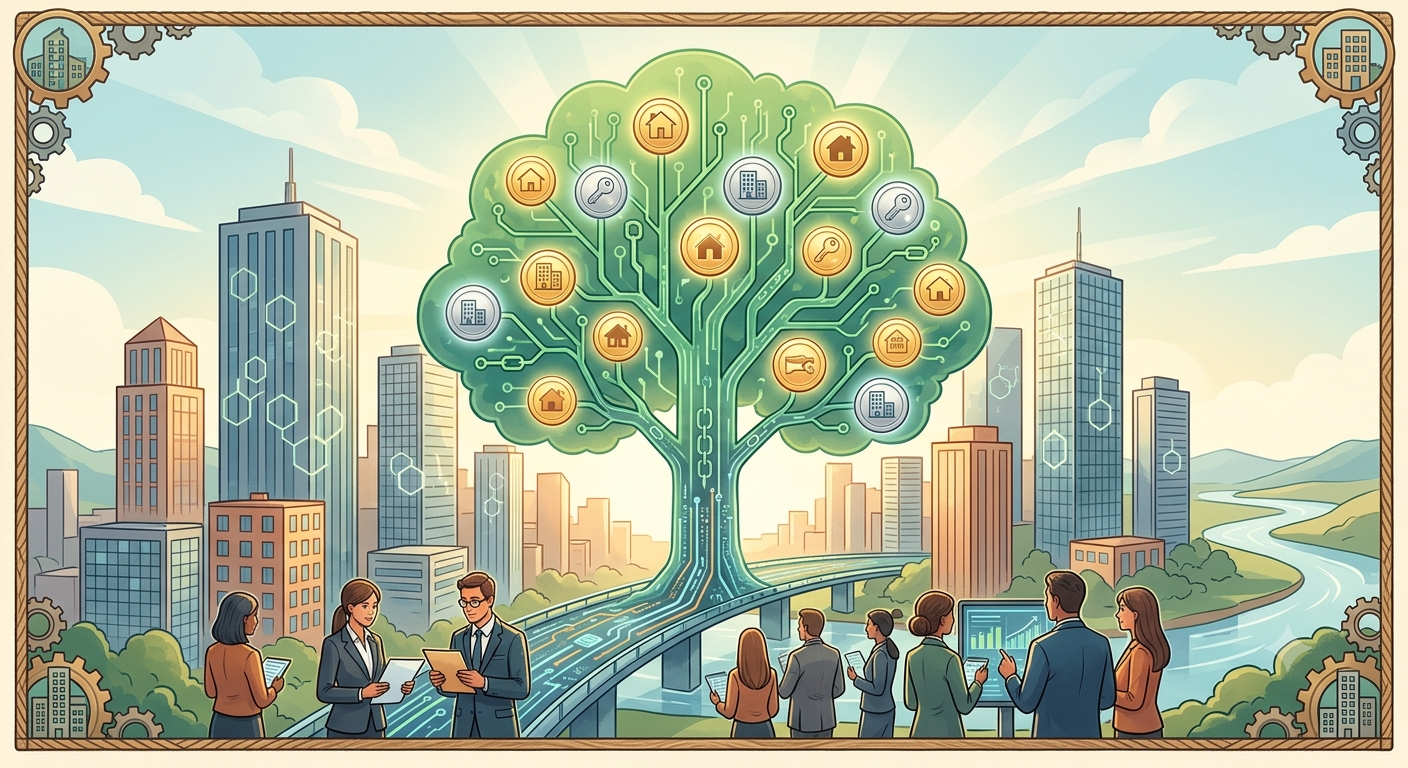
Real estate tokenization is often presented as a simple technological process.
Take a property, divide it into digital fractions, issue tokens, and allow investors to buy and trade them.
In practice, however, real estate tokenization is not primarily a technological problem.
It is a legal architecture problem.
A token does not automatically create ownership of a building.
A blockchain entry does not necessarily replace a land registry.
A smart contract does not, by itself, determine what legal rights investors possess.
And fractionalization does not eliminate securities, corporate, tax, anti-money laundering, consumer protection, or property law.
The central question is therefore not: How do we create the token?
The real question is: What legal right does the token represent, and how can that right be protected and enforced?
This BACS Practical Guide examines the principal legal decisions involved in structuring a real estate tokenization project.
1. Start with the asset, not the token
The first mistake in many tokenization projects is beginning with blockchain technology.
Which network should be used? Ethereum? Polygon?
A permissioned blockchain? Which token standard? Which wallet infrastructure?
These questions matter. But they should come later.
The first step is to identify the underlying asset and the legal rights attached to it.
For example:
- a residential property;
- a commercial building;
- a hotel;
- a logistics facility;
- a portfolio of rental properties;
- a development project;
- future rental income;
- debt secured against real estate;
- shares in a company that owns property.
These are legally different assets. And they may require completely different tokenization structures.
The fundamental principle is simple: Tokenization does not eliminate the legal nature of the underlying asset.
It creates a digital layer through which rights relating to that asset may be represented, transferred, governed, or economically exploited.
2. Decide what the token actually represents
This is the most important legal decision in the entire project.
A real estate token may represent very different rights.
For example, it may represent:
- direct ownership of the property;
- co-ownership;
- shares in a company that owns the property;
- units in an investment structure;
- debt issued by the property-owning company;
- a contractual right to rental income;
- a profit-participation right;
- a right to future sale proceeds;
- a governance right;
- a combination of economic and voting rights.
These models are not interchangeable.
A token representing one share in a company is legally different from a token representing a contractual claim against that company.
A token granting exposure to rental income is not necessarily equivalent to ownership of the underlying building.
A token marketed as “fractional real estate ownership” may, after legal analysis, turn out to provide investors only with a contractual right against an issuer.
This distinction must be clear before the token is issued.
The first legal document in any serious tokenization project should therefore answer a basic question:
What exactly does the token holder own?
If that question cannot be answered precisely, the project is not ready for tokenization.
3. Choose the legal structure
Once the underlying right has been identified, the project must determine how that right will be legally structured.
Several models are possible.
Model A: Direct tokenization of property ownership
Under this model, the token is intended to represent direct ownership or co-ownership of real estate.
Conceptually, this is attractive. In practice, it may be difficult.
Real estate ownership is generally governed by national property law, formal transfer requirements, notarial procedures, land registration systems, and mandatory rules.
In many jurisdictions, transferring a blockchain token does not automatically transfer legal title to land.
This creates a potential divergence: the blockchain says one thing; the land registry says another.
Unless the applicable legal system recognizes the blockchain transfer as legally effective, the token may not constitute direct ownership.
Model B: SPV structure
This is one of the most common approaches. A special purpose vehicle, or SPV, owns the property.
Investors do not directly own fractions of the building. Instead, they acquire tokens representing rights connected to the SPV.
The structure may look like this:
Property → SPV → Token holders
The token may represent:
- shares;
- economic participation rights;
- debt instruments;
- profit rights;
- governance rights.
This model can be more compatible with existing legal systems because the property remains registered in the name of one legal entity.
However, it introduces additional legal questions concerning:
- corporate governance;
- shareholder rights;
- insolvency;
- transfer restrictions;
- management;
- taxation;
- securities regulation.
Model C: Debt-based tokenization
The project may issue tokens representing debt.
Investors finance the acquisition or development of property.
In return, they receive:
- interest;
- repayment rights;
- security rights;
- participation in defined revenues.
This may be simpler in some structures but can trigger financial regulation depending on the characteristics of the instrument.
Model D: Revenue or rental-income tokenization
The token may represent a contractual right to receive part of the income generated by a property.
For example:
- 0.01% of net rental income;
- a percentage of hotel revenues;
- a share of future sale proceeds.
Here, investors may have economic exposure without owning the property itself.
Again, legal drafting is essential.
The token must clearly define the relationship between:
- the property owner;
- the issuer;
- the investor;
- the manager;
- the smart contract.
4. Determine whether the token is a financial instrument
This is one of the most important regulatory questions.
Calling something a “real estate token,” “utility token,” or “RWA token” does not determine its legal classification.
Regulators increasingly apply a substance-over-form analysis.
In the European Union, MiCA does not cover every token. Crypto-assets that qualify as financial instruments fall outside MiCA’s scope and may instead be governed by the existing EU financial-services framework. ESMA has issued specific guidelines on the conditions and criteria for qualifying crypto-assets as financial instruments.
This matters enormously for real estate tokenization.
If a token represents:
- shares;
- bonds;
- transferable securities;
- units in collective investment structures;
- other regulated financial rights,
the project may enter a much more demanding regulatory environment.
The first regulatory analysis should therefore not be: Does MiCA apply?
It should be: What is the legal nature of the token before we decide which regulatory framework applies?
For EU projects, the official starting points should include ESMA’s MiCA framework, the European Commission’s crypto-assets framework and ESMA’s guidelines on the qualification of crypto-assets as financial instruments.
5. Analyse securities and capital-markets regulation
If the token qualifies as a financial instrument, several regulatory questions may arise.
Depending on the structure and jurisdiction, these may concern:
- public offering rules;
- prospectus requirements;
- private placement exemptions;
- investment services;
- trading venues;
- custody;
- investor classification;
- marketing restrictions;
- market abuse;
- secondary trading.
The use of blockchain does not remove these obligations.
A tokenized share may still be a share.
A tokenized bond may still be a bond.
A tokenized investment product may still be an investment product.
The technology changes the infrastructure.
It does not necessarily change the legal classification.
Within the EU, the DLT Pilot Regime was created to support experimentation with DLT-based market infrastructures for tokenized financial instruments, and ESMA has continued reviewing its functioning and development.
6. Define the rights of token holders
A legally serious project should create a precise map of token-holder rights.
At minimum, the documentation should clarify:
- Does the holder own property?
- Does the holder own shares?
- Does the holder have a contractual claim?
- Is there a right to rental income?
- How is income calculated?
- Who pays expenses?
- Who decides renovations?
- Who appoints the property manager?
- Who can sell the building?
- Can token holders vote?
- What majority is required?
- Can the token be transferred freely?
- What happens if the issuer becomes insolvent?
- What happens if the property is destroyed?
- What happens if the property is expropriated?
- What happens when the property is sold?
These are not secondary questions.
They are the legal substance of the token.
7. Build governance before launch
Fractional ownership creates governance problems.
Suppose 2,000 investors hold tokens linked to one building.
Who decides whether to sell it?
Who approves a major renovation?
Who chooses the tenant?
Who decides whether to refinance?
Who can replace the property manager?
What happens if 51% of token holders want to sell and 49% do not?
Tokenization can make ownership more divisible.
But divisibility can also make governance more complex.
A robust structure should therefore define:
- voting rights;
- quorum;
- majority thresholds;
- reserved matters;
- emergency powers;
- delegation;
- conflicts of interest;
- manager removal;
- dispute procedures.
This is where blockchain governance and traditional corporate governance begin to converge.
8. Design transfer restrictions into the architecture
One of blockchain’s advantages is transferability.
One of regulated finance’s realities is that not every asset can always be transferred freely.
A real estate token may need restrictions based on:
- investor eligibility;
- jurisdiction;
- KYC status;
- sanctions;
- holding periods;
- securities laws;
- contractual lock-ups;
- maximum ownership thresholds.
These restrictions should not exist only in a PDF that the blockchain ignores.
Where legally appropriate, they may need to be reflected in the technical architecture of the token.
For example:
- allowlists;
- permissioned transfers;
- identity-linked wallets;
- compliance modules;
- pause functions;
- forced transfers under defined conditions.
This connects directly with BACS’s broader work on the question of how a token should be designed to have legal effect.
9. Address KYC, AML and sanctions
Real estate and digital assets can both create significant financial-crime risks.
A tokenization project may therefore need procedures concerning:
- customer identification;
- beneficial ownership;
- source of funds;
- source of wealth;
- sanctions screening;
- suspicious transaction monitoring;
- wallet screening;
- ongoing due diligence.
The exact obligations depend on the jurisdiction, business model, token classification, and activities performed.
At international level, the Financial Action Task Force’s work on virtual assets and its risk-based guidance for virtual assets and service providers remain important reference points. FATF continues to stress the cross-border financial-crime risks associated with virtual assets and uneven implementation of relevant standards.
10. Connect the blockchain record with legal reality
This is one of the most difficult problems.
Imagine that the blockchain records Alice as the holder of 1,000 property tokens.
But the shareholder register records Bob.
Or the contractual documentation identifies another investor.
Or the land registry recognizes only the SPV.
Which record prevails?
A tokenization project must establish a clear hierarchy between:
- blockchain records;
- corporate registers;
- land registries;
- contractual documents;
- custody systems;
- legally authoritative records.
Without this, tokenization can create multiple competing versions of ownership.
The objective should be legal synchronization.
Not merely digital representation.
11. Plan for insolvency
Many tokenization projects focus on acquisition and trading.
Few focus sufficiently on failure.
But the legal architecture must answer:
- What if the issuer becomes insolvent?
- What if the SPV becomes insolvent?
- What if the property manager fails?
- What if the technology provider disappears?
- What if the tokenization platform closes?
- What if private keys are lost?
- What if the smart contract contains a critical vulnerability?
The token holder’s position in insolvency may be radically different depending on whether the token represents:
- ownership;
- equity;
- secured debt;
- unsecured debt;
- a contractual claim.
This should be analysed before launch.
Not after failure.
12. Design dispute resolution before disputes arise
Real estate tokenization can generate multiple disputes:
- investor versus issuer;
- token holder versus token holder;
- investor versus property manager;
- buyer versus seller;
- shareholder disputes;
- governance disputes;
- smart contract failures;
- fraudulent transfers;
- disputes over distributions;
- disputes over asset sales.
Traditional jurisdiction clauses may be insufficient for a global investor base.
Projects should consider:
- governing law;
- competent courts;
- arbitration;
- emergency procedures;
- interim measures;
- digital evidence;
- wallet attribution;
- on-chain notifications;
- enforcement mechanisms.
This is particularly important when investors are located across multiple jurisdictions.
At BACS, we believe dispute resolution should not be added as an afterthought.
It should be part of the architecture from the beginning.
13. Consider blockchain arbitration and legal oracles
The next generation of tokenized real estate may go beyond traditional dispute clauses.
Imagine that a tokenized property structure contains a programmable escrow.
A dispute arises.
An arbitral tribunal issues an award.
The decision is authenticated.
A legal oracle transmits the legally validated outcome to the smart contract.
The smart contract releases, freezes, or transfers assets according to predefined rules.
The legal decision remains human.
The execution becomes digital.
This is the model BACS has explored through its work on legal oracles and the security challenges of introducing legal data on-chain.
It also connects with our broader thesis that the future of law may lie not only in courts, but in digital legal infrastructure.
14. Build an exit mechanism
Every real estate tokenization project should answer a simple question:
How does the investment end?
Possible mechanisms include:
- sale of the property;
- redemption of tokens;
- buyback rights;
- secondary market sale;
- maturity date;
- refinancing;
- liquidation of the SPV.
The documentation should explain:
- who can initiate a sale;
- what majority is required;
- how the price is determined;
- how proceeds are distributed;
- what happens to tokens after sale;
- whether minority holders can object;
- whether drag-along or tag-along mechanisms exist.
Without an exit architecture, fractional liquidity may be more theoretical than real.
A practical legal checklist
Before launching a real estate tokenization project, the project team should be able to answer at least the following questions:
- What is the underlying asset?
- What exactly does the token represent?
- Who legally owns the property?
- Is an SPV required?
- Is the token a financial instrument?
- Does MiCA apply, or is another regulatory framework relevant?
- Are prospectus or offering rules triggered?
- Who may purchase the token?
- What KYC and AML procedures apply?
- What rights do token holders receive?
- How are rental distributions calculated?
- How are governance decisions made?
- What transfer restrictions apply?
- Which record determines legal ownership?
- What happens in insolvency?
- How are disputes resolved?
- Can interim measures be imposed?
- Can tokens be frozen or transferred under a valid legal decision?
- How does the investor exit?
- What happens when the property is sold?
If a project cannot answer these questions, it is not legally ready for tokenization.
The BACS perspective: tokenization is institutional design
At BACS, we believe the most important question in tokenization is not how to place an asset on blockchain.
It is how to build a legally coherent system around that asset.
A successful tokenization project requires the alignment of multiple layers:
Asset
Legal rights
Corporate structure
Regulatory classification
Governance
Technology
Dispute resolution
Enforcement
This is why tokenization should not be understood merely as digitization.
It is institutional design.
The token is only the visible layer.
Behind it must exist a legal architecture capable of answering who owns what, who decides, who is liable, how disputes are resolved, and how decisions are enforced.
This approach connects directly with the emerging Internet Jurisdiction described in Bitcoin Digital Law and developed across BACS research.
As more real-world assets move into blockchain environments, the central challenge will not simply be creating digital representations of property.
It will be ensuring that digital rights remain legally intelligible, governable, and enforceable.
Conclusion
Real estate tokenization has enormous potential.
It may reduce barriers to investment. Enable fractional participation.
Improve settlement. Expand global access.
Automate distributions. Create new forms of liquidity.
But technology alone cannot deliver these benefits.
A token does not automatically create ownership. A smart contract does not automatically create legal certainty.
A blockchain does not automatically resolve governance. The real foundation of successful tokenization is legal architecture.
Before writing the smart contract, define the right. Before issuing the token, define the owner.
Before opening the market, define the regulation. Before promising liquidity, define the exit.
Before a dispute arises, define how it will be resolved.
And before placing real estate on-chain, ensure that the digital infrastructure is capable of connecting code with legally enforceable rights.
How BACS can support real estate tokenization projects
At BACS, we believe tokenization projects require more than technical implementation or isolated regulatory advice.
They require the coordinated design of the economic, legal, governance and enforcement layers of the tokenized ecosystem.
BACS can support real estate tokenization projects in areas including:
- tokenomics design, helping define the economic logic of the token, distribution mechanisms, incentives, investor participation and long-term sustainability;
- legal structuring, including the analysis of the rights represented by the token, SPV models, contractual architecture and applicable regulatory frameworks;
- token-holder rights, defining ownership, economic participation, income rights, voting rights, transfer restrictions and exit mechanisms;
- governance design, including voting systems, reserved matters, manager powers, conflicts of interest and decision-making procedures;
- digital legal infrastructure, connecting legal rights and decisions with the technological architecture of the tokenized asset;
- legally capable token design, exploring how transfer restrictions, compliance rules, governance mechanisms and legally validated instructions can interact with the token itself;
- dispute prevention and resolution, designing mechanisms capable of addressing conflicts between issuers, investors, managers, token holders and other participants;
- blockchain arbitration, providing specialized dispute resolution mechanisms for conflicts arising within tokenized environments;
- legal oracles and digital enforcement, exploring how legally valid decisions may be authenticated and connected with on-chain actions such as freezing, releasing, transferring or restricting digital assets.
This is where BACS offers a distinctive approach.
We do not view tokenization merely as the digital representation of a real-world asset.
We view it as the construction of a new legal and economic infrastructure around that asset.
A serious tokenization project must answer not only:
What does the token represent?
But also:
Who owns the underlying right?
Who governs the system?
Who can modify the rules?
What happens in the event of a dispute?
How is a legal decision enforced?
Can the digital infrastructure itself recognize and execute legally valid outcomes?
This is the additional layer that BACS seeks to provide: a digital legal layer capable of connecting tokenomics, legal rights, governance, dispute resolution and enforcement.
The objective is not simply to place real estate on-chain.
It is to build tokenized real estate structures in which economic incentives, legal rights and digital execution operate coherently together.
The future of real estate tokenization will not belong to the projects that create the most tokens.
It will belong to those that build the strongest legal infrastructure around them.
At BACS, we help build that infrastructure.
Mi impresión es que esta última frase funciona muy bien comercialmente. Y hay una idea aún más potente que podríamos convertir en el mensaje central de la nueva consultoría de BACS:
From tokenomics to legal rights. From governance to disputes. From legal decisions to digital enforcement.