

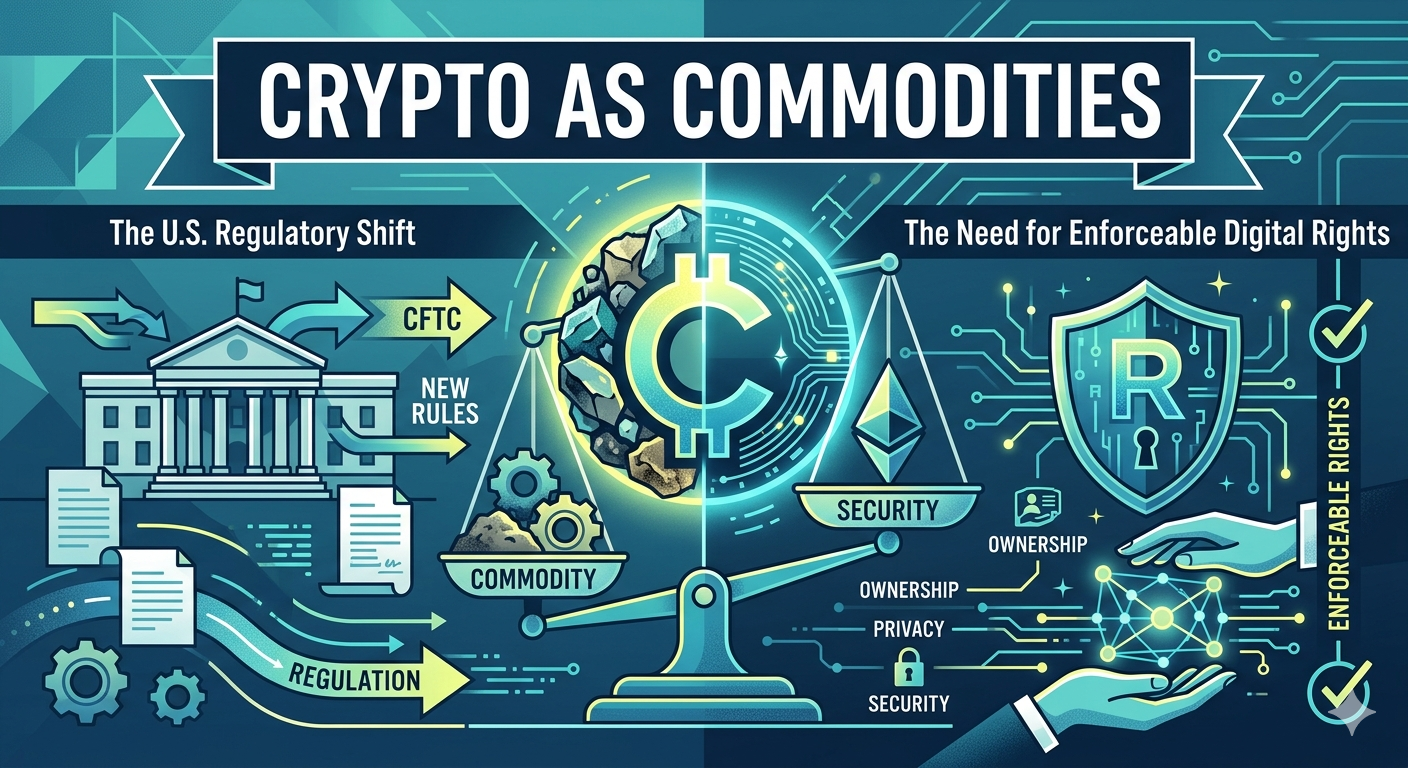
The End of the Securities-Centric Approach
The regulatory treatment of crypto assets in the United States is undergoing a structural transformation. For years, the dominant approach—driven largely by the Securities and Exchange Commission—consisted of analyzing crypto assets through the lens of securities law, applying the Howey Test to determine whether tokens qualified as “investment contracts.”
That approach is now being recalibrated.
The New Regulatory Paradigm
Recent regulatory signals and institutional coordination with the Commodity Futures Trading Commission point toward a new model: most crypto assets are not securities by default, but digital commodities. Securities law would apply only in specific contexts, primarily at the level of issuance, distribution, or financial structuring.
This is not a minor interpretative shift. It is a redefinition of the regulatory architecture governing the crypto economy.
From Asset Qualification to Transaction Qualification
The key legal evolution lies in the separation between the crypto asset itself and the legal relationship surrounding its issuance or commercialization.
Under this framework, a token such as Bitcoin or Ethereum is not inherently a security. It is treated as a digital commodity, whose value derives from the operation of a decentralized network rather than from the managerial efforts of a centralized issuer.
However, the same asset can be embedded within a legal structure that does qualify as a security, if the conditions of the Howey Test are met—particularly where there is a clear expectation of profit based on the efforts of identifiable promoters.
Reordering the Regulatory Map
The emerging framework can be summarized as follows:
- Assets → Commodities (default rule)
- Transactions → Potentially Securities (exception)
In practice, this shifts the focus of regulation away from the ontology of the token and toward the economic reality of the arrangement.
The Rise of the Commodity Framework
The growing role of the Commodity Futures Trading Commission reflects this transition. As the primary regulator of commodity derivatives and anti-fraud enforcement in spot markets, the CFTC is structurally better positioned to supervise decentralized markets where no central issuer exists.
By contrast, the Securities and Exchange Commission retains its historical role in overseeing capital formation and investment contracts, applying securities law where appropriate.
This evolution aligns with broader legislative efforts in the United States aimed at recognizing crypto assets as a distinct asset class, clarifying jurisdictional boundaries between agencies, and reducing regulatory uncertainty for institutional participants.
The Regulatory Gap: Code Executes, but Does Not Judge
Despite this progress, a fundamental problem remains unresolved.
Blockchain systems are designed to execute transactions with precision and finality. Smart contracts operate deterministically. Transfers are irreversible. Ownership is defined by control of private keys.
But none of these mechanisms address a core legal function: adjudication.
When a dispute arises—whether due to fraud, misrepresentation, governance abuse, or contractual breach—there is no native mechanism within the blockchain to interpret legal rights, assess evidence, or enforce corrective measures.
This creates a structural gap between execution and justice.
Toward a Dual-Layer System: Law Meets Code
The next phase of market infrastructure must address this gap.
If crypto assets are to function as commodities within a global, decentralized financial system, they require an embedded legal layer capable of resolving disputes efficiently, producing enforceable decisions, and interacting directly with on-chain systems.
The BACS Model: Dual Enforcement Architecture
The Blockchain Arbitration & Commerce Society promotes a model based on dual enforcement:
-
- Off-chain enforceability, through arbitration awards recognized under international frameworks such as the New York Convention
- On-chain execution, through integration with smart contracts, multisignature mechanisms, and token-level controls
This approach transforms dispute resolution from an external corrective mechanism into an integrated component of the digital asset itself.
The Legal Oracle: Bridging Law and Blockchain
At the core of this architecture lies the concept of the legal oracle.
A legal oracle is not merely a data source. It is a jurisdictional interface capable of translating legal determinations into executable outcomes on-chain.
This enables:
-
- tokens to incorporate dispute resolution clauses at issuance,
- smart contracts to recognize arbitration outcomes as triggers, and
- assets to be frozen, transferred, or reallocated in accordance with legally binding decisions
The principle is simple:
Code can enforce rules, but it cannot interpret them.
Law can interpret rules, but it cannot execute them automatically.
The legal oracle bridges this divide.
Conclusion: Commodities Require Courts
The recognition of crypto assets as commodities marks a decisive step toward their institutionalization. However, commodity markets—whether traditional or digital—cannot function without credible dispute resolution mechanisms.
The Institutional Equation
Without enforceability, there is no legal certainty.
Without legal certainty, there is no institutional capital.
The future of crypto markets will not be determined solely by how assets are classified, but by how rights are enforced.
The next phase of the industry is clear:
Not just programmable assets—
but enforceable digital rights.