

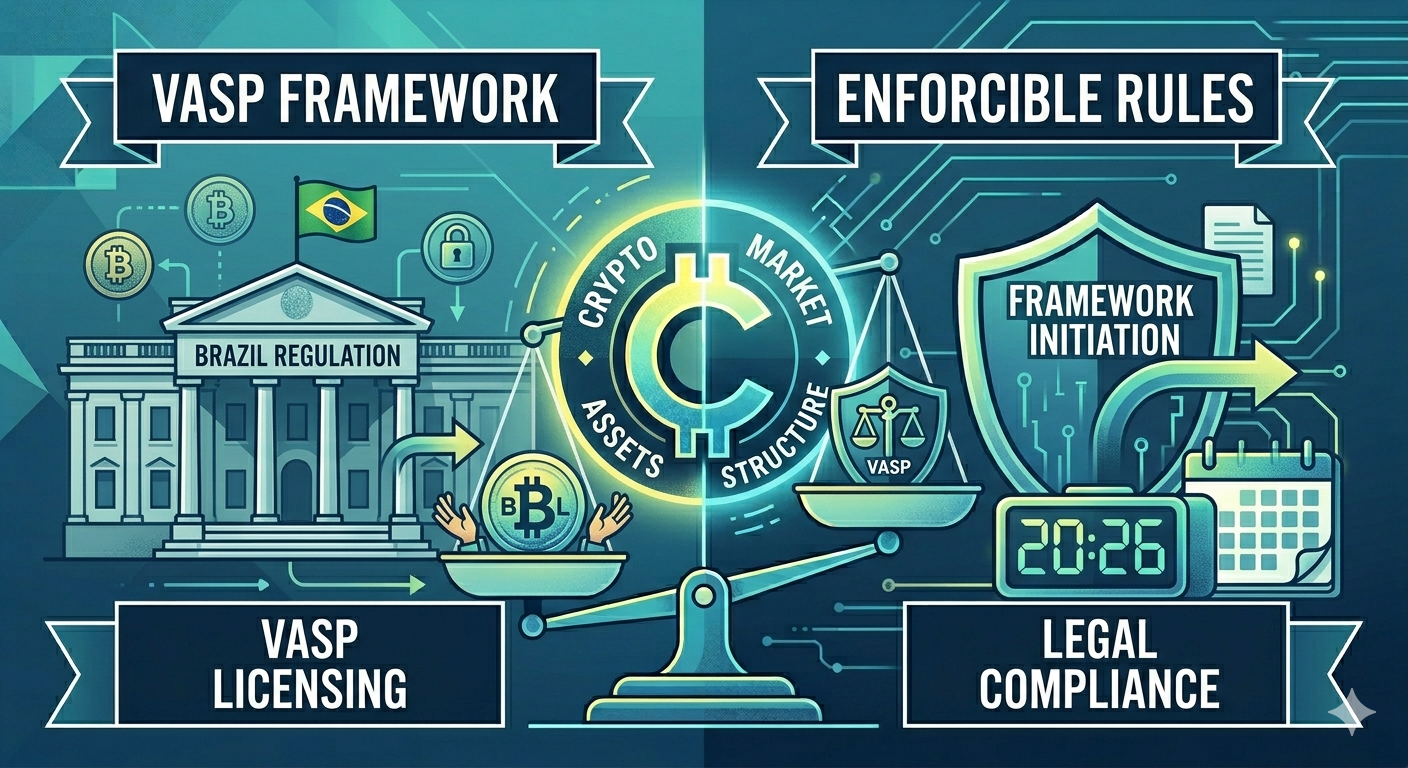
Brazil has taken a decisive step toward integrating crypto-assets into its financial system. By 2026, the country will have implemented one of the most structured regulatory frameworks in Latin America for Virtual Asset Service Providers (VASPs), positioning itself between the highly demanding European model under Markets in Crypto-Assets Regulation (MiCA) and the more fragmented approach seen in the United States.
Key Features of the New Regulatory Framework
The Brazilian model is built around four core pillars:
- Full Integration: VASPs are formally incorporated into the national financial system
- Centralized Supervision: The Banco Central do Brasil acts as the primary regulator
- Mandatory Licensing: All relevant crypto activities require prior authorization
- Hard Deadline: Existing operators must apply before October 30, 2026 or cease operations
This is not a light-touch regime. It is a structural shift that places crypto within the same regulatory perimeter as traditional financial institutions.
Regulatory Timeline: From Legal Recognition to Full Implementation
Brazil’s approach has been gradual but deliberate:
- 2022 – Law 14.478/2022
Establishes the legal foundation for virtual asset services - 2023 – Decree 11.563/2023
Officially designates the Banco Central do Brasil as the main supervisory authority - 2025–2026 – Secondary Regulation
Detailed technical, operational, and prudential requirements are developed - October 30, 2026 – Critical Deadline
Existing companies must submit authorization requests or exit the market
The Central Bank as the Core of the System
Brazil’s regulatory architecture is notable for its clarity. Authority is concentrated in two institutions:
- Banco Central do Brasil
Responsible for licensing, prudential supervision, custody rules, and payment operations - Comissão de Valores Mobiliários
Oversees capital markets and intervenes when crypto-assets qualify as securities
This dual structure avoids regulatory overlap while ensuring that crypto-assets are treated as financial infrastructure rather than a peripheral innovation.
Mandatory Licensing and Institutional-Level Requirements
One of the most significant changes is the introduction of a compulsory licensing regime. Any entity providing exchange, custody, brokerage, or settlement services must obtain authorization from the central bank.
The process is divided into two phases:
- Phase 1: Formal verification of corporate structure, capital adequacy, and management reputation
- Phase 2: Full assessment of the business model, underlying technology, cybersecurity systems, and AML/CFT compliance
The requirements are substantial:
- Up to 36 months to obtain a license
- Significant minimum capital requirements (estimated in the tens of millions of BRL)
- High annual operational costs driven by compliance and infrastructure
In practice, this creates a high barrier to entry, favoring well-capitalized operators and financial institutions.
Three Regulatory Pathways
Brazil does not impose a single route to compliance. Instead, it introduces a flexible system depending on the type of actor:
- New Entrants
Must complete the full authorization process before launching operations - Existing Companies
Benefit from a transition period but must fully comply by October 2026 - Banks and Financial Institutions
Can integrate crypto services through simplified certification procedures
This last category is particularly important. By lowering entry barriers for traditional financial institutions, Brazil is actively encouraging the convergence between banking and digital assets.
A Controlled Transition into the Financial System
Brazil’s message is clear: crypto-assets are no longer a parallel market.
They are becoming part of regulated financial infrastructure.
However, this is not a full absorption. What Brazil is building is a hybrid model:
- Digital assets retain their technological nature
- But their operation is increasingly subject to centralized oversight
This reflects a broader global trend: the transition from pure “digital law” systems—native to blockchain networks—toward supervised digital frameworks embedded within state-controlled financial systems.
Implications for the Global Market
Brazil’s framework has three major consequences:
- Institutionalization of the crypto sector in Latin America
- Acceleration of bank participation in digital asset markets
- Increased compliance costs that may exclude smaller or decentralized actors
In this sense, Brazil mirrors, at a regional level, the structural effects already observed under Markets in Crypto-Assets Regulation (MiCA) in Europe.
Conclusion: Toward a Hybrid Financial Order
Brazil is not attempting to suppress crypto-assets. It is redefining them.
By integrating VASPs into its financial system under centralized supervision, the country is constructing a hybrid financial architecture where blockchain-based assets and traditional finance coexist under a unified regulatory framework.
This model represents a transitional stage in the evolution of the “Internet jurisdiction”: from autonomous digital systems toward regulated environments where code and law increasingly intersect.
BACS Perspective
For operators, exchanges, and financial institutions, the Brazilian framework creates both opportunity and complexity.
Navigating licensing, structuring compliant operations, and ensuring enforceability of digital asset transactions will require specialized legal and technical expertise.
BACS provides advisory and structuring services for VASP licensing in Brazil, as well as dispute resolution mechanisms adapted to digital assets, combining off-chain legal enforceability with on-chain execution.