

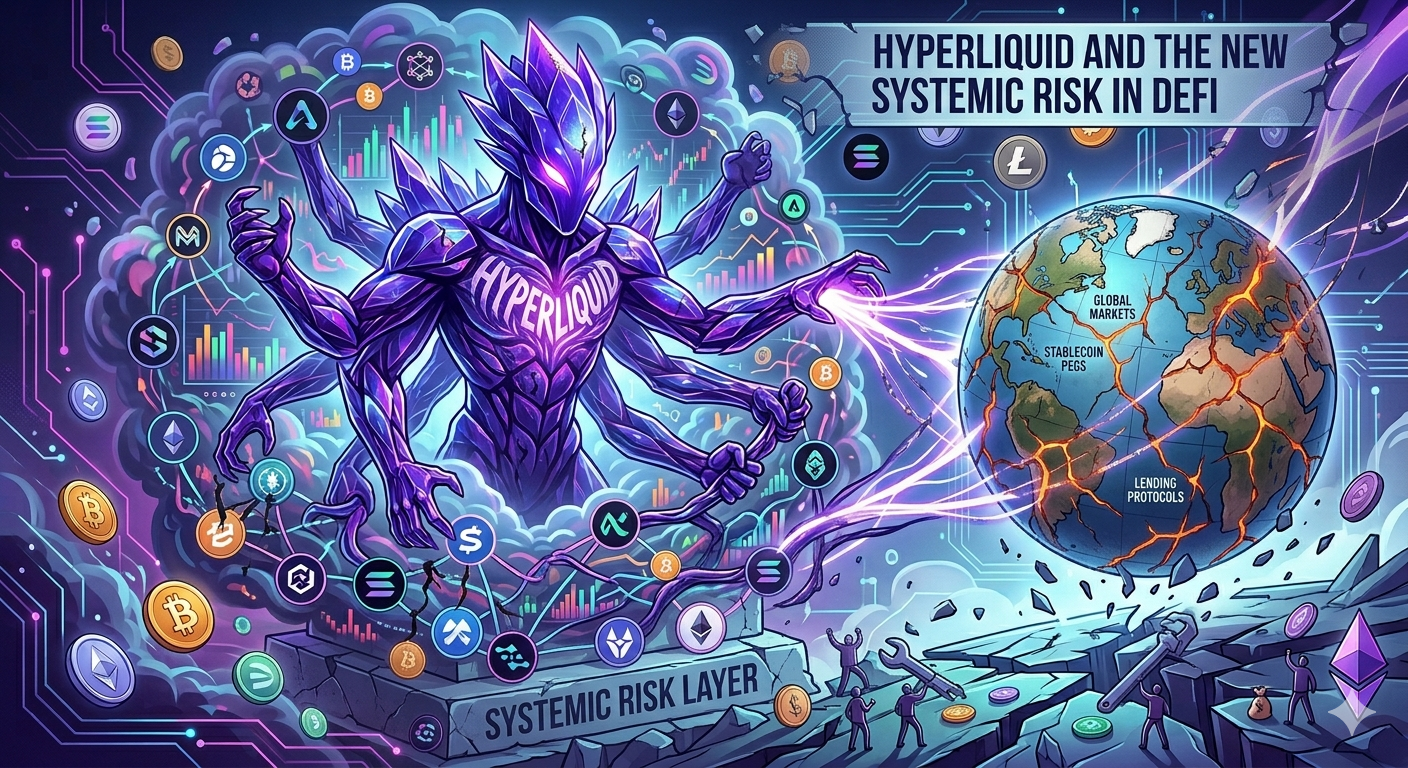
The growth of the crypto ecosystem has never been linear. It has advanced in cycles marked by innovation… and by crises. Each collapse has revealed a different weakness: custody, governance, fraud, or technical architecture. Today, the focus shifts to a new actor: Hyperliquid.
The question is no longer whether Hyperliquid is relevant. The real question is whether its growth can turn it into a new point of systemic risk within the market.
From Mt. Gox to FTX: a history of structural failures
To understand the current moment, it is worth looking back. The ecosystem has evolved through crises:
- 2014: collapse of Mt. Gox → exposed the risks of centralized custody
- 2016: hack of The DAO → revealed vulnerabilities in smart contracts
- 2022: fall of FTX → demonstrated risks of fraud and opacity
Each event reinforced a narrative: removing intermediaries reduces risk. But that thesis is now starting to be questioned.
Hyperliquid: the DEX that behaves like a CEX
Hyperliquid is not a traditional DEX. It does not follow the AMM model popularized by Uniswap. Instead, it introduces an architecture closer to traditional financial markets:
- On-chain order book (real order book)
- Ultra-fast execution on its own L1
- Perpetual futures as the main product
- High leverage
- No custody and no intermediaries
The result is a hybrid: the experience of a centralized exchange, but without the exchange.
And that changes the rules of the game.
The real risk: derivatives without human control
The core issue is not Hyperliquid itself, but what it represents: the combination of highly leveraged derivatives with fully automated systems.
In traditional markets—and also in many CEXs—there are containment mechanisms:
- Insurance funds
- Manual intervention
- Market halts
In Hyperliquid, there are none.
Here, the system operates under a different logic:
code executes automatically. It does not interpret. It does not moderate. It does not correct.
This introduces a new concept: programmed systemic risk.
What would happen in a failure scenario?
An error in smart contracts, a failure in the liquidation system, or a coordinated attack (such as those associated with groups like Lazarus Group) could trigger chain reactions:
- Cascading liquidations in derivatives markets
- Sharp price drops in assets with high exposure
- Contagion to other DeFi protocols
- Loss of confidence in the on-chain model
- Indirect impact on institutional markets
It would not be a total collapse of the ecosystem. But it would be a significant stress event.
Can Hyperliquid bring down the market?
Not in absolute terms.
The crypto market of 2026 is more robust, more diversified, and more institutionalized than in 2022. But that does not mean it is immune.
Hyperliquid can:
- Amplify volatility
- Accelerate downward trends
- Expose structural weaknesses
- Generate a localized systemic event within DeFi
In other words: it does not destroy the system, but it can destabilize it.
The real problem: not technical, but legal
Here lies the key issue.
The biggest limitation of DeFi is not technology. It is the absence of an integrated legal layer.
In environments like Hyperliquid:
- There is no transaction reversal
- There is no asset freezing
- There is no effective judicial enforcement
- There are no dispute resolution mechanisms
This creates a paradox: systems capable of moving billions in seconds… but incapable of resolving conflicts.
Recent cases such as the exploit in Drift Protocol show this clearly: even without a “classic” hack, the economic outcome can be devastating, and recovery mechanisms are limited or non-existent.
The next step: enforcement on the blockchain
If the first cycle was monetary (Bitcoin) and the second was financial (DeFi), the third will inevitably be legal.
The ecosystem needs:
- Dispute resolution mechanisms
- The ability to freeze or recover assets
- Integration between legal contracts and smart contracts
- Hybrid execution systems (on-chain and off-chain)
This is where proposals like Blockchain Arbitration & Commerce Society introduce a key piece: an infrastructure capable of connecting the automatic execution of code with real legal enforcement.
This is not an optional layer. It is a necessary condition for the system to scale without breaking.
Conclusion: Hyperliquid as a symptom
Hyperliquid is not the problem.
It is the symptom of where the market is evolving: more efficiency, more speed, more disintermediation… but also more complexity and more systemic fragility.
The question is no longer whether there will be another stress event in DeFi.
The question is whether, when it happens, the system will be prepared to resolve it.
Today, the answer remains uncomfortable:
Code executes.
But the system still does not know how to deliver justice.