

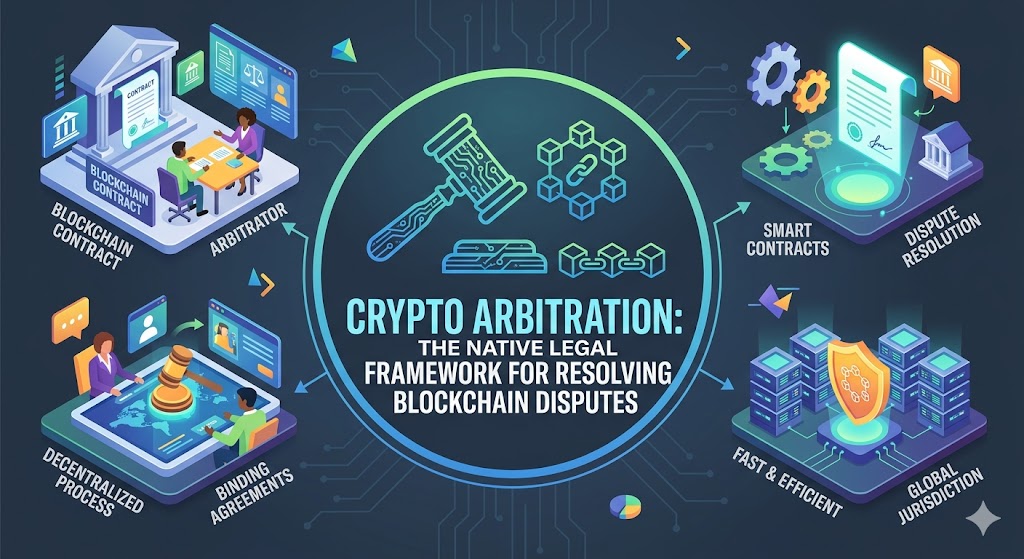
The blockchain ecosystem has evolved from a technological promise into a global economic infrastructure.
However, this growth has brought with it a structural problem: conflicts. From rug pulls to disputes within DAOs, to disagreements over smart contracts or conflicts regarding tokens, the so-called “Internet jurisdiction” requires effective dispute resolution mechanisms.
This is where crypto arbitration emerges as a new legal layer, a native solution designed for a borderless world.
The Problem: Conflicts in a Borderless Environment
The traditional model of law is based on a clear premise: there is a jurisdiction, a competent judge, and an applicable law. But in the crypto world, these three variables become blurred, creating a paradox: systems that are extremely efficient at executing agreements but extremely limited in resolving conflicts.
Problems that traditional dispute arbitration cannot resolve:
1.- Global: A protocol may be deployed across multiple jurisdictions simultaneously.
2.- Anonymous: Participants may be anonymous or use pseudonyms, making identification difficult.
3.- Irreversible: Transactions are automatic and immutable, with no “undo” button.
Common examples of these conflicts include:
✓ Rug pulls: developers who abandon projects after raising funds.
✓ Conflicts in DAOs: contested votes or governance takeovers.
✓ Smart contract errors: unintended executions due to code flaws.
✓ Disputes over asset tokenization: poorly defined or unfulfilled economic rights.
In this context, turning to state courts is not only inefficient but often unfeasible.
The solution: arbitration built into the blockchain itself
El crypto arbitration propone una solución radical: integrar la resolución de disputas dentro del propio sistema tecnológico. No se trata simplemente de aplicar el arbitraje tradicional al mundo cripto, sino de ir un paso más allá: convertir el arbitraje en una infraestructura nativa de la blockchain.
BACS proposes a radical solution
Integrating dispute resolution within the technological system itself. It is not simply a matter of applying traditional arbitration to the crypto world, but of going one step further: making arbitration a native infrastructure of the blockchain.
Comparison: Traditional Justice vs. Crypto Arbitration
Speed
Traditional (Months/Years)
Crypto (Days/Weeks)
Enforceability
Traditional (Complex, cross-border)
Crypto (Automated, on-chain)
Adaptability
Traditional (Slow, precedent-based)
Crypto (Native, tech-savvy)
This implies a fundamental shift: arbitration clauses embedded in smart contracts, procedures tailored to digital assets, voluntary jurisdiction based on the consent of the code, and, most importantly, the automatic enforcement of awards through on-chain mechanisms.
In other words, arbitration is no longer external to the system but becomes part of the protocol itself.
From “Code is Law” to “Law is Executable Code”
For years, the crypto world has operated under the “code is law” paradigm: the code automatically executes what has been agreed upon, without interpretation.
But reality has shown that code does not eliminate conflict; it merely displaces it. Crypto arbitration introduces a conceptual evolution: not only is code law, but law can be executed as code.
Paradigm 1: “Code is Law”
The initial phase of blockchain. Code is the sole source of truth, and its execution is final. Automation is prioritized over fairness, leading to vulnerabilities and irresolvable conflicts.
Paradigm 2: “Law is Executable Code”
The necessary evolution. Legal principles (equity, interpretation) are integrated into the system. An arbitrator’s decisions are translated into executable on-chain code, combining legal certainty and technological efficiency.
BACS: Arbitration as a Tribunal and as a Legal Oracle
In this context, initiatives such as the Blockchain Arbitration & Commerce Society (BACS) represent a decisive step toward this new legal layer. BACS positions itself not only as an international arbitration tribunal but also as a legal oracle capable of bridging the traditional legal world with the blockchain world.
Profile: Blockchain Arbitration & Commerce Society (BACS)
Founded: 2019
Headquarters: Madrid, Spain
Mission: To provide a native dispute resolution layer for the digital economy and Web3.
Website: bacs.
Social Media: LinkedIn | X (Twitter)
This dual level is key: the arbitral award is not only legally valid and enforceable under international conventions (such as the New York Convention), but it can also be executed directly within the digital infrastructure where the dispute arises, through smart contracts, wallets, multisigs, or custody systems.
Why is crypto arbitration inevitable?
The history of international trade offers a clear precedent: lex mercatoria. Before states regulated global trade, merchants themselves developed their own rules and dispute resolution mechanisms. Today we are seeing a similar phenomenon, but in a digital form.
The Web3 economy has created:
-New assets (tokens, NFTs)
-New economic relationships (DAOs, DeFi)
-New risks (hacks, exploits)
-And, inevitably, new forms of justice
Crypto arbitration is not a theoretical option, but a functional necessity of the system.
Conclusion: Justice as a Layer of the Protocol
If blockchain represents a new jurisdiction—the jurisdiction of the Internet—then it needs its own justice system. Crypto arbitration is precisely that: a native legal layer, designed to operate in decentralized, global, and automated environments.
Key Points
In this new paradigm, the question is no longer whether conflicts will exist, but how they will be resolved. The answer points to a model where law is embedded in code, arbitration becomes infrastructure, and justice ceases to be external to become part of the system itself. That is where digital law truly begins.