

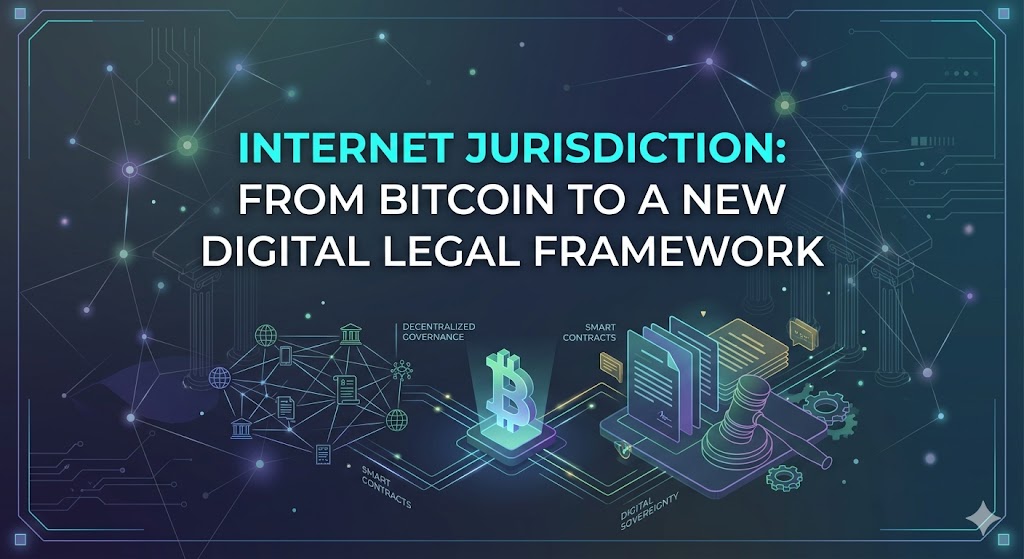
In 2009, something unprecedented emerged. It was not just a new technology, nor merely a new form of money. With the creation of Bitcoin, a new jurisdiction was born: the jurisdiction of the Internet.
For centuries, law has been tied to territory. States created rules, enforced them within their borders, and monopolized the administration of justice. But Bitcoin introduced a radically different paradigm. It operates globally, without the need for permission and according to rules that are not written in statutes, but in code. These rules are not enforced by courts, but by a distributed network of nodes.
Key Takeaways from the article:
▶ Bitcoin ushered in a new legal paradigm based on code, independent of territorial boundaries.
▶ Platforms like Ethereum serve as legislative infrastructures for creating programmable rules (smart contracts).
▶ DeFi protocols function as autonomous legal systems, creating a new
digital lex mercatoria.
▶ Governments are reacting in different ways: integration (U.S.), regulation (EU), and control (China).
▶ The fundamental issue is not technological, but institutional: who will govern this new jurisdiction?
This is the central idea explored in the book “Bitcoin Digital Law: why cryptocurrencies are digital laws of the Internet Jurisdiction”. Cryptocurrencies are not merely financial assets; they are digital laws. They define rights, obligations, and enforcement mechanisms within a new, non-territorial legal framework.
From Bitcoin to Digital Regulatory Frameworks
Bitcoin was just the beginning. With the emergence of the Ethereum blockchain platform, the concept evolved even further. Smart contracts enabled the creation of programmable rules: self-executing legal relationships that do not require intermediaries.
Platforms such as Ethereum, Cardano, and Solana act as legislative infrastructures within this new jurisdiction, allowing anyone to deploy rules that govern economic interactions.
The New Lex Mercatoria of the Internet
This evolution has given rise to what can be described as a new lex mercatoria of the Internet. Decentralized finance (DeFi) protocols such as Uniswap, Aave, and Curve Finance operate as autonomous legal systems.
They define how assets are exchanged, how credit is issued, and how risk is managed, without relying on traditional legal institutions.
At the same time, stablecoins such as Tether (USDT) and USD Coin (USDC) introduce a new dimension: the tokenization of sovereign currencies. These instruments act as private extensions of monetary systems, bridging the gap between traditional finance and the jurisdiction of the Internet.
Timeline:
2009: The Origin
Birth of Bitcoin. The first system of digital rules enforced by a decentralized network is established.
2015: Programmability
Launch of Ethereum, introducing smart contracts and enabling the creation of programmable laws.
2017–2020: The DeFi Boom
Key protocols such as Aave and Uniswap emerge and gain traction, creating autonomous financial systems.
2023–Present: The State Response
Governments respond with regulatory frameworks (MiCA in the EU) and integration tools (Bitcoin ETFs in the U.S.).
The Coexistence and Adaptation of States
What we are witnessing is not the disappearance of the state, but the emergence of a parallel legal framework. This new jurisdiction does not replace national law, but coexists with it. However, its efficiency and global reach create a powerful incentive for states to adapt.
The response of major geopolitical actors clearly reveals this shift. The United States is integrating this new jurisdiction into its financial system through instruments such as Bitcoin ETFs and stablecoin legislation. The European Union, through frameworks such as MiCA, is focused on regulating and controlling it. China, for its part, is developing state-controlled digital infrastructures, such as the digital yuan.
Institutional Disruption: Who Will Govern?
This divergence reflects a deeper question: Who will shape the rules governing the Internet? Because, ultimately, the most disruptive aspect of this new legal framework is not technological, but institutional. For the first time, communities can create, enforce, and adjudicate rules natively within a digital environment.
This opens the door to new forms of governance and dispute resolution. Institutions such as blockchain-based arbitration systems—capable of issuing enforceable decisions both under international law and directly on-chain—represent the next step in this evolution.
The Internet is no longer just a space for communication or commerce. It is becoming a space of law.
And as history has shown, where there is law, there is jurisdiction.
The question is no longer whether Internet jurisdiction exists.
The question is who will govern it.
Also explained in Trplane.com