

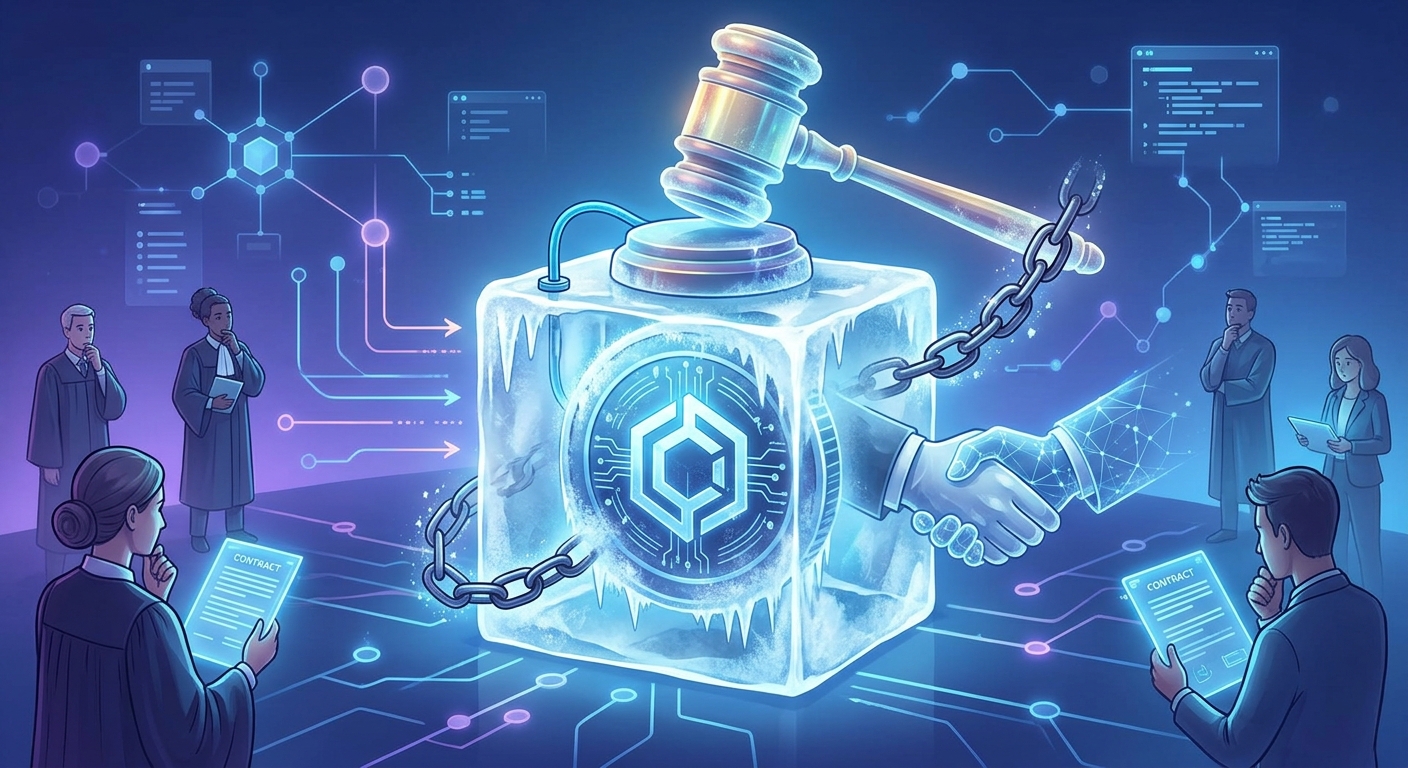
Yes. But a legal decision ordering the freezing of an asset is one thing; the existence of a technical mechanism to enforce that decision is another. The token’s architecture determines how the order can be enforced, not whether the asset falls outside the reach of the law.
An investor loses their cryptocurrencies as a result of fraud. The funds are transferred to another address and remain there, visible on the blockchain. A court orders them to be frozen. Can that order be enforced?
Two questions must be separated. They are often considered together, but belong to different spheres: whether there are legal grounds for ordering the freezing, which is a question of law, and whether there are means of enforcing it, which depends on the architecture of the asset and on who has the ability to act upon it.
The first requires verification of the legal conditions for the measure. The second determines how it can be made effective, and that is what this article seeks to examine.
1. What Does It Legally Mean to Freeze a Token?
Freezing does not mean destroying an asset, transferring it to an authority or permanently depriving its holder of their rights. It means temporarily preventing or restricting the disposal of the asset, for purposes that may be very different: preserving property during proceedings, preventing the disappearance of assets allegedly obtained through fraud, complying with international sanctions or ensuring the effectiveness of a future decision.
Three operations should be distinguished, as they are not equivalent. Freezing prevents an asset from being transferred or used for a certain period. Attachment subjects the asset to a protective or enforcement measure under the applicable procedural law. And compulsory transfer moves the asset to another address or holder as a consequence of an enforceable decision and the mechanisms necessary to implement it.
A token may be blocked without any change of ownership. And a decision recognising someone’s right to recover an asset does not, by itself, produce its transfer.
2. The Short Answer: Architecture Determines How the Decision Is Enforced
Before examining the assets, it is worth stating the conclusion, because it provides the framework for everything that follows.
The technical ability to freeze an asset determines how a legal decision may be enforced. Where someone has the power to block it — an issuer, a custodian or an administrator — there may also be an identifiable person or entity to whom an order can be addressed, provided that person or entity is legally obliged to comply.
Where that power does not exist, the order cannot be enforced through an administrative blocking function. But that does not mean that it has no addressee or that the asset is legally beyond reach. It may be directed against the person controlling the private keys, against an intermediary involved at a later stage or against other persons required to cooperate under the applicable legal system.
An important distinction therefore arises. A technically freezable token facilitates certain forms of enforcement and, for the same reason, is exposed to the risk of unjustified freezing. An asset held in self-custody, without an administrative blocking function, offers greater resistance to such direct intervention, but may also be more difficult to recover when a legitimate decision orders its restitution.
This is not an absolute choice between protection from authorities and the possibility of recovery. It is a matter of understanding which enforcement mechanisms exist and what their limits are.
British legislation provides an example of this distinction. The Economic Crime and Corporate Transparency Act 2023 introduced Chapter 3D into Part 5 of the Proceeds of Crime Act 2002, establishing the crypto wallet freezing order under sections 303Z36 and following. This specific mechanism applies to wallets administered by cryptoasset service providers that meet the relevant statutory requirements.
The intermediary is not a minor procedural detail: it is the addressee that makes this type of order effective. However, the existence of this regime does not exclude other legal measures against those controlling assets held in self-custody.
3. Bitcoin Versus a Stablecoin
With this in mind, the difference between assets ceases to be exclusively technical and acquires legal consequences.
In Bitcoin, there is no central issuer capable of placing an address on a list and blocking its coins through an administrative function of the protocol. If the user has exclusive control of their keys, a court order does not, by itself, modify the operation of the network.
This does not make Bitcoin immune from attachment: a court may adopt measures against the holder, order the delivery of keys or assets where appropriate, act upon assets held by intermediaries and use the enforcement mechanisms available under the applicable legal system. The difficulty does not necessarily lie in the legal possibility of ordering the measure, but in making it effective.
With certain stablecoins, the situation is different because the smart contract may incorporate administrative functions that restrict transfers associated with specific addresses. Circle provides in its terms and policies for address-blocking mechanisms and restrictions on USDC transfers, while Tether provides for freezing mechanisms linked to certain legal and compliance circumstances.
An address may therefore retain a balance that remains perfectly visible on the blockchain while being technically prevented from transferring it. The network continues to operate; what is restricted is that particular asset.
The consequence matters more than it may seem: the decentralisation of the underlying blockchain does not mean that tokens issued on it lack control mechanisms. These are two different layers, and they are constantly confused.
4. Who Can Order the Freezing?
The existence of a blocking function does not determine who may legitimately use it, and the different situations are not of the same nature.
Judicial authorities may order interim measures, attachments or other restrictions on property within their jurisdiction and in accordance with the applicable procedure. Administrative authorities and sanctions regimes may impose asset-freezing obligations or restrictions on transactions involving sanctioned persons and entities.
Token issuers may restrict transfers in the circumstances provided for in their terms, policies and legal obligations. Custodians and intermediaries may also be required to freeze assets under their control upon receiving a valid order or in order to comply with certain legal duties.
The difference in legal nature is what is often overlooked. A judicial decision is an act of authority subject to safeguards. A measure adopted by an issuer may arise from a legal obligation, a contractual power or an internal policy.
The fact that a function exists in the code does not mean that its use is legitimate in every circumstance. The rights of those affected, the proportionality of the measure and the available means of seeking its review must all be considered.
5. Effective Control and the Route Through Conversion Points
Suppose that a court orders certain tokens to be frozen.
If they are held in custody by an entity capable of preventing their transfer, the order may be enforced through the actions legally required of that intermediary.
In the European Union, that intermediary is subject to specific regulatory obligations. Article 70 of Regulation (EU) 2023/1114 requires cryptoasset service providers to take appropriate measures to safeguard their clients’ ownership rights, particularly in the event of insolvency, and to prevent the use of clients’ cryptoassets for their own account.
The same provision establishes specific obligations regarding clients’ funds, other than e-money tokens, including their deposit with certain institutions and their separate identification, subject to the exceptions provided for in the legislation.
MiCA does not create a general power to freeze assets. However, obligations relating to the safeguarding and segregation of assets may facilitate the identification of the intermediary and the positions affected, which is relevant to the enforcement of certain measures.
If the token incorporates a blocking function controlled by its issuer, the measure may be technically enforced through that function, provided that there is an appropriate legal or contractual basis and that the competent operator is able to use it.
And if the assets are held at a self-custody address and the protocol does not allow administrative blocking, the situation changes fundamentally. The court may order the holder to refrain from transferring them, but that prohibition does not prevent a valid transaction from being signed and broadcast.
This leads to a formulation worth remembering: the legal obligation not to transfer an asset is not equivalent to the technical impossibility of transferring it.
A person may breach a court order and move the funds, with the legal consequences arising from that breach, but with the funds already transferred.
However, it is too often concluded from this observation that nothing can be done against a self-custody holder. That is not correct.
One practical route for intervention lies at conversion points. When the holder seeks to convert the assets into traditional money through regulated platforms or intermediaries, identified accounts, banking relationships and entities subject to legal obligations may come into play.
In such cases, action may be directed against the intermediaries or against the funds resulting from the conversion.
The asset is not necessarily frozen within its original protocol: its conversion may be restricted, or action may be taken against the proceeds.
Nor is this route universal. Assets may be transferred directly between individuals, used as a means of payment or circulated without passing through an identified intermediary. But it demonstrates that the absence of a freezing function does not eliminate every legal possibility of intervention.
6. If the Tokens Have Already Been Transferred
Freezing and recovery are different problems. A blocking function may prevent future transfers without reversing transactions that have already been confirmed.
If the assets have been moved, it will be necessary to identify the addresses, reconstruct the transactions and determine who controls them. The traceability of many blockchains facilitates this process, but does not guarantee identification of the holders, and the assets may have been exchanged for other tokens, moved between networks or deposited with intermediaries in different jurisdictions.
What is often missing from the analysis is the legal question, which is decisive: traceability tells us where the asset is, not whether it can be recovered.
For that, it is necessary to determine whether the claim follows the asset into the hands of its current holder — a proprietary claim — or is limited to a claim for value against the person who misappropriated it — a personal claim — and what protection should be afforded to a good-faith purchaser who received it for value without knowing its origin.
The answer varies according to the legal system and determines whether tracing serves a practical purpose or merely provides information.
7. Arbitration and Interim Measures Concerning Tokens
The issue becomes more acute in contractual disputes. Two companies agree to develop a protocol and deposit tokens in a shared treasury. A dispute arises, and one of them intends to transfer the tokens before the dispute is resolved. Can an arbitral tribunal intervene?
It can, and to a greater extent than is often recognised.
The 2006 version of the UNCITRAL Model Law on International Commercial Arbitration devotes Chapter IV A to interim measures and preliminary orders, Articles 17 to 17 J.
Article 17 H provides for interim measures issued by arbitral tribunals to be recognised as binding and enforced, upon application, by the competent court, irrespective of the country in which they were issued, unless otherwise provided by the arbitral tribunal and subject to the applicable grounds for refusal.
Article 17 I establishes the grounds on which recognition or enforcement may be refused and limits judicial review of the merits of the measure.
Its specific application naturally depends on each State’s legislation and on whether this regime has been incorporated into its legal system. Nor should it be confused with the recognition of final arbitral awards under the 1958 New York Convention: these are matters governed by different rules.
It cannot therefore be said that there is no procedural route at all. The 2006 Model Law provides a response to the recognition and enforcement of arbitral interim measures in legal systems that have adopted that regime.
However, an arbitral tribunal does not possess its own coercive powers and may require the intervention of the competent court.
Furthermore, the arbitration agreement does not automatically bind issuers, custodians or developers who are not parties to it, although other legal grounds may exist for requiring them to take certain actions.
The architectural difficulty remains: identifying who can materially enforce the measure over the digital assets.
8. The Legal Oracle: From Decision to Function
This is where the issue that concerns us at BACS arises.
Traditionally, a judicial or arbitral decision is addressed to persons obliged to comply with it. In blockchain, some economic relationships are executed through smart contracts that operate without human intervention in each transaction.
Can a legal decision therefore become an executable instruction?
A legal oracle is the mechanism connecting a decision adopted through a procedure with a function provided for in a smart contract.
If the token incorporates a freezing function, the system may be designed so that it is activated when certain legal conditions are verified: the existence of a decision issued by a competent authority or an arbitral interim measure binding on the parties.
The essential point is the division of responsibilities, which can be expressed as a rule: the oracle verifies; it does not adjudicate.
It checks the authenticity and continuing validity of a decision according to rules established in advance and transmits it to the relevant function. It does not decide the dispute, assess the evidence or replace the tribunal and its procedural safeguards.
If the oracle is given the power to assess independently whether the legal conditions for a measure are satisfied, there is a risk of transferring a decision-making function to a mechanism that lacks the safeguards of the corresponding procedure.
This rule gives rise to design decisions, all of which must be resolved before anything is deployed: which types of decisions activate the function and which authorities may issue them; who verifies authenticity and on the basis of what evidence; who is entitled to request activation; how an incorrect action may be challenged and before whom; under what conditions the measure is lifted; and what happens in the event of conflicting orders, revoked decisions or technical failures.
Automating a measure does not eliminate the need for legal grounds, jurisdiction and safeguards: it also moves them to the design stage.
9. The Opposite Risk and the Safeguards Already Established by Law
The ability to freeze assets carries its own risks.
If an issuer can unilaterally block any address, the holder is dependent on a power of intervention that may seriously affect their rights: an unjustified freezing may prevent payments, transactions and the exercise of property rights.
That power may be necessary to comply with legal obligations or prevent unlawful activities, but it may also be misused.
There is no need to imagine every safeguard from scratch, because legislative models already exist.
The British legislation mentioned above subjects crypto wallet freezing orders to requirements, time limits and review mechanisms. Under the conditions established by law, its regime provides for the possibility of authorising certain exclusions for expenses and activities, as well as varying or discharging orders.
These safeguards demonstrate that freezing should not be conceived as an unlimited power.
And this is what should be required of any private infrastructure incorporating an equivalent function: identified authorised persons, clearly defined grounds for blocking, proportionate duration, a verifiable record of actions, a review procedure and express conditions for lifting the measure.
A power to freeze without appropriate time limits, defined grounds or an effective means of challenge constitutes a significant legal risk for the holder.
Conclusion
Yes, a token may be subject to freezing, attachment or restrictions on its disposal where there are legal grounds and the applicable requirements are satisfied.
What depends on the architecture of the asset is the possibility of enforcing that measure directly on the blockchain: in some cases the issuer may intervene, in others the custodian, and where there is no administrative freezing mechanism, enforcement may require action against the person controlling the keys or against intermediaries involved in its circulation.
A legally valid order is not necessarily a technically executable order.
Conversely, an asset that cannot be frozen directly on the blockchain may still be subject to a legal decision, although its recovery may depend on the possibility of acting against those who control it or against intermediaries.
For this reason, when designing a stablecoin, a tokenised financial instrument or a digital treasury, it is not enough to establish who owns the assets and which law governs the contracts.
It is also necessary to determine what happens when a tribunal orders those assets to be frozen, transferred or returned: who receives that order, under what authority it is carried out, within what timeframe and how the decision can be reviewed if an error occurs.
Legal and technological infrastructure must be designed together, or they will not function effectively.
The challenge is not merely to recognise rights over tokens. It is to ensure that decisions protecting those rights can be enforced, without abandoning the safeguards that make them legal decisions rather than mere technical instructions.
Institutional note: BACS (Blockchain Arbitration & Commerce Society) is a non-profit association registered in the European Union Transparency Register under number 9106897105368-14. It has established BACSIT, an international arbitration tribunal that administers proceedings under its own rules. This article is general in nature and does not constitute legal or regulatory advice for any specific case.
Legal and documentary sources:
- Regulation (EU) 2023/1114 (MiCA), Article 70.
- UNCITRAL Model Law on International Commercial Arbitration, as amended in 2006, Chapter IV A, Articles 17 to 17 J, particularly Articles 17 H and 17 I.
- 1958 New York Convention on the Recognition and Enforcement of Foreign Arbitral Awards.
- United Kingdom, Proceeds of Crime Act 2002, Part 5, Chapter 3D, sections 303Z36 and following, introduced by the Economic Crime and Corporate Transparency Act 2023.
- Circle, USDC terms and address-blocking policy.
- Tether, terms of service and asset-freezing policies.