

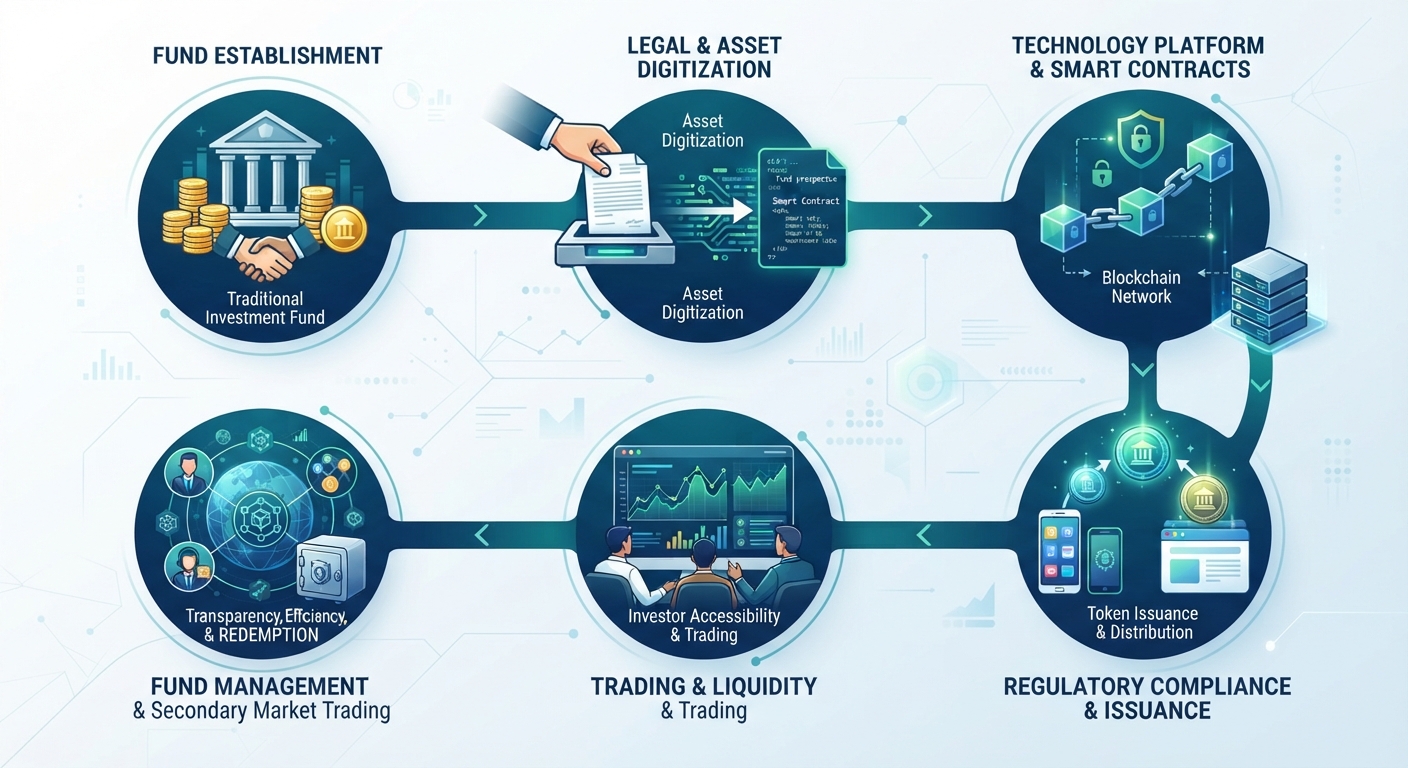
Tokenising a fund means deciding which record establishes ownership, who is responsible for maintaining it and how investors can enforce their rights. The United States, Spain and Hong Kong illustrate different decisions an asset manager must make before launching the product.
In No. 18 of this series, we looked at where to establish a tokenised fund. Once the domicile has been chosen, the operational work begins. Can a blockchain entry establish who owns the units? Who is responsible if a holding is recorded incorrectly? What happens if an investor loses access to their wallet or an authority orders the attachment of their units?
These questions should be answered before choosing a network or writing a smart contract. The answers determine who can update the register, under what conditions and with what effect on the investor’s rights.
1. What does the token establish?
The first decision is whether the token legally represents a fund unit or reflects a holding recorded in a separate register. The two structures may look the same in an investor’s app. The difference becomes decisive when a transfer needs to be established, a balance corrected or a redemption entitlement determined.
The fund documentation should identify the legally recognised register, who maintains it and when an entry takes effect. If an intermediary holds the position, the documentation should also specify who appears on the fund register and how the end investor establishes their entitlement against that intermediary.
In the European Union, units that qualify as financial instruments fall outside MiCA under Article 2(4)(a). The manager must identify the rules that apply to the fund, its marketing and any investment services provided. Markets in Crypto-Assets Regulation (MiCA)
2. Who maintains the register?
United States. For the Franklin OnChain U.S. Government Money Fund, Franklin Templeton Investor Services (FTIS) maintains the official ownership record, known as the master securityholder file, through a blockchain-integrated system. The prospectus describes a system that operates on a public network and restricts transactions to authorised wallets. The transfer agent can correct errors and unauthorised transactions and restrict transfers. Fund prospectus · Franklin’s submission to the SEC
On 12 August 2026, staff of the SEC’s Division of Investment Management said they would refrain from recommending enforcement action under Section 17(f) of the Investment Company Act and Rule 17f-2 in a specific arrangement, based on the facts and representations submitted. The arrangement concerned FTIS’s custody of shares in the OnChain Fund acquired by other Franklin funds. The safeguards included segregated accounts and a separate wallet for each investing fund, limits on who could issue instructions, daily reconciliation and at least three independent verifications per fiscal year, two of them without advance notice. The letter sets out the staff’s enforcement position for that arrangement and has no legal force or effect. SEC staff response
Spain. Spanish law allows fund units to be represented using distributed ledger technology (DLT). The securities are recorded in the distributed ledger system itself, and legal responsibility for administering the register rests with a designated entity known as the ERIR. For securities that are not traded on a DLT market infrastructure under the EU pilot regime, Spain’s securities regulator, the CNMV, requires the designated entity to be authorised to provide securities custody services and provides for an official registration for each issuance. Law 35/2003 on collective investment undertakings · Law 6/2023 on securities markets and investment services · CNMV guidance on DLT-based financial instruments
For an asset manager, the practical implication is that the technology provider’s contract and the system’s permissions must reflect the powers of the entity responsible for the register. The fund documents, contracts and technical controls should assign responsibility for each action consistently.
3. Launch a new unit class or migrate an existing one
An asset manager can launch a tokenised class within an existing fund where the applicable rules and fund documents allow it. The manager can then define from the outset who can subscribe, how holdings are recorded and which transactions investors can carry out. A new fund may be appropriate where the distribution model, settlement timetable or investor profile calls for a different structure.
Migrating an existing class requires setting a cut-off date, reconciling holdings and preserving the records needed to establish ownership. The manager must also carry over pledges, attachments and other restrictions affecting the units, and decide how pending orders will be handled during the transition. At the end of the migration, the rights attached to each holding must be preserved and each holding must be recorded only once.
The same test applies when the technology provider changes or the network is no longer viable. The Franklin arrangement offers a practical reference. The handover to a successor transfer agent covers the shares, the records and the administrative controls needed to manage them. SEC staff response
4. Define who can issue instructions
Governance takes shape in the system’s permissions. The manager must identify who can link a wallet address to its holder, register a transfer, correct a balance, record an attachment or restore access to a holding when an investor loses access to their wallet.
For each action, the documentation should specify who verifies the facts, what evidence they require, who authorises the action and who carries it out. The Franklin arrangement illustrates this separation of duties. Transaction confirmations are sent to authorised people other than those who issued the investment instructions, then reconciled against the underlying authorisations. SEC staff response
5. Test what happens when subscriptions or redemptions go wrong
On subscription, the distributor or the manager checks the investor’s identity and eligibility, depending on the distribution channel. Once payment is confirmed and the applicable net asset value is determined, the allocated units are entered in the register. On redemption, removal of the units from the register must be coordinated with payment to the investor.
The design is tested by the exceptions. What happens if payment arrives after the cut-off, an order is submitted twice or a payment fails after the units have been removed from the register? In each case, the manager must be able to reconcile the register with its own systems and those of the entities involved in custody or payment. Investors should know who is handling the issue and how they can establish their position while it is being resolved.
6. Design distribution and secondary trading separately
The asset manager must determine where the fund may be marketed, who may acquire units and under what conditions those units may be transferred. A network that operates around the clock can facilitate transfers. Subscriptions and redemptions remain subject to the fund’s timetable and terms.
Hong Kong shows how this distinction works in practice. The Securities and Futures Commission (SFC) addresses the tokenisation of SFC-authorised investment products and their secondary trading in separate circulars. Secondary trading is subject to specific requirements on fair pricing, orderly trading, liquidity provision and investor disclosure. On 26 October 2026, the SFC announced that secondary trading had begun for two tokenised money market funds on a licensed platform. SFC circular on tokenisation · SFC circular on secondary trading · SFC announcement
The European Union’s DLT Pilot Regime also has its own eligibility criteria. Article 3 of Regulation (EU) 2022/858 covers certain units in collective investment undertakings by reference to MiFID II, where the market value of assets under management is below €500 million. The regulation also sets aggregate limits for each infrastructure and requires a transition strategy to be activated when the aggregate market value reaches €9 billion. EU DLT Pilot Regime
7. Build enforcement of investors’ rights into the register
An attachment order, a succession or an arbitral award may require action on units recorded on a blockchain. The design should identify who verifies the relevant documents, who determines whether action can be taken and which entity has authority to record it. A decision issued in another jurisdiction may require recognition or enforcement before it can take effect against the holding.
This is where a legal oracle can help. When an attachment order is received, for example, a legal oracle can verify the source of the document against predefined rules and translate its terms into an operational instruction that identifies the holder, the units affected and the scope of the measure. The authorised entity approves or records the entry within its legal powers. The system preserves evidence of what was verified, who authorised the action and when it was carried out.
Before launch, an asset manager should be able to demonstrate who owns the units, how money moves in and out of the fund, and how investors can enforce their rights. The answers must hold up when a provider changes, a registry error is discovered or an authority intervenes.
At the Blockchain Arbitration & Commerce Society (BACS), we work with tokenisation projects to design dispute resolution mechanisms and integrate legal oracles into their operations. BACS established the BACSIT international arbitration tribunal, which administers proceedings under its own rules.