

For more than thirty years, the Internet has functioned as a network of information without a truly integrated economic layer. Value circulated, but payments always came from outside: cards, banks, gateways, subscriptions, or advertising. The technical architecture and the financial architecture were never truly unified.
The HTTP 402 Payment Required status code is a standard response code reserved for future use. The original idea was that this code could be used by digital micropayment systems to indicate that access to the requested content requires payment. Although it was defined in the early HTTP specifications, a method for the client to make the payment was never standardized, leaving it as a placeholder. The x402 protocol is the first serious attempt to give it real, standardized functionality.
That design is now beginning to change.
The activation of the x402 protocol by Stripe on the Base network introduces an idea that remained theoretical for decades: that payment becomes part of the language of the Internet itself. Not as an added layer, but as a native function of the protocol.
KEY POINT
The protocol revives the HTTP 402 “Payment Required” status code, defined in the early days of the web but never effectively implemented. For years, it remained an unrealized concept. With x402, that code is no longer a technical curiosity—it becomes the gateway to a programmable economy.
Definition: HTTP 402 Payment Required
The HTTP 402 status code was conceived as a mechanism to enable micropayments on the Internet. Its logic was simple: a server could require payment before delivering a resource. However, no standardized infrastructure ever existed to execute that payment automatically. As a result, the code remained an empty placeholder within the protocol.
x402 fills that gap.
The mechanism is straightforward. A client requests access to a resource—an API, an AI model, real-time data—and the server responds with a 402 status indicating the price. The client executes the payment automatically, typically using a stablecoin such as USDC on a low-cost network. Once the payment is confirmed, the resource is unlocked.
Payment ceases to be an external action. It becomes a protocol instruction.
The agent economy
The real transformation is not designed for humans, but for machines.
The next phase of the Internet will be driven by autonomous agents: artificial intelligence systems that interact with each other, consume services, and make economic decisions in real time. These agents cannot operate with credit cards or traditional subscription models. They require a granular, automated, and programmable economy.
In this environment, machine-to-machine micropayments become the fundamental unit of exchange.
An agent will be able to pay to query a database, execute an algorithm, access an API, or acquire computing power. All of this will occur in real time, without human intervention, and with instant settlement.
The Internet is no longer a network of users. It becomes a network of economic agents.
The technical infrastructure is already in place
For decades, the problem of micropayments was not conceptual, but technical. The cost of processing a transaction made small payments impractical.
Today, that barrier has largely disappeared.
Blockchain networks enable near-instant settlement, stablecoins provide price stability, and layer-two solutions reduce transaction costs to fractions of a cent. For the first time, paying for each digital interaction is technically viable.
The “pay-per-use” model is no longer theoretical. It is operational.
But solving the technical layer does not solve the entire system.
The emerging problem
When payments become automated, disputes do not disappear. They change form and increase in volume.
What happens if a service charges but fails to deliver?
What if the data is incorrect or manipulated?
What occurs when a coding error triggers thousands of unintended payments?
Blockchain executes instructions, but it does not interpret situations.
It cannot distinguish between performance and breach. It cannot assess fraud. It cannot resolve complex disputes.
Execution without judgment creates an incomplete system.
The absence of a legal layer
Every economy requires rules, dispute resolution mechanisms, and systems to enforce decisions. Without these elements, trust cannot scale.
The programmable economy proposed by x402 introduces a paradox: the more efficient the payment system becomes, the more critical the legal layer becomes.
For this model to scale globally, a structured legal layer is required, including:
– Clear identification of the service provider
– Defined rights and contractual obligations
– Specialized dispute resolution mechanisms
– Effective enforcement of legal decisions
Without these elements, the system remains incomplete.
From automatic execution to programmable justice
This is where a new category begins to emerge within the ecosystem: arbitration integrated into digital infrastructure.
Instead of the traditional model—contract, breach, litigation, enforcement—the digital architecture enables a different flow:
programmable contract → dispute → arbitral decision → automatic enforcement
This model opens the door to systems where dispute resolution is not external, but embedded in the design of the system itself.
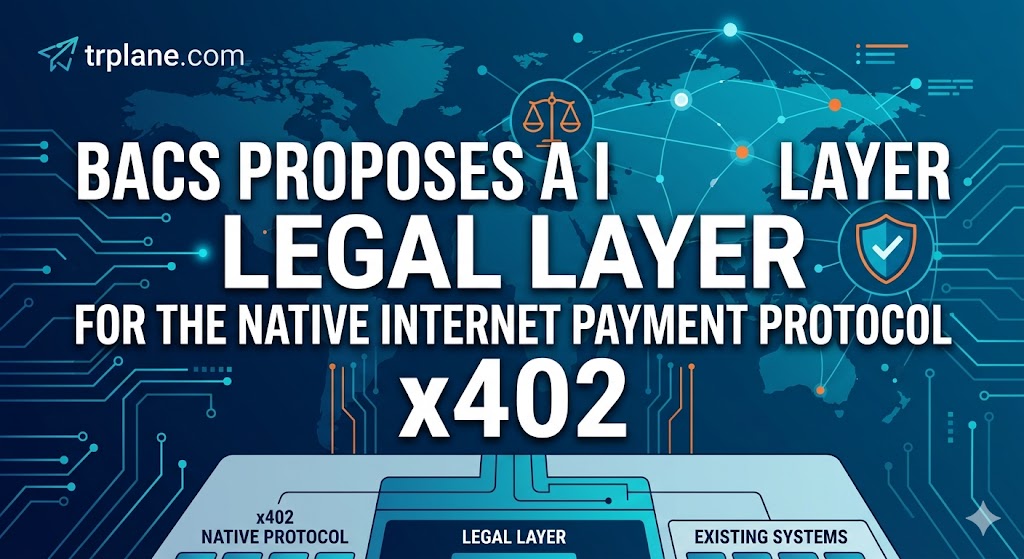
In this context, initiatives such as BACS propose a natural evolution: acting simultaneously as an arbitral tribunal and a legal oracle.
This implies more than issuing decisions.
It means those decisions can be enforced both in the traditional legal domain—through international recognition of arbitral awards—and directly within the technological infrastructure—through smart contracts, wallets, or programmable custody systems.
Justice ceases to be merely declarative. It becomes executable.
The new architecture of the Internet economy
The history of the Internet has been a layered evolution: first communication, then information, then platforms. Now we are entering a new phase: economic infrastructure.
x402 represents the beginning of an Internet where every interaction can carry direct economic value.
But every economy requires more than payments. It requires structured trust.
The financial layer is already being built. The question is who will build the legal layer.
Because in the next phase of the Internet, it will not be enough to execute transactions.
They will need to be resolved. More information at www.traplane.com