
In recent years, Lithuania has established itself as one of the leading regulatory hubs for Electronic Money Institutions (EMIs) in Europe. What began as a strategy to attract fintech companies after Brexit has evolved into a mature ecosystem where banks, startups, and digital financial infrastructure providers coexist.
Today, obtaining an EMI license in Lithuania is not just a regulatory step. It is a strategic decision for any company seeking to operate within the financial jurisdiction of the European Union.
At BACS (Blockchain Arbitration & Commerce Society), we support companies throughout the entire licensing process, from initial structuring to final authorization.
What an EMI license enables
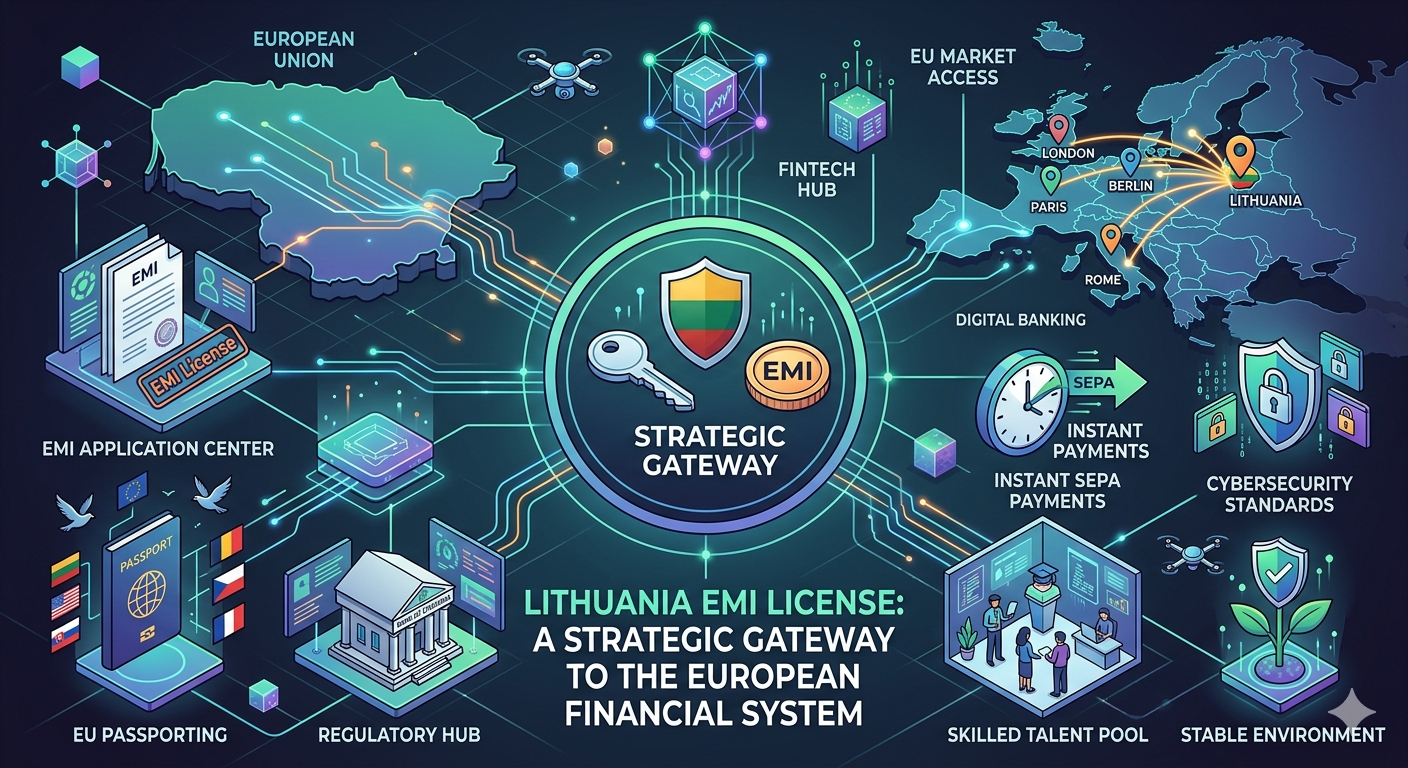
An Electronic Money Institution license allows companies to issue electronic money and provide payment services such as digital wallets, IBAN accounts, card issuance, and SEPA transfers. Unlike traditional banks, EMIs cannot grant credit using client funds, but they can securely hold and transfer money within the financial system.
Through the EU passporting mechanism, a Lithuanian EMI can operate across all 27 Member States without requiring additional licenses. This makes Lithuania one of the most efficient entry points into the European market.
For many digital businesses — fintech companies, exchanges, payment platforms, or crypto-related projects — this is not just a license. It is infrastructure.
Why Lithuania
Lithuania offers a combination that is difficult to find elsewhere in Europe: regulatory clarity, operational agility, and a pro-innovation environment.
The Bank of Lithuania is known for its technical approach and relatively efficient processes. Licensing timelines typically range between six and twelve months, significantly faster than in jurisdictions such as Germany, France, or Spain.
In addition, the country has developed a complete fintech ecosystem, including regulatory sandboxes, direct access to European payment systems, and a talent pool specialized in compliance and financial technology.
What is required
Obtaining an EMI license in Lithuania requires meeting strict conditions.
-
- A minimum initial capital of €350,000 must be fully paid in. Additional ongoing capital requirements depend on the scale of operations.
- The company must have real presence in Lithuania, including offices, key personnel, and effective management. Purely formal structures are not accepted.
- The management team must pass a fit and proper assessment. Key roles such as CEO, AML officer, and risk officer must demonstrate relevant experience in financial services and compliance.
- A complete application dossier is required. This includes a detailed business model, operational structure, and a three-year financial plan.
- Safeguarding of client funds is essential. Funds must be protected through segregated accounts or equivalent mechanisms.
- AML/KYC compliance must be robust, particularly for projects involving cryptoassets.
- Finally, the regulator assesses technological infrastructure, internal controls, audit systems, and compliance with data protection regulations.
How BACS works
At BACS, we do not simply prepare documentation. We support the entire licensing process.
We assist in structuring the business model, defining governance, and preparing the application in line with the standards required by the Bank of Lithuania.
We coordinate all elements of the project — legal, operational, and compliance — to ensure consistency and viability from the outset.
We also support communication with the regulator throughout the process, which is critical to reducing timelines and avoiding delays.
Our objective is clear: not only to obtain the license, but to ensure the company is ready to operate from day one.
Conclusion
Obtaining an EMI license in Lithuania requires preparation, capital, and regulatory alignment. However, it provides direct access to the European market and positions the company within one of the most dynamic fintech ecosystems.
For companies operating in payments or digital financial models, Lithuania has become one of the most strategic jurisdictions from which to build.
In this process, having the right support makes the difference between a stalled application and a successful one.
This is where BACS operates.