

Skip to content

What is BACS?

  • Join BACS
  • International regulation
  • International tribunal
  • Contact
  •   Access
  • Español
  • Join BACS
  • International regulation
  • International tribunal
  • Contact
  •   Access
  • Español
Blockchain Arbitration & Commerce Society
  • About BACS
    • Board of directors and tribunal of arbitration
  • Services
    • Quality seal
    • Crypto complaints
    • Networking
    • Training
    • Events
  • News
  • Members
  • Home
  • About BACS
    • Board of directors and tribunal of arbitration
  • Services
    • Quality seal
    • Crypto complaints
    • Networking
    • Training
    • Events
  • News
  • Members
  • Home
Home » Arbitraje » Tokenization Is Not Digitization: It Changes the Legal Nature of the Asset

Autor

Author

Picture of Ignacio Ferrer-Bonsoms

Ignacio Ferrer-Bonsoms

Home » Arbitraje » Tokenization Is Not Digitization: It Changes the Legal Nature of the Asset
17 de May de 2026

Tokenization Is Not Digitization: It Changes the Legal Nature of the Asset

Asset Ownership Asset Tokenization BACS Blockchain Blockchain Arbitration Crypto Law digital assets Digital Law European Union Internet Jurisdiction Legal Infrastructure Legal Tokenization MiCA Programmable Assets Property Rights smart contracts Tokenization Tokenized Assets

Share

Sign up for this activity

Discounts on events and training are available to all BACS members.

Your level is STANDARD and you have a 10% discount.

Your level is PREMIUM and you have a 20% discount.

Your level is PREMIUM + and you have a 30% discount.

Send request

When many companies hear about tokenization, they think of a simple technological process: converting a traditional asset into a digital representation recorded on blockchain.

But that view is incomplete.

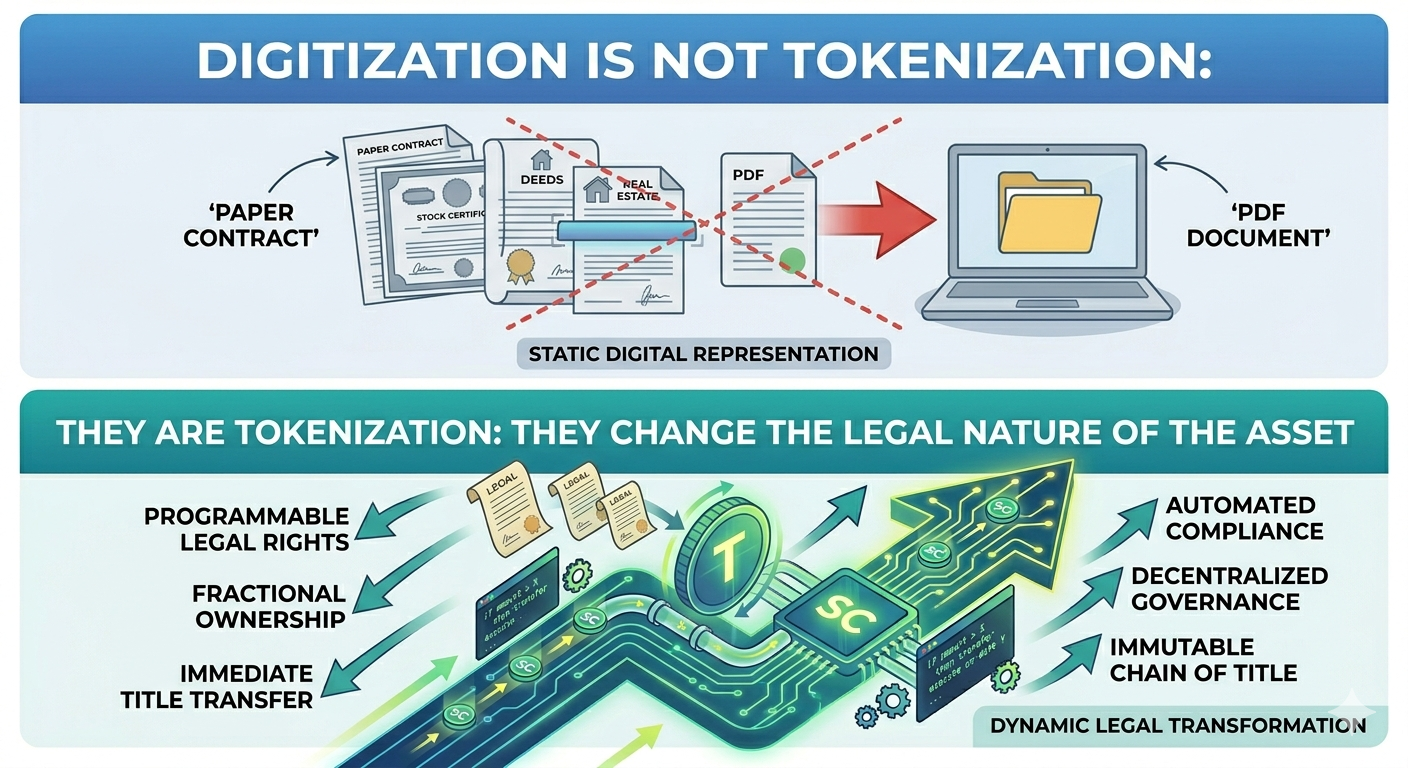
Tokenizing is not simply digitizing.

Tokenizing means altering the legal and functional structure of the asset.

And understanding this difference is essential for any company, investor, or institution seeking to operate in the digital economy.

Digitization Does Not Change the Nature of the Asset

Digitization consists of converting analog information into electronic format.

A contract scanned into PDF remains the same contract.

A share recorded in a database remains the same share.

A title deed stored electronically continues to be subject to the same legal regime.

Technology changes the medium.

But it does not transform the legal essence of the asset.

Tokenization Does Change the Legal Logic

Tokenization goes much further.

It consists of creating a token on blockchain that incorporates economic, political, or proprietary rights and that can be transferred automatically according to programmed rules.

The token is not just a digital file.

It is a legal and technological unit with the capacity for autonomous circulation.

This alters essential aspects such as:

  • the form of transfer;
  • proof of ownership;
  • restrictions on disposition;
  • enforcement of rights;
  • dispute resolution;
  • attachment and freezing mechanisms.

Consequently, tokenization changes the legal architecture of the asset.

From Registry to Executable Asset

In traditional systems, rights depend on registries, intermediaries, and manual procedures.

In blockchain, the asset itself can incorporate automatic rules.

A token can:

  • be transferred instantly;
  • be blocked in the event of breach;
  • distribute returns automatically;
  • limit its trading;
  • execute contractual clauses;
  • be subject to integrated arbitration.

The asset ceases to be a passive right and becomes executable software.

Tokenization and Legal Disintermediation

Tokenization reduces the role of certain intermediaries.

Transfers, settlements, and verifications can be carried out directly on the network.

But this does not eliminate the need for law.

On the contrary.

It requires redesigning the rules that determine:

  • who is the owner;
  • what rights the token incorporates;
  • which law applies;
  • which jurisdiction resolves disputes;
  • how decisions are enforced.

Tokenization does not eliminate the legal framework.

It reconfigures it.

Concrete Examples

A tokenized equity interest can be traded globally with greater liquidity.

A tokenized real estate asset can be divided among multiple investors.

A tokenized bond can pay interest automatically.

A stablecoin tokenizes fiat money and transforms it into programmable monetary infrastructure.

In all these cases, the asset ceases to operate under a purely documentary logic and becomes integrated into a logic of automatic execution.

The Problem of Legal Equivalence

The fundamental question is whether the token produces the same legal effects as the underlying asset.

The answer depends on multiple factors:

  • the contractual structure;
  • the applicable regulation;
  • custody of the asset;
  • investor protection;
  • enforceability of rights.

Without an adequate legal architecture, the token may lack the intended legal effect.

For this reason, tokenization is not an exclusively technological matter.

It is, above all, a legal issue.

MiCA and Tokenization in Europe

The European Union has made progress through Markets in Crypto-Assets Regulation (MiCA), but much of tokenization still depends on corporate, civil, financial, and securities laws.

The real difficulty is not only issuing a token.

It is ensuring that the token is legally enforceable and opposable to third parties.

BACS and the Legal Standards of Tokenization

Blockchain Arbitration and Commerce Society was created precisely to address this need.

Tokenization requires:

  • integrated arbitration clauses;
  • enforcement mechanisms;
  • attachable or freezable tokens;
  • interoperable legal standards.

BACS acts as a legal layer so that tokenized assets are not merely technological representations, but instruments with full legal effectiveness.

From Digital Representation to a New Legal Object

Tokenization does not convert an asset into a digital file.

It transforms it into a programmable legal object.

The asset incorporates automatic rules of transfer, control, and enforcement.

This transformation affects ownership, circulation, collateralization, and dispute resolution.

In other words, tokenization redefines the legal nature of the asset.

Conclusion

Digitization means changing the medium.

Tokenization means changing the legal and operational structure of the asset.

That is why tokenization is not digitization.

It is the redesign of the way rights exist, circulate, and are enforced in the jurisdiction of the Internet.

And those who understand this difference will be in a position to lead the next stage of the digital economy.

Share your crypto thoughts

All BACS members have access to this section to share their reports, narratives, and other thoughts related to their professional sector and the blockchain technology environment.

If you wish to submit your publication, please email info@bacsociety.com or use the form.

Submit article

Previous Stablecoins Are Not Digital Money: They Are Programmable Monetary Power

Newsletter

Crypto industry news, international regulation, training and professional events

Contact

  • SPAIN
  • C/ Antonio Acuña 9, 2º izq. - Madrid (Spain)
  • DUBAI
  • Innovation Hub Gate Avenue- South Zone Unit GA-00-SZ-G0-RT-147 DUBAI
  • info@bacsociety.com
  • +34 91 018 29 46
  • Web form

Communication area

  • Crypto industry news
  • Events and networking
  • Blockchain training
  • International regulation

Social media

Twitter Telegram

© The Blockchain Arbitration. All Rights Reserved 2023

Legal Notice  |  Privacy policy  |  Cookies Policy
Manage cookie consent
Our website uses cookies to improve your user experience by analyzing your browsing habits and in compliance with Law 34/2002, of July 11, 2002, on information society services and electronic commerce (LSSICE). The information about the cookies we use is what will ensure that the user can make their decision consciously and freely when giving their consent or, on the contrary, not to accept the installation of cookies on your device under the terms of Article 22 of Law 34/2002 of July 11, Services of the Information Society and Electronic Commerce (LSSICE).
Functional Always active
The storage or technical access is strictly necessary for the legitimate purpose of enabling the use of a specific service explicitly requested by the subscriber or user, or for the sole purpose of carrying out the transmission of a communication over an electronic communications network.
Preferencias
El almacenamiento o acceso técnico es necesario para la finalidad legítima de almacenar preferencias no solicitadas por el abonado o usuario.
Statistics
Technical storage or access that is used exclusively for statistical purposes. El almacenamiento o acceso técnico que se utiliza exclusivamente con fines estadísticos anónimos. Sin un requerimiento, el cumplimiento voluntario por parte de tu Proveedor de servicios de Internet, o los registros adicionales de un tercero, la información almacenada o recuperada sólo para este propósito no se puede utilizar para identificarte.
Marketing
The storage or technical access is necessary to create user profiles to send advertising, or to track the user on a website or multiple websites for similar marketing purposes.
  • Manage options
  • Manage services
  • Manage {vendor_count} vendors
  • Read more about these purposes
See preferences
  • {title}
  • {title}
  • {title}

Your level is STANDARD and you have a 10% discount.

Your level is PREMIUM and you have a 20% discount.

Use the form below to apply for registration for the activity. We will confirm your registration by email after checking the availability of places.

Basic information about your data protection:

Responsible party: Blockchain Arbitration Society (hereinafter BACS)

Purpose: Manage your request for inscription +info

Rights: You have the right to access, rectify and delete the data, as well as other rights, as explained in the additional information. +info

Additional information: You can here consult additional and detailed information on Data Protection

Idioma ES

.

.