

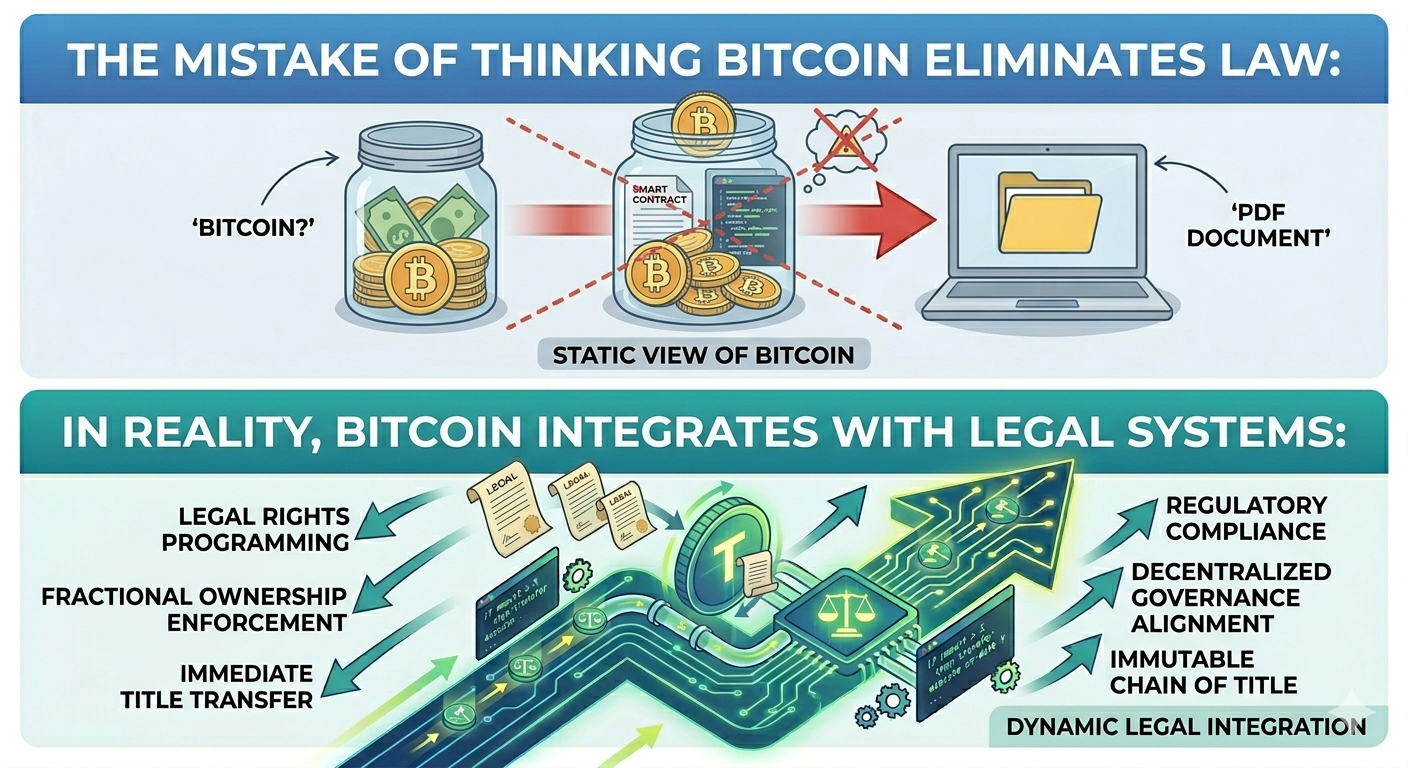
Since its origins, Bitcoin has been interpreted by many as a technology designed to dispense with the State, banks, and ultimately law itself.
The idea is well known.
If the protocol allows value to be transferred without intermediaries and guarantees the automatic execution of its rules, it would seem that the legal system is no longer necessary.
However, this interpretation is based on an incorrect premise.
Bitcoin does not eliminate law.
Bitcoin creates a new form of law.
This is precisely the central thesis developed in my book Bitcoin Digital Law: Why Cryptocurrencies Are Digital Laws of the Internet Jurisdiction and Why States Must Adapt (Bitcoin Digital Law: Why Cryptocurrencies Are Digital Laws of the Internet Jurisdiction and Why States Must Adapt).
The fundamental idea is clear:
Cryptocurrencies are digital laws of the Internet Jurisdiction, and States will have no choice but to adapt.
Understanding this thesis is essential to grasp the true legal dimension of the blockchain revolution.
Bitcoin as a Normative System
Law, in its most basic sense, is a set of rules that organizes conduct and generates predictable consequences.
It defines who may do what, under what conditions, and with what effects.
Bitcoin performs exactly this function.
The protocol establishes objective rules regarding:
- monetary issuance;
- transaction validation;
- ownership of units;
- irreversibility of payments;
- consensus mechanisms;
- economic sanctions for conduct contrary to the protocol.
These rules do not depend on the discretion of an authority.
They are applied automatically through software and distributed consensus.
In this sense, Bitcoin is not merely a technology.
It is a normative system executed by code.
From State Law to Digital Law
Traditionally, legal rules emanate from States and are applied by courts and public administrations.
Bitcoin introduces a different logic.
The rule is embedded directly in the protocol.
Execution is automatic.
Coercion occurs through cryptographic and economic mechanisms.
Authority does not reside in a central institution, but in the consensus of the network.
For this reason, Bitcoin can be understood as a form of Internet-native digital law.
It does not replace the entire state legal order.
But it does establish an autonomous normative system in monetary and property matters.
What Bitcoin Does Eliminate
Bitcoin reduces the need for certain intermediaries.
It is not necessary to request authorization from a bank to transfer value.
It is not necessary to depend on a State to issue the monetary unit.
There is no entity with discretionary power to alter the money supply.
In this sense, Bitcoin radically transforms the way money is organized.
But eliminating intermediaries is not the same as eliminating law.
It means replacing certain forms of regulation with others embedded in software.
Law Remains Necessary
Although Bitcoin incorporates its own rules, economic activity continues to generate issues that the protocol cannot resolve by itself.
For example:
- fraud;
- theft of private keys;
- contractual breaches;
- operational errors;
- disputes between parties;
- inheritance and succession;
- judicial attachments;
- civil liability.
Code executes.
But code does not judge.
The blockchain can record facts.
But it cannot by itself determine who is right in a dispute.
Therefore, law does not disappear.
Its function becomes even more important.
The Internet Jurisdiction
The emergence of Bitcoin marks the birth of a new normative sphere: the Internet Jurisdiction.
In this environment:
- Bitcoin functions as digital monetary law.
- Ethereum functions as programmable legislation.
- Stablecoins act as Internet-native currencies.
- Smart contracts automate execution.
- Tokenization represents property rights.
- Digital arbitration provides dispute resolution mechanisms.
This is not a lawless space.
It is a space with a new form of law.
The Thesis of Bitcoin Digital Law
The thesis developed in Bitcoin Digital Law: Why Cryptocurrencies Are Digital Laws of the Internet Jurisdiction and Why States Must Adapt holds that cryptocurrencies are not merely speculative assets or financial instruments.
They are genuine normative structures.
Each protocol incorporates binding rules regarding issuance, ownership, transfer, and enforcement.
These rules operate globally and independently of state borders.
For this reason, cryptocurrencies constitute digital laws of the Internet Jurisdiction.
And precisely for that reason, States will have no choice but to adapt to this new legal and economic reality.
Bitcoin as Digital Monetary Law
Bitcoin’s historical contribution does not consist solely in creating a scarce asset.
Its true innovation is that it established a global normative regime for the issuance, transfer, and preservation of value.
That regime operates:
- without borders;
- without schedules;
- without prior authorization;
- without central intermediaries.
And it applies uniformly to all participants in the network.
From this perspective, Bitcoin is a form of digital monetary law.
The Role of BACS
Blockchain Arbitration and Commerce Society was created to provide the legal infrastructure required in this new jurisdiction.
BACS develops:
- specialized arbitration for blockchain disputes;
- legal standards for digital assets;
- digital enforcement mechanisms;
- integration between legal decisions and on-chain execution.
Because the digital economy does not require less law.
It requires law that is technically interoperable with blockchain.
Conclusion
Bitcoin does not eliminate law.
It reconfigures it.
It transfers certain normative functions from state institutions to open protocols executed by software.
At the same time, it generates new needs for interpretation, dispute resolution, and enforcement.
The Bitcoin revolution does not consist in creating a world without law.
It consists in demonstrating that law can also exist in the form of code.
And, as I argue in Bitcoin Digital Law: Why Cryptocurrencies Are Digital Laws of the Internet Jurisdiction and Why States Must Adapt, cryptocurrencies are digital laws of the Internet Jurisdiction, and States will have no choice but to adapt.