

Skip to content

What is BACS?

  • Join BACS
  • International regulation
  • International tribunal
  • Contact
  •   Access
  • Español
  • Join BACS
  • International regulation
  • International tribunal
  • Contact
  •   Access
  • Español
Blockchain Arbitration & Commerce Society
  • About BACS
    • Board of directors and tribunal of arbitration
  • Services
    • Quality seal
    • Crypto complaints
    • Networking
    • Training
    • Events
  • News
  • Members
  • Home
  • About BACS
    • Board of directors and tribunal of arbitration
  • Services
    • Quality seal
    • Crypto complaints
    • Networking
    • Training
    • Events
  • News
  • Members
  • Home
Home » News » The Institutionalization of On-Chain ‘Yield’: Regulation, Staking, and the New Framework of Ethereum ETFs

Author

Picture of Ignacio Ferrer-Bonsoms

Ignacio Ferrer-Bonsoms

Ignacio Ferrer-Bonsoms is a business lawyer and founder of the Blockchain Arbitration & Commerce Society (BACS), an initiative focused on the development of legal infrastructure for the digital economy.

His work centers on how legal systems interact with emerging technologies such as blockchain, digital assets and artificial intelligence, with a particular focus on cross-border structures, dispute resolution and legal enforceability.

He has been involved in the structuring of digital and blockchain-related projects across multiple jurisdictions, providing him with a practical perspective on how these systems operate and where they face limitations.

Through BACS, he develops frameworks and proposals aimed at bridging the gap between law and technology, contributing to the evolution of legal systems in digital environments.

He is the author of Bitcoin Digital Law, where he explores blockchain as an emerging form of digital legal order and analyzes its implications for traditional legal frameworks.

Home » News » The Institutionalization of On-Chain ‘Yield’: Regulation, Staking, and the New Framework of Ethereum ETFs
30 de April de 2026

The Institutionalization of On-Chain ‘Yield’: Regulation, Staking, and the New Framework of Ethereum ETFs

Share

Sign up for this activity

Discounts on events and training are available to all BACS members.

Your level is STANDARD and you have a 10% discount.

Your level is PREMIUM and you have a 20% discount.

Your level is PREMIUM + and you have a 30% discount.

Send request

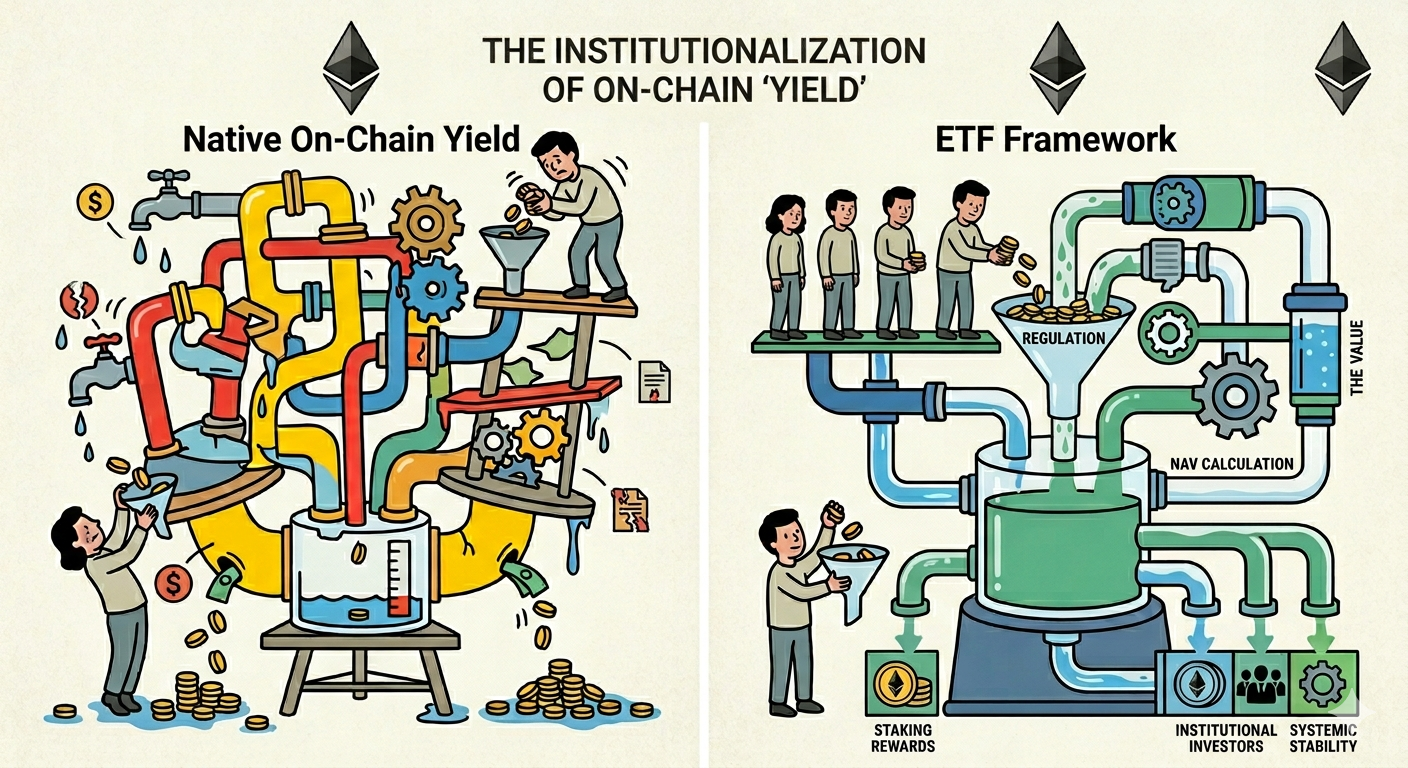
Yield has returned to the center of the crypto ecosystem, but this time under a different logic: it is not only a financial innovation, but a phenomenon in the process of regulatory integration.

The recent evolution of the criteria of the U.S. Securities and Exchange Commission and the Commodity Futures Trading Commission marks a turning point. For the first time, staking—historically located in a gray area—begins to fit within a legal framework compatible with traditional financial products, such as ETFs.

This change is not minor: it represents the transition of “crypto yield” from the regulatory periphery to the core of the financial system.

From Regulatory Vacuum to the Legal Qualification of Staking

For years, the key question has been whether staking rewards should be considered securities under U.S. law.

The dominant interpretation, based on the Howey Test, generated structural uncertainty:
Is there an investment in a common enterprise?
Do profits depend on the efforts of others?

The new regulatory approach introduces a relevant nuance: not all staking implies a traditional investment relationship. In certain cases—especially when it involves protocol validation—rewards may be considered a technical result of the network’s operation, and not a financial instrument in the strict sense.

This conceptual shift enables something that was previously unfeasible: the integration of staking into regulated vehicles.

The ETF as a Bridge Between Two Legal Systems

The emergence of Ethereum ETFs with integrated staking represents a phenomenon that is more legal than merely financial.

On the one hand, these products operate within the regulated framework of the traditional securities market.
On the other, they capture yield generated in a decentralized infrastructure such as Ethereum.

The result is a hybrid that connects two normative orders:
-The traditional financial system (custody, supervision, disclosure)
-The internet jurisdiction (consensus, validation, automatic execution)

In this sense, staking ceases to be a purely technical activity and becomes a legally recognizable and structurable source of yield.

Key Actors in the Institutionalization of Staking

The entry of large asset managers has accelerated this normalization process.

Among the main players are:
-BlackRock, which has promoted products with exposure to ETH and yield-generation strategies
-Grayscale Investments, a pioneer in the distribution of structured crypto products
-VanEck, with ETF proposals that directly integrate staking
-Lido, as key infrastructure for liquid staking

These actors not only bring capital, but something more relevant: regulatory legitimacy.

Yield as an Element of Asset Qualification

From a legal perspective, the differentiating element of Ethereum compared to Bitcoin is clear: its capacity to generate yield.

While Bitcoin is configured as a passive asset (store of value), Ethereum introduces a productive dimension.

This has direct implications for its qualification:
-The asset ceases to be merely speculative
-It approaches traditional categories such as income-generating assets
-It allows its integration into institutional portfolios under risk-adjusted return criteria

The data is significant: ETH ETFs with staking offer an estimated net annual yield of 2–3%, compared to the structural 0% of spot Bitcoin ETFs.

Regulatory Risks and Structural Tensions

However, this institutionalization is not without legal and operational risks.

  1. Liquidity Risk
    Staking implies a temporary lock-up of assets. In an ETF, this creates a structural tension:
    The investor demands immediate liquidity
    The protocol imposes exit times

This mismatch may force managers to operate in secondary markets, introducing price and execution risks.

  1. Regulatory Requalification Risk
    The current criteria of the SEC and the CFTC are not necessarily final.

A change in interpretation could:
Reclassify certain staking structures as securities
Impose additional obligations on issuers and managers
Directly affect the viability of ETFs

  1. Concentration Risk
    The use of protocols such as Lido introduces a critical issue: the centralization of validation within infrastructures that are apparently decentralized.

From a legal perspective, this reopens the debate on:
-Liability
-Governance
-Possible qualification as an intermediary

Implications for Future Regulation

The development of ETFs with staking forces regulators to address a structural question: how to integrate yield sources native to blockchain within frameworks designed for traditional financial instruments.

In Europe, the Markets in Crypto-Assets Regulation does not yet fully resolve this issue.

This opens several scenarios:
-Development of specific regulation for staking
-Adaptation of existing categories (CASP, custody, management)
-Creation of hybrid standards between financial law and blockchain architecture

Conclusion: From Technical Yield to Legal Yield

The real change is not that Ethereum generates yield.

The change is that this yield is beginning to be recognized, structured, and distributed within traditional legal frameworks.

This marks the beginning of a new phase:
-Staking ceases to be a technical activity
-It becomes a relevant legal category
-And it becomes part of the global financial system

Ultimately, Ethereum ETFs with staking are not just investment products.

They are the first clear manifestation of how the internet jurisdiction begins to integrate—and tension—traditional financial law.

Share your crypto thoughts

All BACS members have access to this section to share their reports, narratives, and other thoughts related to their professional sector and the blockchain technology environment.

If you wish to submit your publication, please email info@bacsociety.com or use the form.

Submit article

Previous GENIUS Act 2026: towards the configuration of stablecoins as the legal infrastructure of the dollar

Newsletter

Crypto industry news, international regulation, training and professional events

Contact

  • SPAIN
  • C/ Antonio Acuña 9, 2º izq. - Madrid (Spain)
  • DUBAI
  • Innovation Hub Gate Avenue- South Zone Unit GA-00-SZ-G0-RT-147 DUBAI
  • info@bacsociety.com
  • +34 91 018 29 46
  • Web form

Communication area

  • Crypto industry news
  • Events and networking
  • Blockchain training
  • International regulation

Social media

Twitter Telegram

© The Blockchain Arbitration. All Rights Reserved 2023

Legal Notice  |  Privacy policy  |  Cookies Policy
Manage cookie consent
Our website uses cookies to improve your user experience by analyzing your browsing habits and in compliance with Law 34/2002, of July 11, 2002, on information society services and electronic commerce (LSSICE). The information about the cookies we use is what will ensure that the user can make their decision consciously and freely when giving their consent or, on the contrary, not to accept the installation of cookies on your device under the terms of Article 22 of Law 34/2002 of July 11, Services of the Information Society and Electronic Commerce (LSSICE).
Functional Always active
The storage or technical access is strictly necessary for the legitimate purpose of enabling the use of a specific service explicitly requested by the subscriber or user, or for the sole purpose of carrying out the transmission of a communication over an electronic communications network.
Preferencias
El almacenamiento o acceso técnico es necesario para la finalidad legítima de almacenar preferencias no solicitadas por el abonado o usuario.
Statistics
Technical storage or access that is used exclusively for statistical purposes. El almacenamiento o acceso técnico que se utiliza exclusivamente con fines estadísticos anónimos. Sin un requerimiento, el cumplimiento voluntario por parte de tu Proveedor de servicios de Internet, o los registros adicionales de un tercero, la información almacenada o recuperada sólo para este propósito no se puede utilizar para identificarte.
Marketing
The storage or technical access is necessary to create user profiles to send advertising, or to track the user on a website or multiple websites for similar marketing purposes.
  • Manage options
  • Manage services
  • Manage {vendor_count} vendors
  • Read more about these purposes
See preferences
  • {title}
  • {title}
  • {title}

Your level is STANDARD and you have a 10% discount.

Your level is PREMIUM and you have a 20% discount.

Use the form below to apply for registration for the activity. We will confirm your registration by email after checking the availability of places.

Basic information about your data protection:

Responsible party: Blockchain Arbitration Society (hereinafter BACS)

Purpose: Manage your request for inscription +info

Rights: You have the right to access, rectify and delete the data, as well as other rights, as explained in the additional information. +info

Additional information: You can here consult additional and detailed information on Data Protection

Idioma ES

.

.