

The White House report: a rebuttal of the banking sector’s argument
The recent report by the White House Council of Economic Advisers introduces a key element into the regulatory debate on stablecoins: it dismantles, on an empirical basis, one of the main arguments put forward by the traditional banking system.
For months, the banking sector has argued that yield-bearing stablecoins pose a systemic threat, by encouraging the flight of deposits and reducing lending capacity. However, the official analysis concludes that even in a scenario of a total ban on yields, the impact on bank lending would be marginal, estimated at between $1.2 billion and $2.1 billion.
This finding is not merely technical. It is structural.
It means that stablecoins do not extract capital from the financial system, but rather redistribute it within new infrastructures.
Stablecoins as a legal framework for digital money
From a digital law perspective, stablecoins should not be understood solely as financial instruments or means of payment.
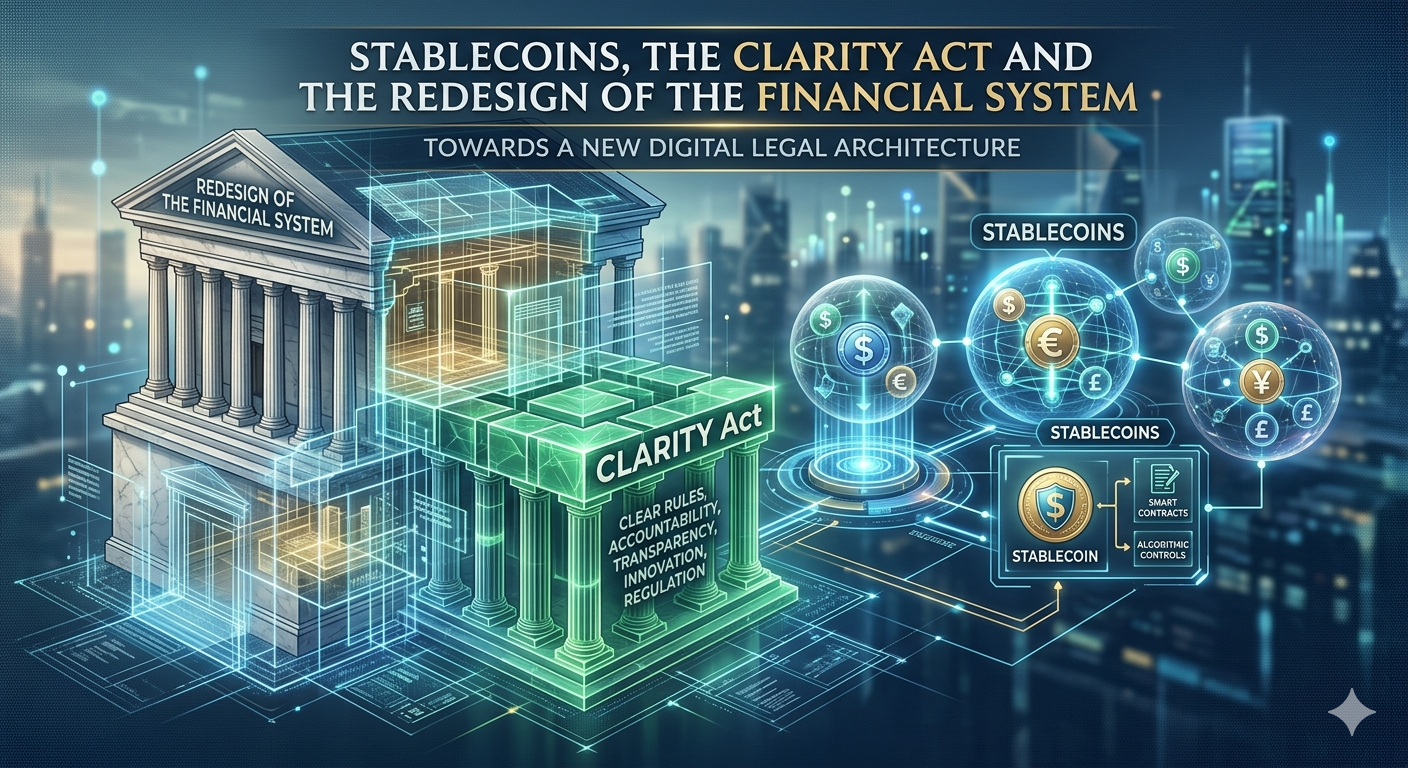
They are, in fact, a new form of regulatory architecture.
Each stablecoin incorporates rules on issuance, backing, redemption and circulation that are automatically enforced through code. In this sense, they constitute a concrete manifestation of what might be termed ‘digital law’: rules that do not require judicial or administrative intervention for their enforcement.
This phenomenon heralds a profound transformation:
Money ceases to be merely an economic instrument and becomes a programmable legal system.
In this new environment, the distinction between financial infrastructure and the regulatory system begins to disappear.
The CLARITY Act and the formalisation of digital jurisdiction
The progress of the CLARITY Act must be understood within this broader context.
Far from being a simple asset classification law, the CLARITY Act represents an attempt to integrate the emerging jurisdiction of the internet into the US legal system. Senator Bill Hagerty has confirmed that it will soon be brought before Congress, cementing its position as a central pillar of the US regulatory framework.
The bill seeks to:
Define the legal nature of digital assets (securities vs. commodities)
Establish an operational framework for decentralised finance
Protect the right to self-custody of digital assets
This last point is particularly relevant from BACS’s perspective.
Self-custody means that control of the asset does not lie with an intermediary entity, but directly with the holder via cryptographic keys. This completely redefines the logic of the exercise of rights and obligations.
DeFi and the redefinition of the intermediary
At the same time, the US Securities and Exchange Commission has clarified that many DeFi interfaces do not require registration as financial intermediaries, provided they do not hold funds in custody or provide investment advice.
Tools such as MetaMask and Uniswap thus fall outside the traditional scope of intermediary regulation.
This stance has profound legal implications:
It implicitly recognises that financial activity can exist without traditional intermediation
It validates the existence of autonomous, code-based infrastructures
It opens the door to liability models different from those of the traditional system
In this environment, the concept of a ‘party’ in a legal relationship becomes blurred, and the fulfilment of obligations increasingly depends on technical mechanisms.
The real debate: scale and concentration
The American Bankers Association has shifted the focus of the debate towards the potential scale of stablecoins.
The risk highlighted is not so much the return, but the possibility that, on a large scale, deposits could become concentrated among stablecoin issuers, thereby reducing the funding base of traditional banks.
This argument raises a significant legal question:
Should the law anticipate market structures that have not yet become established, or adapt progressively as they emerge?
The answer will determine the pace of development of the ecosystem.
Implications for dispute resolution regarding digital assets
The growth of stablecoins and DeFi infrastructure has a direct consequence: the emergence of new types of legal disputes.
These include:
Disputes over the redemption and backing of stablecoins
Disputes arising from smart contracts and automatic enforcement
Liability in decentralised interfaces
Jurisdictional issues in global systems without a clear location
In this context, traditional dispute resolution mechanisms have obvious limitations.
The enforcement of decisions regarding digital assets cannot depend exclusively on state structures if the asset is located on a blockchain.
This is where models such as BACS become relevant.
BACS and enforcement in the digital realm
The evolution of the financial system towards programmable infrastructures calls for dispute resolution mechanisms that are equally adapted to this reality.
The BACS model is based on a two-tier approach:
Traditional legal recognition through international arbitration
Technical enforcement capability over digital assets
This combination bridges the gap between legal decision-making and effective enforcement, particularly in environments where control of the asset resides in cryptographic keys.
In practice, this means that dispute resolution can be integrated directly into the digital infrastructure, reducing reliance on external mechanisms.
Conclusion: from the financial system to the regulatory framework
The debate over stablecoins and the CLARITY Act is not merely regulatory.
It is structural.
What is at stake is not just how digital assets are regulated, but how a new regulatory framework—based on code and consensus—is integrated into the existing legal order.
The White House report marks a turning point by removing one of the main political obstacles.
The next step is more profound: building legal mechanisms capable of operating within this new architecture.
In that process, the boundary between law and technology will continue to blur.
And it is in that space that the next generation of legal systems will be defined.