

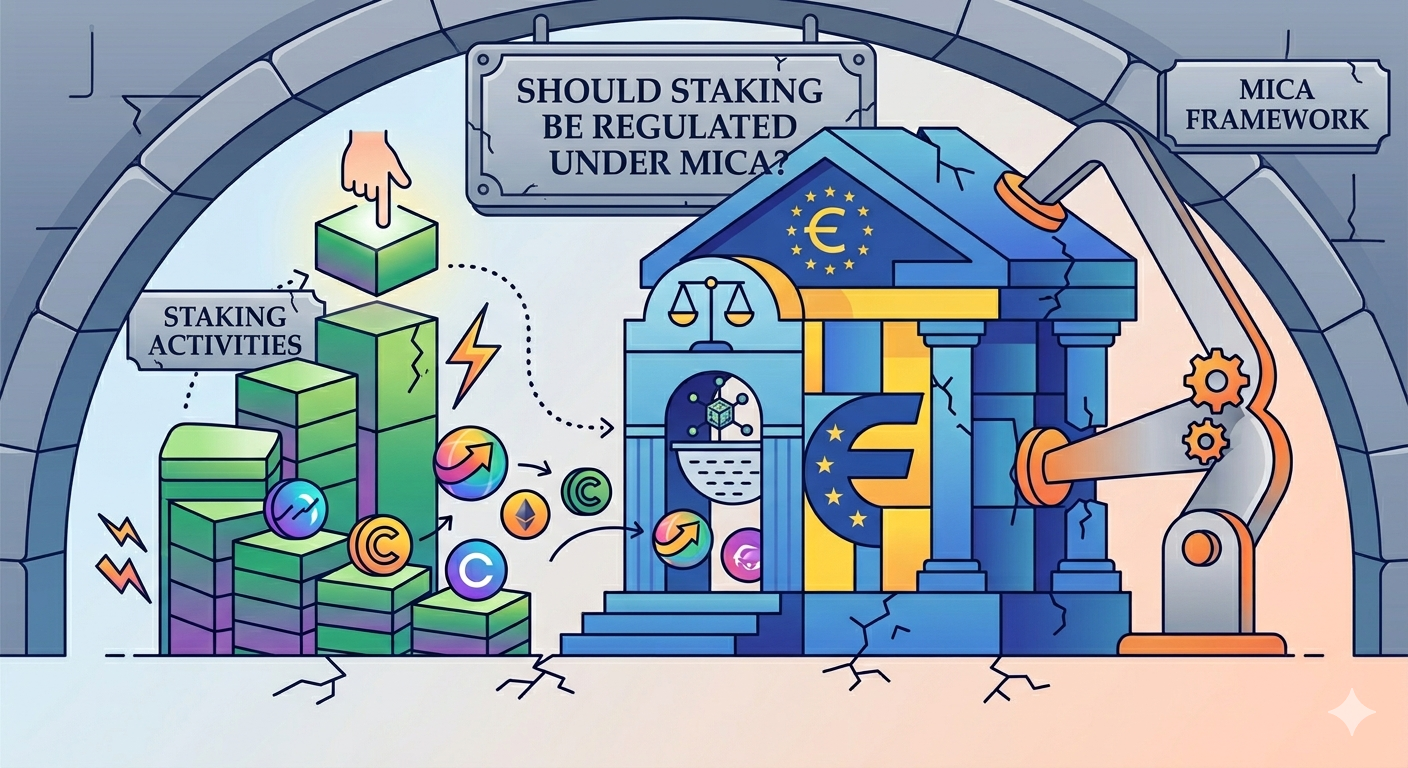
The institutionalization of staking in the United States has opened an inevitable debate in Europe: should this activity be subject to specific regulation under the MiCA Regulation?
The answer is not obvious. And that is precisely where the problem lies.
Unlike other clearly defined services, staking sits in a hybrid zone between technology, network infrastructure, and economic activity. This ambiguity makes it difficult to fit within existing legal categories and creates a gap that, far from being neutral, increases risk.
Key points of the debate
✔ Regulatory ambiguity: staking is not defined in MiCA
✔ Crucial differentiation: its legal treatment depends on the model (direct, delegated, or liquid)
✔ Central dilemma: infrastructure vs financial service
✔ Latent risks: operators, investors, and system stability
The growth of staking —and its progressive integration into financial products— makes it increasingly difficult to keep it outside the regulatory perimeter.
The current gap in MiCA
The MiCA Regulation does not contain an explicit reference to staking. This raises a fundamental question:
Can it fit within already regulated services, or does it require its own category?
The main categories under MiCA are:
- Custody and administration of crypto-assets
- Operation of trading platforms
- Execution of orders
- Advisory services
- Placement of crypto-assets
Staking, in its purest form (network validation), does not directly fit into any of these.
But when third parties are involved —especially in delegated staking or liquid staking models— the legal classification changes completely.
Three staking models, three legal treatments
Not all staking is the same. And this distinction is critical from a regulatory perspective.
Level of regulatory complexity
- Direct staking → Low
- Delegated staking → Medium-High
- Liquid staking → Very high
1. Direct staking (self-staking)
The user validates the network with their own resources and retains full control over their assets.
- No intermediary
- No service provided to third parties
- No management of third-party assets
Conclusion: activity hardly regulatable under MiCA.
2. Delegated staking
The user delegates their assets to a third party.
Here, key legal elements appear:
- Management of third-party assets
- Expectation of return
- Operational dependence
This model may fit within:
- Custody
- Crypto-asset management
And therefore within the regulatory perimeter.
3. Liquid staking
Protocols such as Lido allow users to obtain liquid tokens representing staked assets.
This model introduces additional risks:
- Issuance of derivative tokens
- Depegging risk
- Dependence on smart contracts and governance
From a legal perspective, it comes close to:
- Structured financial products
- Collective investment schemes
Here, the level of regulatory exposure is maximum.
The underlying issue: infrastructure or financial service?
The central dilemma is not technical, but legal.
Is staking an infrastructure necessary for the functioning of the network?
→ Outside MiCA
Or is it a service that manages third-party assets with an expectation of return?
→ Inside MiCA
The difficulty is that it can be both at the same time.
And this overlap is precisely the point of friction between:
- Traditional financial law
- Decentralized architecture
Staking also introduces a determining element: it generates yield.
And in financial law, yield rarely remains unregulated.
Risks of incomplete regulation
The absence of definition does not eliminate risk. It amplifies it.
1. Risk for operators
Exchanges and custodians may be:
- Operating without a license without knowing it
- Exposed to future sanctions
- In a situation of permanent legal uncertainty
2. Risk for investors
Users lack clarity on:
- Who is liable in case of slashing or failures
- What rights they have over their assets
- How risk is managed
3. Structural risk (liquidity)
There is a particularly critical issue:
- Assets locked in staking
- Liquid liabilities towards users
This mismatch can generate operational and legal tensions in stress scenarios.
4. Systemic risk
As staking becomes integrated into:
- ETFs
- Funds
- Institutional products
risks scale:
- Validator concentration
- Dependence on protocols
- Cascading effects in case of failure
Towards a new regulatory framework
Europe has three possible paths:
Option 1: Interpretation of MiCA
Extend existing categories.
Problem: legal uncertainty.
Option 2: Specific reform
Create a dedicated category for staking.
Advantage: clarity
Risk: overregulation
Option 3: Hybrid approach (most likely)
Differentiate between:
- Staking as infrastructure → not regulated
- Staking as a service → regulated
This model would allow balancing innovation and protection.
The blind spot: dispute resolution
There is a critical element that is rarely addressed:
When staking fails, what happens legally?
- Who is liable?
- Where is the dispute resolved?
- How is a decision enforced?
Current systems are not prepared:
- Traditional courts are slow and territorial
- On-chain systems lack full legal capacity
This creates a structural need:
To integrate dispute resolution and enforcement mechanisms into the design of the product.
This is precisely where solutions such as BACS provide value:
- Specialized crypto arbitration
- Resolution adapted to technical environments
- Hybrid enforcement (legal + on-chain)
Conclusion: staking as a regulatory stress test
Staking is much more than a technical functionality.
It is a stress test for European financial law.
It forces fundamental questions:
- What is a financial service in the blockchain era?
- Where does regulation begin and end?
- How are decentralized systems integrated into centralized legal frameworks?
Europe has not yet given a definitive answer.
But what is clear is that staking will not wait.
And when regulation arrives, it will not be neutral: it will redefine who can operate, how, and under what conditions.