

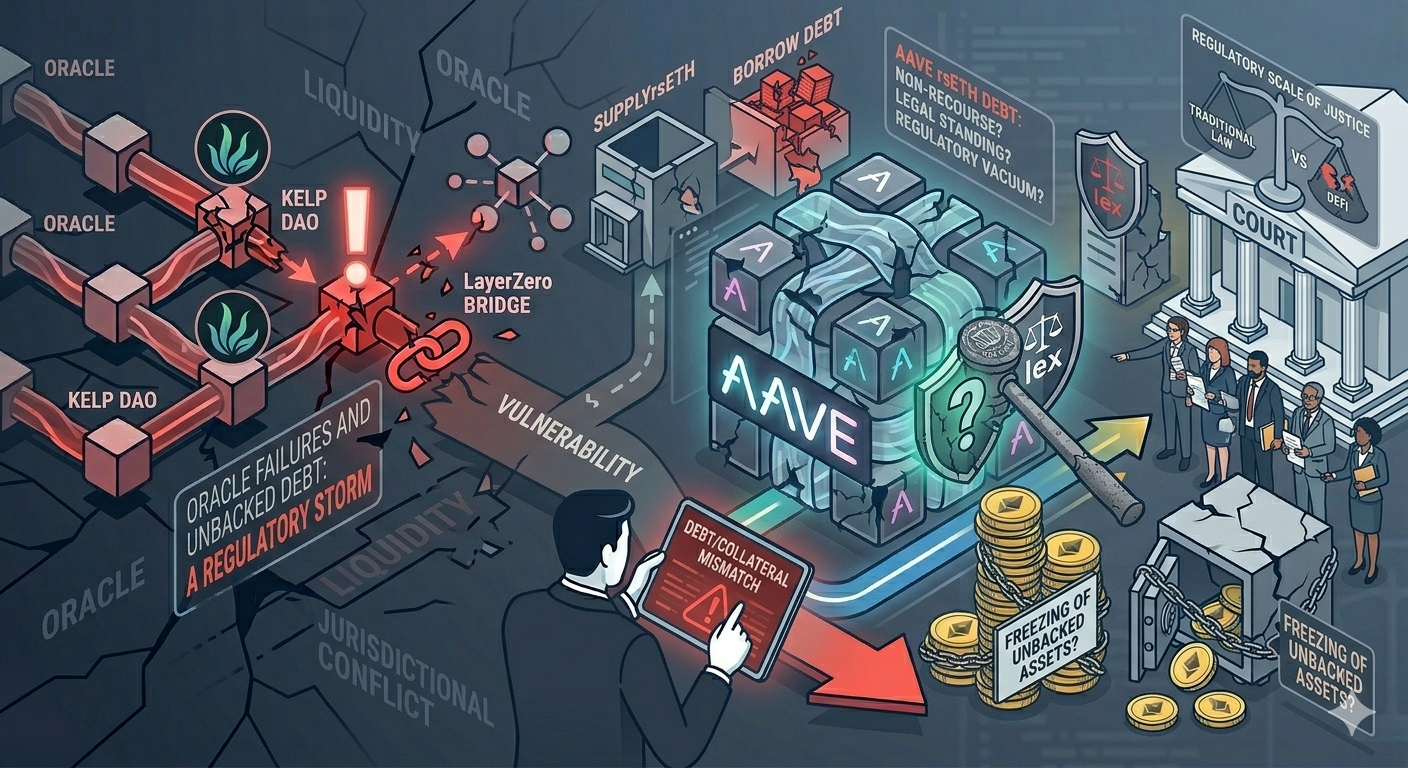
The recent incident affecting the Aave ecosystem cannot be analyzed solely as a technical failure or a market event. What happened raises a structural legal question: what happens when a protocol generates debt based on assets that, in reality, lack backing?
This case is not exceptional. It is a direct consequence of the current design of decentralized finance and highlights a growing need for effective blockchain dispute resolution mechanisms.
The origin of the problem: collateral without economic substance
The exploit linked to the rsETH ecosystem allowed the introduction into the system of assets that, according to available reports, did not have effective backing.
These assets were used as collateral in Aave to obtain loans in real assets, creating a scenario that may give rise to digital asset disputes.
From a traditional legal perspective, this would immediately raise several issues:
- inexistence or defect in the object of the contract
- possible unjust enrichment
- invalidity of the underlying transaction
However, in DeFi, execution does not stop for these questions.
The breakdown between technical execution and legal validity
The system works exactly as designed: the smart contract executes.
But that automatic execution does not necessarily imply legal validity.
Here lies the central fracture of the current model:
- the transaction is valid in code
- but it may be invalid in law
The protocol recognizes as legitimate a guarantee that, in economic and legal terms, may not be so.
And on that basis, a debt is created.
The creation of “debt without legal basis”
The outcome is particularly relevant: the system generates an economic obligation (the debt in Aave) that does not necessarily have a solid legal foundation.
In the traditional financial system, a similar scenario would trigger mechanisms such as:
- reversal of transactions
- liability of the issuer or intermediary
- judicial intervention
In DeFi, these tools do not exist natively.
The available responses are limited:
- market freezing
- governance decisions
- socialization of losses
None of them resolves the underlying legal issue or provides a clear framework for crypto arbitration.
The structural gap: absence of legal enforcement
The case reveals a critical limitation of the DeFi ecosystem:
There is no integrated mechanism that allows:
- legal assessment of the validity of the transaction
- issuance of a binding decision
- execution of that decision over the assets
In other words, there is a lack of effective legal enforcement in blockchain systems.
The system executes, but it does not judge.
The need for an operational legal layer
These types of scenarios reinforce a key idea: DeFi cannot scale as a financial system without integrating a legal layer that is operational, not merely theoretical.
This implies incorporating mechanisms that allow:
- verification of the validity of the asset used as collateral
- resolution of disputes arising from defective transactions
- execution of decisions over the affected assets
Without these elements, the system will continue to generate situations where technical execution and legal reality diverge, increasing the relevance of crypto dispute resolution frameworks.
The BACS proposal: integrating law and code
From this perspective, building an operational legal layer is not only a theoretical need, but a concrete line of development.
In this context, BACS proposes a model in which law does not act ex post, but is integrated from the design stage of the system, combining crypto arbitration with technical enforceability.
This implies:
- dispute resolution mechanisms specialized in digital assets
- the ability to issue decisions with binding effects
- integration with technical infrastructure to enable execution (on-chain and off-chain)
The key is not to replace code, but to complement it.
Where code executes, law must be able to qualify and, where appropriate, correct.
Towards a tokenization standard with enforceability
The Aave–rsETH case shows that it is not enough to design efficient protocols. Digital assets must incorporate, from their origin, minimum legal elements:
- identification of the issuer
- clear definition of rights
- determination of applicable law
- dispute resolution mechanism
- capacity to execute decisions
This is where enforceability in tokenization becomes critical.
Without these elements, the system will continue to produce assets that are technically valid but legally questionable.
Conclusion
The incident is not only an infrastructure failure. It is a demonstration that DeFi still lacks an operational legal layer.
As long as there is no system capable of aligning:
- technical execution
- legal validity
- effective enforcement
situations will continue to arise where debt exists in code, but not necessarily in law.
And it is precisely at this point where one of the most relevant areas of development in the ecosystem emerges: the real integration between law, crypto arbitration, and technology.