

The European Commission’s consultation on the review of the MiCA Regulation is open until 30 September. Most of the public debate revolves around the expected topics: thresholds, licensing, stablecoins, DeFi. But there is an entire layer of the problem the consultation barely touches, and it conditions everything else: the private law of crypto-assets. BACS has placed it at the centre of its response.
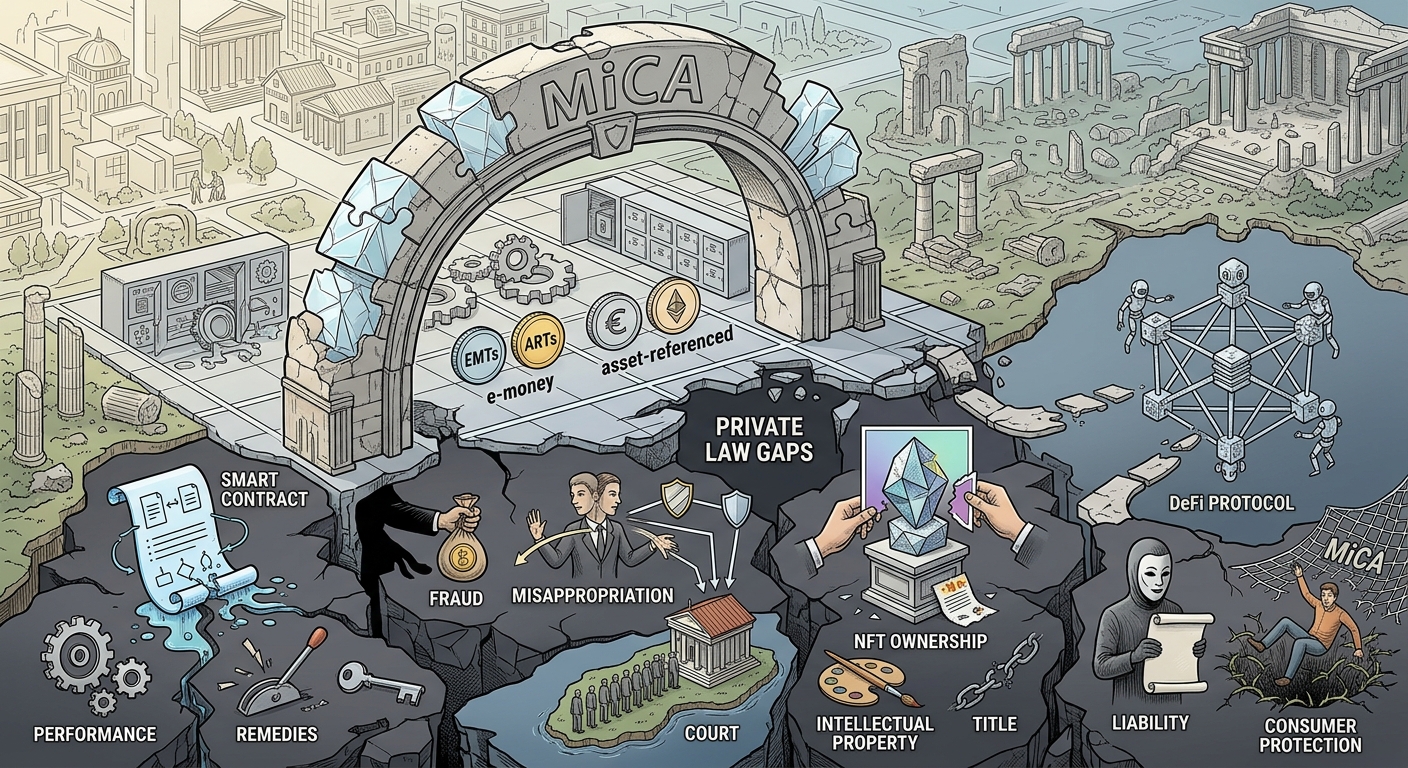
MiCA is, in essence, market and intermediary regulation: who may issue a crypto-asset or provide services over it, with what capital, what disclosures and under whose supervision. It is a prudential architecture. What MiCA does not resolve is what happens between private parties when something goes wrong: who owns a crypto-asset, when title passes, where the client stands if the custodian fails, which law governs a cross-border dispute and before whom it is resolved. Regulating the intermediary without answering these questions is building the house without foundations.
First gap: property
There is no rule in Union law stating what a crypto-asset is in proprietary terms: whether it is an object of property, what kind of right attaches to it and how that right is protected against third parties. Each Member State answers with its own national categories — thing, intangible, claim, sui generis object — and the answers diverge. UNIDROIT has offered an excellent foundation with its Principles on Digital Assets and Private Law, but they are soft law: they guide, they do not bind.
The practical consequence: the most elementary question in commerce — “whose asset is this?” — currently has twenty-seven potentially different answers within the single market.
Second gap: transfer
Closely linked: when does title to a crypto-asset pass? Technical settlement (the on-chain record) and legal transfer are not necessarily the same thing, and no European text says when they coincide. Nor is there a common rule on good-faith acquisition: if I receive an asset that traces back to a theft, do I acquire it or must I return it? For money and negotiable instruments that question has centuries of answers; for crypto-assets, it depends on which court you draw.
Third gap: custody and insolvency
MiCA does address custody: it requires providers to segregate clients’ assets and to make arrangements to safeguard their ownership rights, particularly in the event of insolvency. But the Regulation presupposes the property right rather than harmonising it. If the national law of the failed custodian gives the client a proprietary position, the client can separate the assets from the estate; if it gives only a personal claim, the client queues with the other creditors. The protection MiCA promises is worth, in practice, whatever the underlying national property law is worth — which means the European client’s position depends on where their custodian happens to be established.
Fourth gap: applicable law
Which law governs a crypto-asset? Classical conflict rules rest on the location of the thing (lex rei sitae) or of the register — criteria that an asset replicated across thousands of nodes defies by design. The Hague Conference is working on the question, but no applicable instrument exists yet. Meanwhile, every cross-border dispute begins with a preliminary battle over which law and which forum, consuming time and money before the merits are even reached.
Fifth gap: dispute resolution and enforcement
The last gap is the one that turns the others into an everyday problem: there is no dispute-resolution layer suited to the subject matter. State courts face pseudonymous parties, technical issues, assets that move in minutes and proceedings that take years. Arbitration is a natural fit — flexibility, specialisation, international enforceability under the New York Convention — but it requires infrastructure: clauses designed for on-chain environments, arbitrators who understand the technology, and mechanisms connecting the award to enforcement over the assets themselves.
What BACS has proposed
In its response to the consultation, BACS has argued that the MiCA review is the opportunity to open this debate, and has accompanied its position with an articulated legislative annex: a proposal for a European Digital Legal Infrastructure Regulation addressing the proprietary recognition of digital assets, rules on transfer and finality, effective client protection in custodian insolvency, and the integration of dispute-resolution and enforcement mechanisms suited to the digital environment.
The underlying thesis is simple: the Union has already regulated the intermediaries; it has yet to regulate the basic legal relationship. Until it does, the legal certainty of the European crypto-asset market will rest on twenty-seven national laws that were never designed for this object.
The consultation remains open until 30 September. The full text of the BACS response is available to interested institutions, academics and practitioners.
BACS is an association registered in the EU Transparency Register (REG 9106897105368-14). BACS operates a Court of Arbitration specialised in digital assets and therefore has an institutional interest in the development of the legal infrastructure whose necessity is described here.