

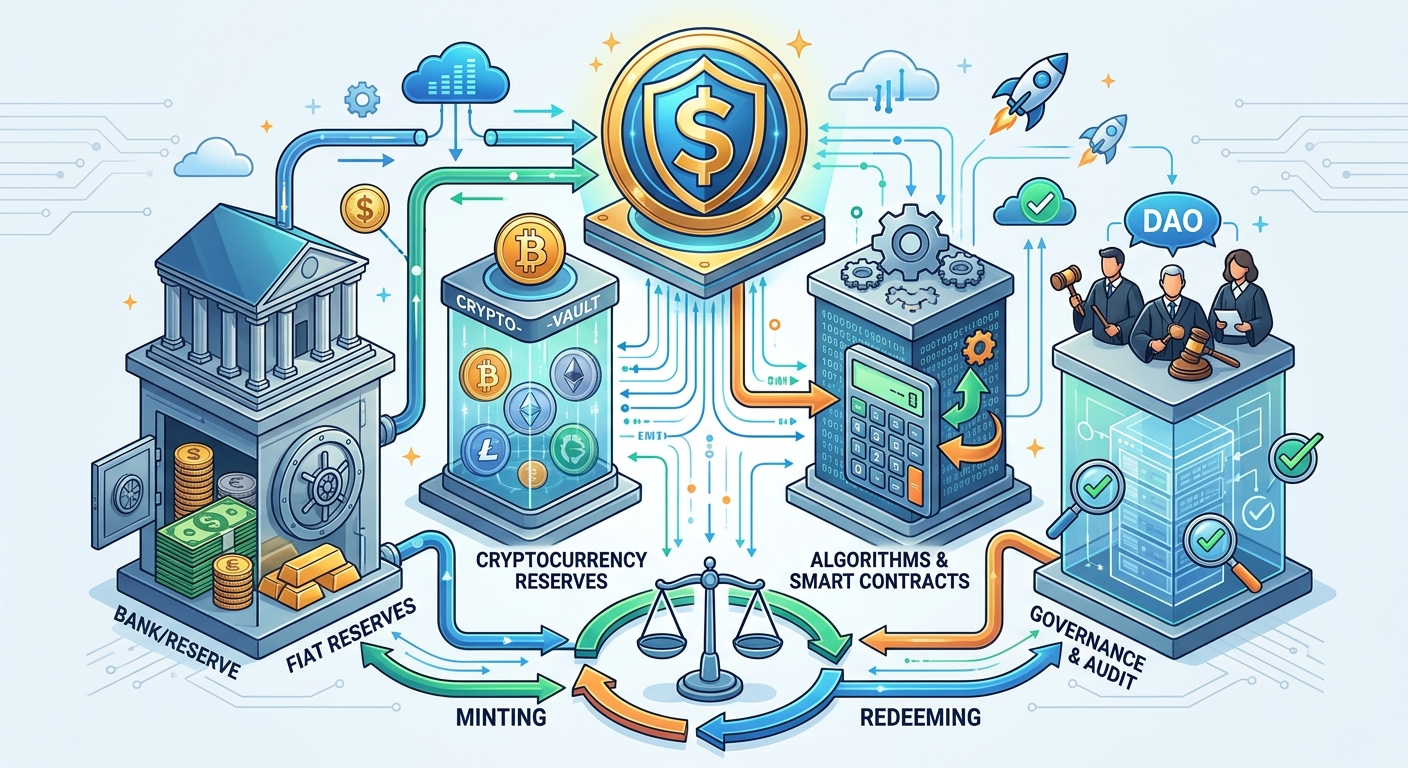
Anyone contemplating the issuance of a stablecoin in the European Union tends to arrive with a list of technical parameters: the collateral, the stabilisation mechanism, the chain, the price oracle. That list arrives too late. Regulation (EU) 2023/1114 does not regulate a spectrum of possible designs to choose among: it defines two closed categories, imposes a distinct regime on each, and leaves everything else outside both. The architecture is not designed and then fitted; the box is chosen and the box dictates the architecture.
Set out as a sequence of decisions, the order is as follows.
1. What it references
This is the decision on which everything else depends.
If the token references a single official currency and is issued on the receipt of funds, it is an e-money token (EMT). If it references any other value, right or combination of these — a basket of currencies, commodities, other crypto-assets — it is an asset-referenced token (ART). There is no intermediate third category.
The difference is not nominal. The EMT attracts the e-money regime: article 48(2) provides that e-money tokens are deemed to be electronic money, and Titles II and III of Directive 2009/110/EC apply to them unless the Regulation provides otherwise. The ART attracts a regime of its own, built around a reserve of assets. These are two regulatory worlds, and the choice of what the token references is what separates them.
2. Who may issue
This is where most projects fail, and it is worth knowing before spending on development.
For an EMT, article 48(1) is categorical: no person may offer an e-money token to the public or seek its admission to trading other than its issuer, and the issuer must be authorised as a credit institution or as an electronic money institution, and must have notified and published the white paper. There is no “stablecoin issuer” licence: one must be a bank or an electronic money institution. A third party may offer the token with the issuer’s written consent, but that creates no alternative route to issuance.
For an ART, article 16(1) requires the issuer to be a legal person or other undertaking established in the Union and authorised by the competent authority of its home Member State under article 21, or else a credit institution complying with article 17.
Article 16(2) contains the only two exits, and they are narrow: the average outstanding value of the token, calculated at the end of each calendar day over twelve months, must never exceed EUR 5,000,000, and the issuer must not be connected to a network of other exempt issuers; or the offer must be addressed solely to qualified investors and the token held only by them. Even on the exemption, the article 19 white paper must be drawn up and notified.
In other words: five million euros is the ceiling of the unauthorised project. Above it, one holds a licence or one does not issue.
3. The reserve
If the box is ART, article 36 is the centre of the design, and it admits no shortcuts.
The reserve must be legally segregated from the issuer’s estate and from the reserves of other tokens, so that — in the words of the provision — the issuer’s creditors have no recourse to it, in particular on insolvency. It must also be operationally segregated. Every issuance and every redemption must be matched by a corresponding increase or decrease in the reserve, and its aggregate value, at market prices, must be at least equal to the aggregate value of holders’ claims.
Valuation is mark-to-market where possible, on the more prudent side of bid and offer, and only with good-quality market data; where that is not possible, mark-to-model, conservatively, and the amortised cost method is expressly excluded. The reserve is subject to an independent audit every six months, the result of which is notified to the competent authority and published.
For an EMT the logic is different, because funds received are governed by the safeguarding requirement of article 7(1) of Directive 2009/110/EC, to which article 54 adds two requirements: at least 30% of the funds received must at all times be deposited in separate accounts in credit institutions, and the remainder may only be invested in highly liquid financial instruments with minimal market, credit and concentration risk, denominated in the same official currency that the token references.
4. What the design may not include
Three prohibitions that dispose at a stroke of most of the business models presented as innovative.
Interest cannot be paid. Article 40 prohibits it for ARTs and article 50 for EMTs, and the drafting of the latter is deliberately broad: any remuneration or benefit related to the length of time a holder keeps the token counts as interest, including net compensation or discounts with an equivalent effect, benefits provided by third parties, and benefits built into the price or remuneration of other products. A rewards programme for maintaining a balance is interest. A reduced fee on another service for holding the token is interest.
Redemption is a permanent and free-of-charge right. For the EMT, article 49 requires issuance at par value on the receipt of funds, and redemption at any time at the holder’s request, at par value, in funds other than electronic money, with no fee whatsoever. For the ART, article 39 establishes the right of redemption at all times against the issuer, at the market value of the referenced assets or by delivering those assets, likewise without fee, and adds that where the issuer accepted funds in an official currency when selling the token, it must always offer the option of redemption in that same currency.
And the token cannot rest on its own protocol alone. Both regulated boxes are built on a redemption claim backed by identifiable assets. A design that maintains parity solely through algorithmic incentives has no reserve to segregate and no par value to guarantee: it falls outside both regimes and, in consequence, cannot be presented to the public as stable or as redeemable. What was debated in 2022 as a question of financial engineering is today, in the Union, a question of regulatory fit that has been settled.
5. The growth ceiling, which is designed at the outset
Two mechanisms force success to be treated as a design risk.
Article 23 provides that where an ART used as a means of exchange exceeds, on an estimated quarterly average of daily activity within a single currency area, one million transactions and EUR 200,000,000 in aggregate value, the issuer must stop issuing and submit to the competent authority, within forty working days, a plan to bring activity back below both thresholds. The authority may require modifications, including the setting of a minimum denomination amount.
Article 43 provides for the EBA to classify a token as significant where at least three of seven criteria are met — among them more than ten million holders, an issued value or reserve above EUR 5 billion, or more than 2.5 million daily transactions and EUR 500 million in daily value — and the consequence is that supervision passes from the national supervisor to the EBA.
To which article 35 adds own funds of at least the highest of EUR 350,000, 2% of the average reserve, or one quarter of the preceding year’s fixed overheads; increasable by up to 20% on a risk assessment, and by between 20% and 40% on the basis of stress testing.
6. The part almost nobody designs: the dispute
So far, the regulatory design. What is missing is the question that occupies us at BACS, and which is rarely in any of the project’s documents: when the holder claims and the issuer does not pay, what path does that claim follow?
It is worth saying that the regulatory structure has already solved much of what proves insoluble with other crypto-assets. There is an identified issuer, with a known domicile, authorised and supervised; there is a segregated reserve over which holders hold a right that survives the issuer’s insolvency; and there is a redemption claim of determinate content. That is precisely what is absent when the asset in dispute lives in a decentralised structure: somebody to bind and an estate on which to project the award.
But three decisions remain, and they are taken at the structuring stage or never. The first is the channel: an arbitration clause in the terms of issuance, with a chosen seat and set of rules, determines who decides and how quickly; its absence leaves the holder to whichever jurisdiction turns out to apply, which with an issuer in one Member State and holders in thirty countries is not an answer but a prior problem.
The second is access to the reserve. The legal segregation of article 36 protects the reserve from the issuer’s creditors, but it does not of itself determine how a holder, or an arbitral tribunal, reaches those assets when the issuer does not cooperate. If the custodian of the reserve operates under instructions that admit an adjudicated decision — a condition that can be agreed when the custody is constituted — the award reaches the asset. If not, the award is an order directed at someone with no reason to comply with it.
The third is the valuation date in ARTs, where redemption is made at the market value of the referenced assets: the date of the request, of the breach, of the award and of actual payment are four different figures, and if the terms of issuance do not say, a third party will decide it.
Hence the conclusion, which is the one that underpins our work. A well-structured stablecoin is not the one that complies with the Regulation: it is the one that complies with the Regulation and provides, in its own architecture, the channel by which an adjudicated decision reaches the asset. The first is audited every six months. The second can only be decided beforehand, while the parties still cooperate.
Institutional interest note: BACS (Blockchain Arbitration & Commerce Society) is a non-profit association registered in the European Union Transparency Register under number 9106897105368-14, and has established an international tribunal of arbitration, BACSIT, which administers proceedings under its own rules. This analysis is general in nature and does not constitute legal advice on any particular project or jurisdiction.
Sources: Regulation (EU) 2023/1114 (MiCA), articles 3(1)(6), 3(1)(7), 16, 23, 35, 36, 39, 40, 43, 48, 49, 50 and 54; Directive 2009/110/EC, articles 1(4), 1(5), 7(1), 9(1) and 12.