

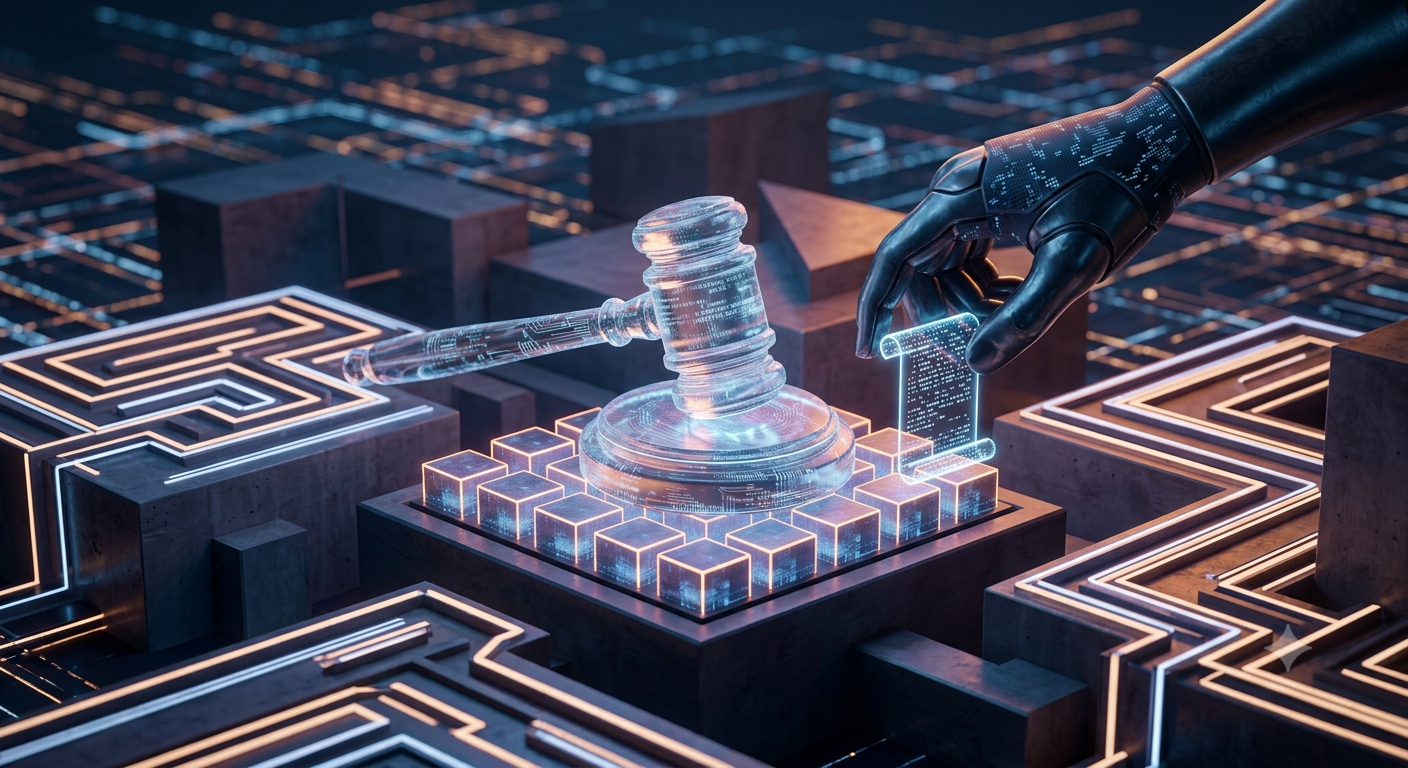
What is a legal oracle and why does it matter?
One of the greatest challenges of blockchain technology is its closed nature.
Smart contracts are deterministic and self-executing, but they can only operate using information that already exists on the blockchain itself. They cannot independently access external data such as market prices, event outcomes, or judicial decisions.
To solve this problem, blockchain ecosystems rely on oracles: systems that act as bridges between the off-chain world and blockchain networks.
Legal oracles represent a natural evolution of this concept.
Rather than introducing financial or technical data, they introduce legally relevant information: arbitral awards, court judgments, notarized documents, certified agreements, regulatory determinations, or any other legal event capable of triggering the execution of a smart contract.
The potential is enormous.
Imagine a rental agreement where non-payment automatically initiates an on-chain enforcement process.
Or an international commercial agreement where a breach of contract immediately triggers the release or freezing of escrowed funds.
Or a decentralized arbitration system where an arbitral award becomes a directly executable instruction within a blockchain environment.
However, this promise comes with significant security risks.
If not properly addressed, legal oracles may become the weakest link in the entire chain of trust.
The fundamental problem: trust in the data
Information security is built around a simple principle: every system has an attack surface.
In traditional smart contracts, the attack surface is generally limited to the contract’s code.
Once oracles are introduced, that attack surface expands dramatically beyond the blockchain itself.
Legal oracles create what could be described as a trust-in-the-data problem.
When a smart contract receives legal information from an external source, how can it verify that the information is authentic, accurate, complete, and unaltered?
This challenge has multiple dimensions.
First, there is authenticity.
Who guarantees that the arbitral award received by the smart contract is genuine and not forged?
Second, there is integrity.
How can we ensure that the information has not been modified during transmission?
Third, there is timeliness.
Does the data accurately reflect the current legal status of the dispute, or is there a delay that could be exploited?
Blockchain guarantees immutability once information is recorded.
It does not guarantee the truthfulness of information before it enters the system.
Attack vectors affecting legal oracles
The history of blockchain security contains numerous examples where the point of failure was not the smart contract itself, but the external system feeding data into it.
Oracle manipulation attacks have already caused losses worth hundreds of millions of dollars across the decentralized finance ecosystem.
With legal oracles, the consequences may be even more significant because they involve not only economic losses but legally binding outcomes.
Manipulation at the source
The first attack vector involves compromising the source itself.
If the institution generating the legal information—whether a court, arbitration center, digital notary, or regulatory authority—is compromised before the data reaches the oracle, everything built on top of that information becomes unreliable.
Blockchain can preserve false information just as effectively as true information.
Transmission attacks
The second attack vector concerns the communication channel between the legal source and the blockchain.
Between the creation of a legal decision and its registration on-chain, information travels through networks that may be vulnerable to interception or manipulation.
A sophisticated attacker could potentially alter information in transit if appropriate cryptographic protections are not implemented.
Oracle centralization
The third attack vector arises from centralization.
If a single node or organization is responsible for introducing legal data onto the blockchain, that entity becomes a single point of failure.
A centralized oracle may be compromised, coerced, corrupted, or simply make mistakes.
In all cases, the reliability of the entire system becomes dependent upon one actor.
Legal ambiguity
Perhaps the most subtle challenge is legal ambiguity itself.
Law is rarely binary.
Judicial decisions may be appealed.
Arbitration awards may be challenged.
Contracts may be interpreted differently by different parties.
Legal rights often evolve over time.
How can a legal oracle translate the complexity and nuance of legal reasoning into executable code?
Excessive simplification may result in incorrect or unjust outcomes.
Mitigation mechanisms: toward secure legal oracles
None of these risks are insurmountable.
Blockchain security engineering has already developed a number of mechanisms that can significantly reduce the attack surface associated with legal oracles.
Oracle decentralization
The first mechanism is decentralization.
Rather than relying on a single source, robust oracle systems aggregate information from multiple independent participants and apply consensus mechanisms to determine the correct outcome.
If the majority of trusted sources agree, the probability of successful manipulation decreases dramatically.
Projects such as Chainlink have demonstrated the effectiveness of this model for financial data.
The challenge lies in adapting similar approaches to legal data, where there is often only one official source of truth.
Cryptographic signatures at the source
The second mechanism involves cryptographic authentication.
If the legal authority generating the information—whether a court, arbitrator, or notary—digitally signs the data before transmission, any subsequent modification becomes immediately detectable.
This approach requires legal institutions to adopt public key infrastructure and digital signature systems.
While implementation may be challenging, the technology already exists.
Challenge periods and dispute windows
A third mechanism is the introduction of challenge periods.
Rather than executing immediately upon receiving legal information, the system may create a predefined window during which interested parties can challenge the validity of the data.
This approach resembles dispute resolution models used by projects such as Kleros and Aragon Court.
Human review remains available while preserving the benefits of automation.
Continuous auditing
The fourth mechanism is ongoing auditing.
Just as smart contracts require security audits before deployment, legal oracle systems require regular reviews of both their technical infrastructure and organizational procedures.
Security cannot be treated as a one-time event.
It must be continuously monitored and updated.
The legal dimension of technical security
Legal oracles reveal an interesting paradox.
They are technical systems designed to execute legal decisions, yet their security depends equally on technical and legal factors.
A cryptographically secure oracle may still produce unjust outcomes if the legal process generating the underlying information is flawed.
Conversely, a sound legal framework may be undermined by vulnerabilities within the technical infrastructure responsible for executing it.
This interdependence requires collaboration between lawyers and technologists.
Engineers cannot build secure legal oracles without understanding legal complexity.
Lawyers cannot design effective digital enforcement mechanisms without understanding technical limitations and risks.
The professionals capable of operating in both worlds become essential.
The future of legal infrastructure increasingly depends on individuals who understand both legal reasoning and technological architecture.
Conclusion
Legal oracles represent one of the most promising developments in the evolution toward digitally enforceable justice.
The ability to translate legal decisions into automatic and irreversible on-chain actions has the potential to transform contract enforcement, dispute resolution, and the protection of rights in digital environments.
Yet this promise can only be realized responsibly if security is treated as a foundational requirement.
The manipulation of a legal oracle is not an abstract technical issue.
It is a threat capable of producing real legal consequences for real people.
The path toward secure legal oracles depends on decentralization, cryptography, continuous auditing, and, above all, cooperation between the legal and technical communities.
That bridge cannot be built by technology alone.
Nor can it be built by law alone.
It must be built from both sides at the same time.
As digital assets, tokenized property, blockchain arbitration, and digital enforcement continue to evolve, legal oracles may become one of the most important pieces of infrastructure within the emerging Internet Jurisdiction.
The challenge is ensuring that they are not only functional.
But trustworthy.