

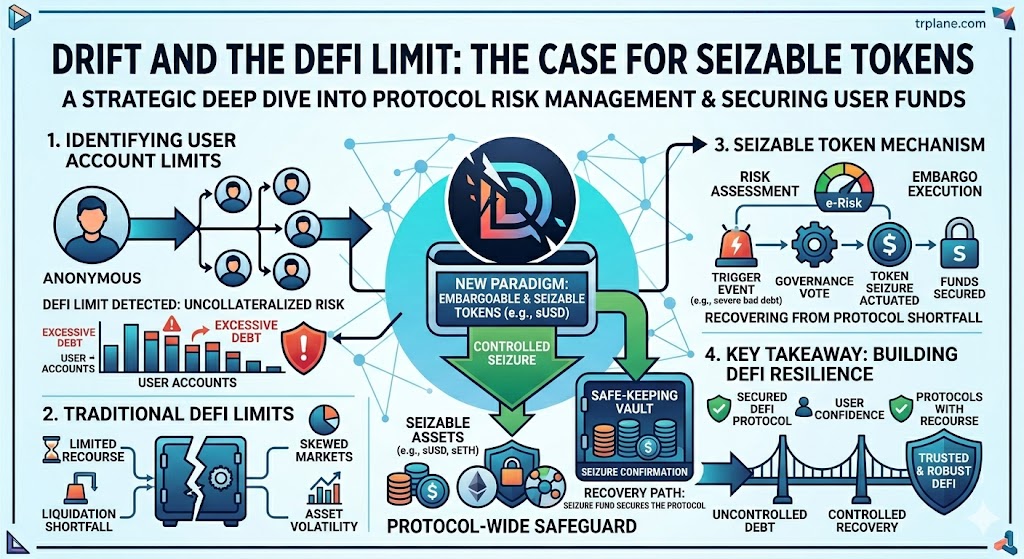
When the system works but the outcome is unjust
The recent incident involving Drift Protocol, built on Solana, where over $285 million was drained, was not a traditional hack. It was a demonstration of both the greatest strength and the deepest weakness of decentralized finance.
There were no technical failures. There were no vulnerabilities in the protocol.
All operations were valid and authorized within the system.
And yet, the outcome was abusive.
This case marks a turning point, exposing a structural problem: the inability to enforce legal decisions on digital assets once they have been transferred.
The gap between TradFi and DeFi
Enforcement exists in traditional finance
In traditional finance, a similar situation would trigger clear protection mechanisms. Courts or arbitral bodies can order asset seizure, account freezing, or restitution.
Intermediaries ensure that these decisions are effectively executed.
In DeFi, enforcement disappears
In DeFi, that layer does not exist.
Assets are controlled by cryptographic keys. Once transferred, they can move across chains, be swapped, or fragmented across multiple addresses.
Traceability exists, but intervention does not.
The result is clear. Technical execution is absolute, while legal enforcement is absent.
The structural problem: a system without correction
The Drift case shows that the current system cannot correct abusive outcomes.
A system that cannot correct cannot scale.
Automation without legal safeguards creates efficiency, but also irreversibility. And irreversibility is the real systemic risk.
The solution: seizable tokens
What is a seizable token
A seizable token is a digital asset designed to enable legal enforcement.
It includes linkage to a legal framework, integration with dispute resolution mechanisms, and the technical ability to freeze or forcibly transfer assets.
This is not about arbitrary control. It is about legitimate enforcement.
From code is law to law is enforceable in code
The current model relies on code executing rules.
The next step is enabling law to be executed within code.
This does not replace decentralization. It completes it.
The role of arbitration and BACS
International arbitration is the most efficient mechanism for this transition. It is fast, flexible, and globally recognized.
In this context, BACS emerges.
BACS enables not only dispute resolution, but direct on-chain enforcement.
This changes the paradigm. It is not just about deciding, but about enforcing.
Application to the Drift case
If the assets had been designed as seizable tokens, arbitration could have been triggered, fund movements restricted, and restitution executed.
The attack would not have been irreversible.
Conclusion
The Drift case is not an anomaly. It is a signal.
The next phase of DeFi will not be only technological, but also legal.
Without enforcement mechanisms, the system will remain efficient, but incomplete.
Digital asset seizure is foundational for a truly robust decentralized financial system.