

The rapid expansion of digital assets has created an entirely new category of legal disputes. These are no longer limited to traditional contractual conflicts, but extend to cryptocurrencies, tokens, smart contracts, DeFi protocols, digital wallets, and blockchain-based infrastructures.
These disputes share a common feature: they involve assets that exist exclusively within decentralized digital networks.
This raises a fundamental legal question:
How can a legal decision be enforced when the asset exists on a blockchain?
This is one of the defining challenges of the digital economy. Resolving a dispute is important—but in the context of digital assets, the real issue is enforcement. Without effective execution, legal decisions risk becoming purely theoretical.
In this context, international arbitration is emerging as one of the most effective mechanisms for resolving blockchain disputes. However, its real evolution lies in a new paradigm: the direct enforcement of arbitral awards on blockchain.
The Core Problem: Deciding Is Not the Same as Enforcing
In traditional legal systems, once an arbitral award is issued, the winning party may seek enforcement before national courts, typically under the framework of the New York Convention of 1958.
Courts can then order asset seizures, enforcement measures, or transfers of property.
This system works efficiently when assets are located within centralized infrastructures—such as bank accounts, securities, or real estate.
However, when the disputed asset is a cryptocurrency or token held on a blockchain, significant limitations arise.
Courts may recognize and validate the award, but they do not control the technical infrastructure where the asset exists. If the losing party controls the private keys of a wallet, they may simply refuse to transfer the assets, move them to another address, or conceal them within decentralized systems.
This creates a structural gap:
The law can decide, but it cannot always enforce.
Why Arbitration Has an Advantage in Blockchain Environments
Arbitration offers a key advantage over traditional litigation: it can be integrated into the contractual and technical design of the system from the outset.
In blockchain-based projects, parties can agree in advance that disputes will be resolved through arbitration. This agreement can be embedded in legal documentation, platform terms, token issuance structures, DAO governance frameworks, or even directly within smart contracts.
This allows something crucial:
Enforcement can be designed from the beginning
Arbitration is no longer just a post-dispute mechanism. It becomes part of the operational architecture of the digital asset.
Rather than resolving disputes after they arise, the system itself can be structured so that arbitral decisions produce real effects within the blockchain environment.
Three Models of Arbitral Enforcement in Blockchain
In practice, three main models of enforcement are emerging, each with a different level of effectiveness and automation.
1. Voluntary Enforcement
This is the simplest model. Once the arbitral award is issued, the losing party voluntarily complies by transferring the digital assets or performing the required action.
While common in commercial relationships, it has an obvious limitation: it depends entirely on the debtor’s willingness to comply.
Automation level: 10%
2. Traditional Judicial Enforcement on Digital Assets
In this model, the arbitral award is enforced through national courts. Courts may order measures against centralized intermediaries such as exchanges, custodians, or regulated crypto service providers.
This approach is legally robust and already in use. However, it has a clear limitation: it is far less effective when assets are held in self-custodied wallets or within DeFi protocols.
Automation level: 40%
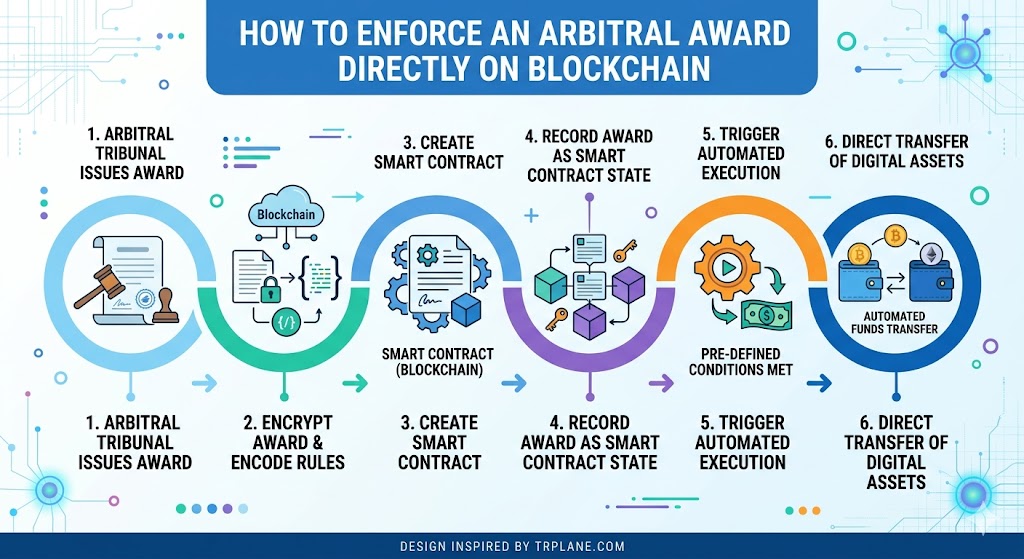
3. Programmable Enforcement via Smart Contracts
This is the most advanced and transformative model.
It involves designing tokens, smart contracts, or custody structures that incorporate enforcement mechanisms from the outset. These mechanisms may include freezing assets, releasing escrow funds, transferring tokens, or restricting movements under predefined legal conditions.
Once an arbitral award is issued, a trusted system communicates the decision to the smart contract, which executes the programmed action automatically.
In this model, enforcement is no longer dependent on state intervention or voluntary compliance. It becomes a native function of the digital asset itself.
Automation level: 95%
The Key Role of Legal Oracles
For arbitral enforcement to function on blockchain, a bridge is required between the legal world and the code environment.
This bridge is known as a legal oracle.
A legal oracle is an authorized entity or system that transmits legally verified information—such as the existence and content of an arbitral award—to a smart contract. Once the information is received, the smart contract executes the predefined logic.
Blockchain systems cannot interpret complex legal documents or assess evidence. They execute instructions. The legal oracle provides the verified input that allows execution to occur.
BACS: Arbitration Designed for Blockchain Enforcement
In this emerging landscape, BACS (Blockchain Arbitration & Commerce Society) represents a new type of legal infrastructure.
Founded in 2019 and based in Madrid, BACS is a specialized arbitration institution focused on disputes involving digital assets, blockchain systems, and tokenized structures.
Through its arbitral tribunal, BACSIT, BACS is developing a model in which arbitration is not external to blockchain systems, but integrated within them.
This includes:
- Designing arbitration clauses adapted to blockchain environments
- Structuring escrow and custody mechanisms compatible with arbitral decisions
- Enabling the communication of arbitral awards to smart contracts via legal oracles
- Supporting tokenization projects with embedded dispute resolution frameworks
BACS operates at the intersection of law and technology, transforming arbitral awards into actionable instructions capable of producing real effects on digital assets.
This is the shift from arbitration applied to blockchain to arbitration embedded in blockchain.
Toward a New Digital Legal Infrastructure
Tokenization is rapidly expanding across finance, payments, and digital asset markets. However, the legal infrastructure for dispute resolution remains underdeveloped.
A functional digital economy requires a three-layer structure:
Layer 1: Blockchain
Technical infrastructure where assets exist and move
Layer 2: Smart Contracts
Execution mechanisms governing transactions
Layer 3: Arbitration
Decision-making and dispute resolution system
Without this third layer, the system remains incomplete. Code can execute predefined rules, but it cannot resolve complex disputes, fraud, or interpretive conflicts.
Law remains essential—but it must evolve to integrate with blockchain.
The Future: Legally Enforceable Digital Assets
One of the most promising developments is the creation of digital assets that incorporate legal enforceability from their inception.
These assets may include built-in mechanisms for freezing, conditional transfers, dispute-triggered execution, or arbitration-based outcomes.
Such structures will be particularly relevant in tokenized finance, digital securities, cross-border transactions, escrow systems, and complex investment platforms.
In this context, institutions like BACS are positioned to define the legal standards that will govern these systems.
Conclusion
The greatest challenge of blockchain is not technological. It is legal.
Blockchain enables the transfer of value and the execution of transactions. But when disputes arise, a system is still required to determine rights and enforce outcomes within the digital environment.
This is where specialized arbitration becomes critical.
BACS represents a new approach: a legal layer designed for the blockchain economy, where arbitral awards are not merely declarative, but operational.
In the future, trust will not rely solely on code.
It will depend on the integration of code, arbitration, and enforceability.
That is where a new digital legal infrastructure begins.
More information also at traplane.com