

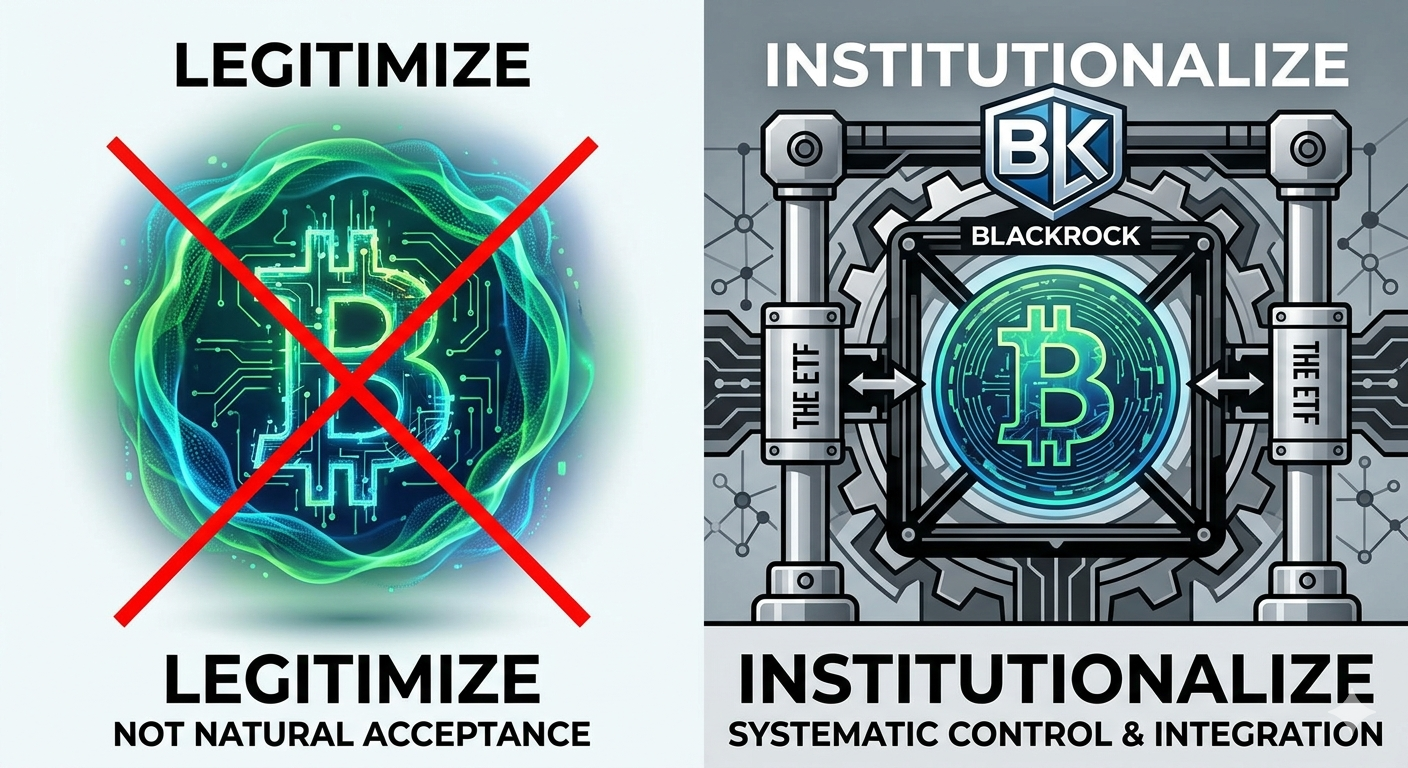
For years, the debate around Bitcoin has been marked by a recurring question: does it need legitimization by the traditional financial system? The recent approval and expansion of Bitcoin ETFs—especially those driven by actors such as BlackRock—seem to have given an implicit answer that, however, should be qualified from a legal and structural perspective.
The dominant narrative suggests that the entry of large institutions “validates” Bitcoin. But this interpretation is, at best, incomplete. And at worst, conceptually wrong.
Bitcoin did not need to be legitimized.
Bitcoin was already legitimate.
The legitimacy of Bitcoin is not institutional
Unlike traditional assets, whose validity depends on regulatory frameworks, central authorities, or state legal systems, Bitcoin operates under a completely different logic. Its legitimacy does not derive from an external authority, but from a set of rules codified and accepted by consensus.
This implies a profound change in the way we understand law and economic validity.
Bitcoin is not simply an asset.
It is a normative system.
A system where rules are not interpreted: they are executed. Where trust is not delegated: it is verified. And where validity does not depend on state recognition, but on participation in the network.
For that reason, claiming that an ETF legitimizes Bitcoin means inverting the logical order of factors.
It is not the financial system that validates Bitcoin.
It is Bitcoin that has created a system robust enough for the financial system to have to adapt to it.
From rejection to integration: the institutional strategy
The evolution of actors such as BlackRock cannot be understood as a simple opportunistic adoption. For years, Bitcoin was perceived as a marginal experiment, alien to traditional financial structures. However, its persistence, growth, and capacity for global coordination have forced a paradigm shift.
The approval of Bitcoin ETFs in the United States in 2024 marked a turning point. Not because it introduced something new into Bitcoin, but because it opened a door for institutional capital to access it without altering its foundations.
The ETF does not transform Bitcoin.
It transforms the way the financial system accesses Bitcoin.
This is key: the ETF acts as an interface, not as a validation. It allows traditional investors to gain exposure to the asset without directly interacting with decentralized infrastructure.
In other words, it translates Bitcoin into the language of traditional finance.
But it does not redefine it.
Institutionalization is not legitimization
This is where the fundamental distinction arises: to institutionalize is not to legitimize.
Institutionalization implies the integration of a phenomenon into existing structures. It means adapting it, packaging it, and distributing it according to standards recognizable to the financial system.
That is exactly what an ETF does.
It turns Bitcoin into a financial product.
But turning something into a product does not imply granting it validity.
Bitcoin already had value, already had rules, already had a market.
What changes with the ETF is the access channel, not the nature of the asset.
From this perspective, the entry of BlackRock is not an act of validation, but a strategic recognition: the financial system cannot ignore a system that operates outside of it and that, moreover, is capturing value in a sustained way.
Bitcoin Digital Law: a framework to understand the shift
This phenomenon can only be fully understood through a different conceptual category: Bitcoin Digital Law.
As developed in Bitcoin Digital Law, Bitcoin is not merely a technological or financial innovation. It is the manifestation of a new type of normative order: a system of codified rules that operate within the so-called jurisdiction of the Internet.
In this context, each protocol is not just a tool.
It is a form of law.
Bitcoin establishes rules on monetary issuance, transaction validation, and digital property. And it does so without resorting to state institutions. Its enforcement does not depend on courts, but on the network.
This redefines classical concepts such as sovereignty, jurisdiction, and normative validity.
And, above all, it raises a radical inversion:
it is not States that grant validity to these systems,
it is these systems that force States and institutions to position themselves in relation to them.
The ETF as a point of convergence
The creation of Bitcoin ETFs represents, in this sense, a point of convergence between two worlds: the traditional financial system and the jurisdiction of the Internet.
But this convergence is not symmetrical.
The financial system does not absorb Bitcoin.
It adapts to it.
The ETF is a tool of integration, but also a signal of something deeper: the inability of the traditional system to ignore structures that operate outside its control and that, nevertheless, generate legitimacy, liquidity, and trust.
From this perspective, the institutionalization of Bitcoin does not imply its domestication, but its expansion.
Bitcoin does not enter the financial system.
The financial system enters Bitcoin.
Conclusion: a structural transition
Reducing the role of BlackRock to that of a legitimizing agent of Bitcoin is to misunderstand the magnitude of the change we are experiencing.
What is at stake is not the validation of an asset, but the transformation of the frameworks through which we understand money, law, and trust.
Bitcoin did not need permission.
It did not need validation.
What it needed—and what it has achieved—is to create a system solid enough for even the most traditional institutions to have to integrate it.
The ETF does not legitimize Bitcoin.
It confirms that Bitcoin Digital Law is already underway.